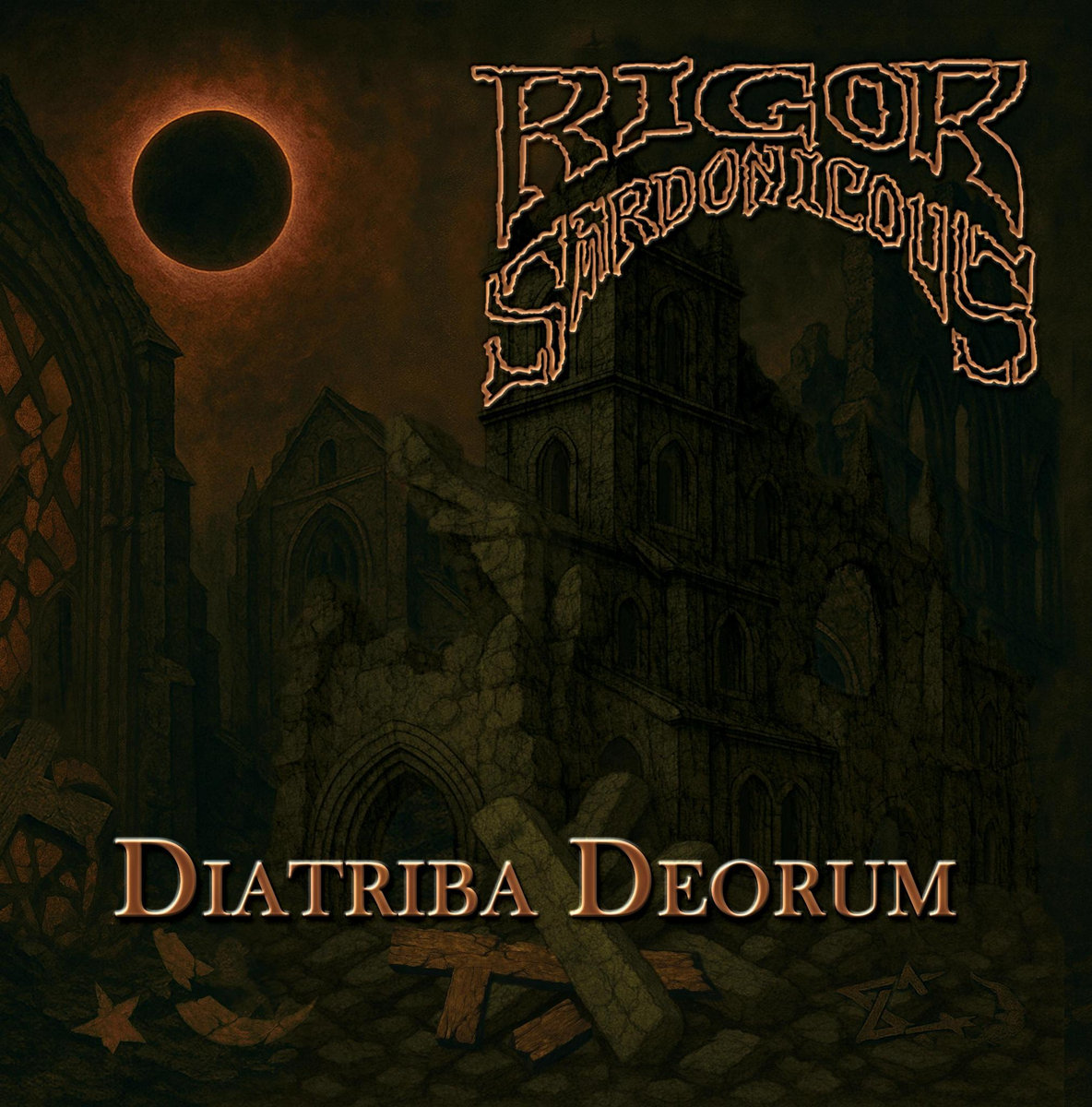
With Diatriba Deorum, Rigor Sardonicous release their eighth album. The seven tracks clock in at 44:36; stylistically, the band, founded in 1988, remains committed to its extremely stripped-down Funeral Doom, which is rooted more in plodding Death Metal than in melodic Doom and stands in the tradition of Winter, Disembowelment and, later, Khanate.
Rigor Sardonicous in a Brief History of Doom Metal
The band comes from the primordial depths of the genre, from a time when the terms Death Doom and Funeral Doom did not yet exist. Their first demo dates from 1994, the Stream from the Heavens Big Bang year of Funeral Doom. Their first album followed in 1999, one year after Evoken’s debut Embrace the Emptiness, in that memorable year which also saw the release of Last Tape Before Doomsday, Hierophant’s self-titled EP and Nortt’s Graven demo. A time when Sludge was just beginning to recede and Post-Metal had yet to embark on its Isis-fueled ascent. A period when people were still searching for terminology to distinguish the music of Saint Vitus from that of My Dying Bride just as much as that of EyeHateGod from Candlemass. One term that was circulating at the time was Doomcore: a designation for anything that fused Doom Metal with elements of Industrial (e.g. Skin Chamber), Hardcore Punk (e.g. Buzzov*en) or Death Metal (e.g. Paradise Lost), while bands following in the footsteps of Black Sabbath, Saint Vitus, Trouble and Pentagram were initially distinguished simply as Doom Metal and later as Traditional Doom.
The Musical Essence of the Band
And it is from this primordial soup of Doomcore that Rigor Sardonicous emerged, remaining true to themselves for decades. The duo plays its own utterly distinctive music: a Goregrind version of Funeral Doom, with downtuned guitars, drum machines and pitch-shifted vocals. In place of radical speed comes radical slowness, with Winter, Thergothon and Disembowelment as its godfathers. You should therefore not expect technically sophisticated or majestically sounding Doom Metal from the duo. They have never been interested in devising complicated musical constructions, but rather in distilling the musical essence of a kind of disgust with existence.
The production is raw, murky, static and massive. The guitars predominantly play very simple, elongated riffs. The drums are more of a mechanical framework than a dynamic component. The vocals sit low in the mix and sound less like traditional Death Metal vocals than another noise within the overall mass of sound. The band takes the central parameters of Funeral Doom (slowness, heaviness, repetition, morbid atmosphere) and pushes them consistently to their limits. An important trademark, and at the same time the greatest point of criticism in many reviews, has always been that the band chooses immersion over transformation as its method.
Rather than introducing a riff slowly and then taking the listener somewhere through new harmonies, layers, melodies or dynamics, Rigor Sardonicous leave it essentially unchanged. The band does not alter the music; instead, the monotony alters the listener’s perception of the same riff.
Especially in this dirty and raw incarnation, this is a method that provokes, tests and challenges the listener. While the same approach in Ambient Funeral Doom can oscillate between hypnotic, dreamy and boring, Rigor Sardonicous leave no room for luxuriating in atmospheric elegance. As a result, a feeling of sensory overload or saturation can arise more quickly – perhaps that is even the point. This is the toolbox the project has retained for decades, and Diatriba Deorum is no exception.
A Discourse on Monotony
Here I would like to offer a brief meta-draft of a review, because what happens in the reviews of Diatriba Deorum is paradigmatic of many Funeral Doom releases. We see a split among the reviewers without any actual disagreement in their descriptions of the music.
On one side is Steel Druhm’s review for Angry Metal Guy. His basic conclusion is that individual songs work, but the album as a whole does not. In fact, all of the tracks on Diatriba Deorum operate according to the principle described above, resulting in a compression of differences across the album. The more similarly the tracks function, the less distinct their individual developments become. What feels hypnotic at six minutes can feel redundant at nine. Druhm consequently considers With God’s Love and Death Cult to work quite well, while finding I Am particularly overlong because of its lack of variation; he highlights Commandment and Actus Tragicus as exceptions.
The German webzine Bleeding4Metal takes the opposite position. Metal Guru, and I hope he will not take this the wrong way, does not seem to have quite as much Sludge, Drone or Funeral in his everyday repertoire as one might infer from his emphasis on having rarely heard anything quite this heavy and reduced. But precisely because of that or nevertheless he praises the reduction as a uncompromising aesthetic consequence and reaches for the familiar toolbox of atmospheric vocabulary: concrete, lead, lava, cement, because these are the images that describe the music’s viscous and glacial movement. His formulation is particularly interesting: “Mr. Tony ‘The Riff-Meister’ Iommi” would have enjoyed both the brutal sound and the deliberately blunt, explicitly not mindless, riffs. A connection to Black Sabbath is probably the highest unvarnished praise in Doom.
Sercifer from the Spanish-language Metallerium goes one step further: Diatriba Deorum is explicitly judged as Funeral Doom, whose reduced aesthetic is rooted precisely in the absence of organs or synthesizers and therefore in its lack of dynamics and density. Metallerium rates the album 8.5/10 and describes it as consistently dark, dense Funeral Doom. A synthesis of these different approaches can be found in Metal Eclipse’s Metalcatto. He attributes enormous density and a consistently morbid effect to the album and explicitly recognizes the monotony as part of the concept, yet still finds himself exhausted by its repetitive, slow intensity.
The question, then, is how one approaches the music. Steel Druhm essentially asks what the album does with its 44-minute running time that could not also have been told in 20 minutes. Sercifer, on the other hand, asks about the nature of Funeral Doom and whether the album corresponds to it. Both questions are legitimate and nevertheless lead to completely different conclusions.
If I want to know whether the album is good, then I have to know what I expect from Rigor Sardonicous and from Diatriba Deorum. Diatriba Deorum is an album that seeks to explore a very small musical space of ideas as completely as possible. That perhaps explains the extremely divergent reactions.
Anyone who understands Funeral Doom as a compositional genre in which slowness and repetition must function as means of creating tension, resolution and atmosphere will not find much to enjoy here, because the album refuses development. But if Funeral Doom is understood as state-based music, whose function is to place the listener in a heavy, static, morbid state, then the supposed weakness becomes its central quality.
On Diatriba Deorum, Rigor Sardonicous very consciously take the latter path. The record is therefore not simply mediocre from either perspective. It is radically reduced Funeral Death Doom, making a clear aesthetic choice and thereby operating on the boundary where consistency threatens to turn into monotony. And I simply argue that this has been intentional all along, and that form carries content.
Form Carries Content
This is where we can go further than the existing reviews. Because if we read Diatriba Deorum as a systematic dismantling of the monotheistic image of God, the circle between form and content closes. The lyrics do not formulate a simple anti-religious position; rather, they expose the internal logic of faith, guilt and submission. With God’s Love already contrasts the supposed blessing of life with inevitable decay (“All that you love will soon decay”), while Death Cult extends this criticism to the three Abrahamic religions: YHWH, Christ and Allah appear together as representatives of a system that legitimizes suffering through guilt and promises of redemption. Invocation Prayer is crucial as an ironic internal perspective: the actual prayer (“Praise be to Thee O’ Lord”) immediately tips over into images of “rot” and “misery”.
This is compatible with Nietzsche’s On the Genealogy of Morality, particularly his analysis of guilt and the ascetic ideal, as well as with Foucault’s concept of pastoral power. Religion appears here as a system that interprets human suffering and codes it morally, thereby stabilizing it. Power operates not merely through the command itself, but through the subject adopting the categories of guilt, truth and redemption and applying them to themselves. This perspective is radicalized in I Am, perhaps the central track on the album. The lyrical subject takes on the entire range of religious and existential categories: “wrath”, “fate”, “pain”, “faith”, “emptiness”, “misery”, while simultaneously declaring itself the “creator”, “false prophet” and “virgin whore of god”. God and his opposite collapse into one another. Evil speaks through the voice of God. The lyrical subject takes precisely those categories through which religious order distinguishes purity from sin, redemption from damnation, and turns them into components of a monstrous identity.
In Beholden Unto Me and Commandment, this becomes an explicit relationship of power: “Kneel weakened and weep” and “Do as I say for I am the One” reduce religion to obedience, while guilt, shame and redemption appear as instruments of discipline. The religious command does not have to be constantly enforced physically, the believer adopts its categories himself. Religion is therefore attacked not merely as a false explanation of the world, but as a system that forces the individual into a particular conception of themselves.
Conclusion
And yes, Diatriba Deorum refuses development, resolution and liberation for much of its running time; the songs remain trapped in heavy, repetitive structures. This can be perceived as a compositional weakness, but in the context of the lyrics it can also be understood as a formal counterpart to the concept:
The music enacts the hopelessness described by the lyrics.
No path leads to redemption. Everything culminates in the final lines of Actus Tragicus:
“We are the dead.”
Reduction is therefore not merely a Funeral Doom convention, but an aesthetic staging of a closed system. The human being searches for meaning, adopts the prescribed categories of guilt and redemption, and nevertheless ends in death. And if we understand the music as part of the concept, then Rigor Sardonicous offer no development, no progression and no escape. The duo seeks exhausting monotony not merely because they want to play crushingly Heavy Metal, but because they seek to press the idea of life as suffering into musical form.
The human being is held within a system of repetition, commandment, guilt and punishment; the music holds the listener within a system of repetition, heaviness and absent resolution. Rigor Sardonicous therefore do not merely tell us about a world without redemption; for 44 minutes, they let the listener musically experience a world in which redemption is structurally impossible.