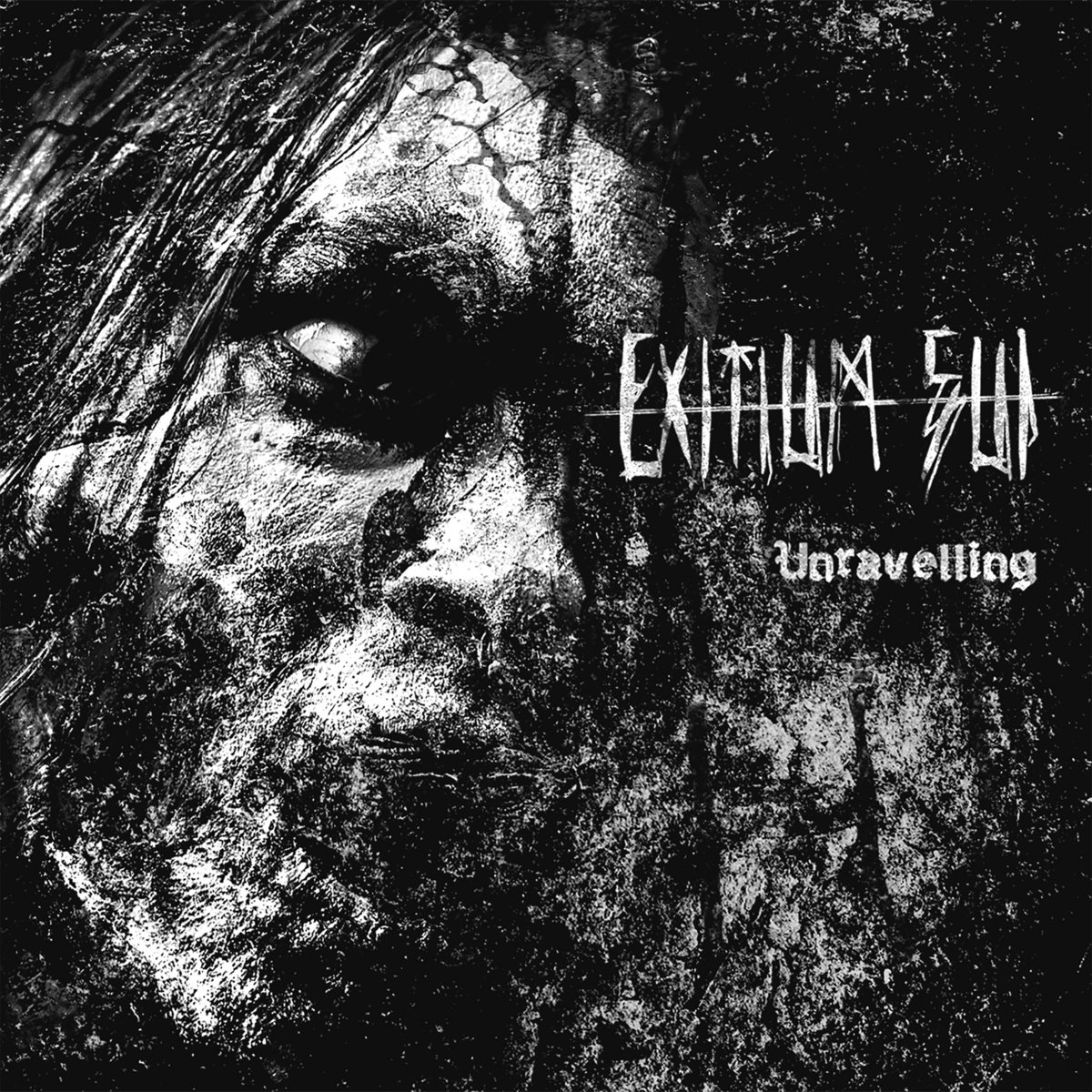
Unravelling by Exitium Sui offers Funeral Doom with pronounced Black and Death Metal elements. The foundation is slow, heavy, marked by pronounced dissonance, yet again and again interrupted by aggressive outbursts, melodic passages and moments of ethereal beauty. Weight, darkness and brutality stand in contrast to melodic and atmospheric moments. These contrasts form a musical, atmospheric-emotional and lyrical movement that travels from individual suffering, through the dissolution of the human subject, to the questioning of all creation and of being itself. Unravelling describes an anticosmic and antinatalist downward spiral of generalized creation arising from a radical nihilism.
A Millwheel
A millwheel that begins with the isolated individual, wanders through cosmology, religion and mythology, and finally, in a bright moment of togetherness, greets the nothing.
Only Death Remembers begins forceful and sluggish, with a rushing base sound through which the lead guitar eats its way, while the lyrics deal with memory, regret and self-alienation. In lines such as “Old regret, old / My refrain, my lie” the lyrical I describes itself as a subject that has lost any positive substance of self. The slowness of the riffing turns time itself into a burden. Repetition becomes the experience of being stuck. The piece remains within its own weight, and that weight is not merely the weight of grief. It is the weight of existing. The wall tears open and the piano enters, reverberating in the background. Like a memory of music, of beauty, of the happiness found in non-being. The subject’s existence consists of regret, repetitions and lies, the guttural vocals become a wall of sound within the ongoing seething of the music, and an operatic singing works its way through the background, similar to the lead guitar. If, following Camus, we must imagine Sisyphus as a happy man, not because he possesses a task and a purpose but because he accepts the absurdity of his activity, then E.S. writes from the perspective of the postmodern human, without the support of a task or a purpose in existence, and without the Camusian acceptance. The central statement “It’s all that I know” points to a solidification of the state that the music makes tangible. Loneliness is the foundation of this existence: “Only lonely bedrock.” The double bass hammers out the toil of life, and the loneliness of the subject, of every subject, holds nothing positive. It is “empty sorrow,” without “fire inside.” The reverberating beauty of the piano fades out. The piece ends. The subject has become a person whose identity consists of its relation to the memories of its own suffering, of the gaps, the lies. Existence remains suspended in meaninglessness.
Existence is Destructive
In the second piece, Draped in Black Flame, this perspective widens. The isolated “I” disappears and is replaced by a “We.” And this “We” is no social community, no couple, no group. The Black Flame refers to the anticosmic, chaos-gnostic conceptual space in which the black flame or black spark can be understood as a fragment of a chaotic, endless reality out of which creation has emerged. Under this perspective, the “We” does not designate a group within the world. It designates creation itself, collective being.
“We are the brethren
We are the blade
[…]
We are the cold sickness, murderers”
These are not merely descriptions of a destructive social mass. The world, existence itself, is destructive. And creation is not afflicted by a sickness. It is the sickness. The “We” is the totality of being, experiencing itself as violence, sickness and destruction. With “We are the dead suns” this identity finally becomes cosmic. The human loses its independence and dissolves into a more encompassing, dying creation.
The Music: Funeral Doom, shaped by Black and Death Metal
Musically, E.S. varies the pattern only marginally, and the dynamic shift is integrated rather than working as a contrast. The lead guitar sounds bright into the space of the steadily advancing drums. Breaks into quiet passages remain absent. Between these musical patterns, E.S. works out its Funeral Doom, shaped by Black and Death Metal. The vocals vary, without becoming the load-bearing element, between screaming, croaking, growling, speaking and clean singing. Unlike many representatives of Apocalyptic Funeral Doom, the voice is mostly mixed into the tonal space. The voice at times works against drowning in the noise (Drowning Viracocha), asserting itself fully as an instrument within the sound. The underlying music is droning and furrowed, contrast coming again and again from the bright lead guitar, which is rarely pushed to the foreground, and from incorporated instruments (organ, piano, strings). E.S. generates, musically, the sluggish, pressing state of being.
The album’s aggressive Black Metal component receives its function within the anticosmic dimension. The music thereby breaks out of the static heaviness of Funeral Doom, without ever truly leaving that heaviness behind. Blastbeats, harsh vocals and cutting dissonances generate movement and violence. This movement is that of a world destroying itself. The pairing of Funeral Doom and Black Metal thus forms the two sides of a single process: the weight of existence and its violent dissolution.
Creation produces Suffering
Drowning Viracocha traces the movement back to creation itself. Viracocha, the creator figure of Inca mythology, appears here as a drowning man: “My drowning Viracocha.” The creator himself is pulled into ruin. The images of the “Smothering Madonna” and the “Maternal shroud” function similarly. Motherhood and creation, ordinarily bound to birth, protection and continuation, are turned into images of suffocation and burial.
The album’s antinatalist dimension traces the archetypes of life as participants in the problem of existence itself. Creation produces suffering, consciousness, alienation and, finally, death. If “all death is eternal,” then death no longer appears merely as the tragic end of an otherwise valuable process. It becomes the final, and perhaps the only stable, constant within a reality whose remaining categories are disintegrating. With “Crippled by the God-Hand” this critique of creation becomes explicitly religious. The hand of God, which traditionally promises protection, guidance or salvation, cripples the human. Heaven is no longer the desirable goal; hell can even appear more attractive than an existence experienced as unbearable. The position becomes even clearer with the line “The sum of man to suffer.”
The human being is not understood as the crown of creation, but as a creature whose existence is essentially determined by suffering. And the piece’s ending drives this movement to complete erasure:
“Choked and buried, ground into naught
Never to be found.”
This is no longer only about the death of an individual. The individual is meant to vanish from the order of being. And “Naught” here is more than a synonym for death. It designates the longed-for abolition of existence.
Here lies a decisive difference from an ordinary depressive or suicidal reading. Unravelling does not say that life is unbearable and that the individual therefore wishes to die. The lyrics generalize the problem. The suffering of the individual becomes a symptom of the suffering of existence itself. This also explains the abundance of cultural, religious and mythological fragments. R’lyeh, Satan, Viracocha, Madonna, Isis, Anu, Keres, Atropos and Leviathan do not belong to one consistent mythological system. They represent different cultural forms through which humans have tried to name creation, order, transcendence, death and the incomprehensible. One might understand this mythology as a kind of cultural salad bar from which Exitium Sui draws images and terms for a particular atmosphere. What matters, though, is that the various religious and mythological systems are placed side by side precisely because none of these frames of meaning is privileged. Christian, ancient Near Eastern, Mesoamerican, Greek and Lovecraftian conceptions become different surfaces of the same metaphysical question.
With this, Unravelling touches a radical nihilism. There is no reliable framework of meaning in which “good,” “evil,” “true,” “God,” “human” or “creation” function unambiguously. Lyotard’s diagnosis of the end of the grand narratives shines through here, connecting to what was already noted, that E.S. depicts the agony of the postmodern individual. “Subverted lore,” “unbegotten wisdom,” “unbegotten truth” and “subverted law” from “Septikinesis” are formulations that do not merely negate individual answers, but strip of authority the very systems meant to determine what an answer would be in the first place. This is, ultimately, the crux of postmodernity. The categories are no longer ordered but fused together. Truth, myth, religion and violence appear as components of one contaminated system of meaning.
Because of this, Sickness Flooding Nihil becomes significant as a short instrumental piece. After the first four tracks, in which the individual, humanity and creation increasingly appear as problems, language itself is interrupted. The sound of rushing water and an acoustic guitar step in where there is nothing left to name. “Nihil” becomes a state. At this point the music stands, in a sense, for what remains after the disintegration of all meanings.
What remains is a contemplative, sorrowful music of directionless calm without stagnation.
After the mythological and cosmic imagery, the final text is stated in strikingly simple terms:
“Hold my hand and squeeze it firmly.”
It is precisely this simplicity that makes Until the End Hath Found Us the fitting conclusion. The music finds synthesis by taking up the melody hinted at in Sickness Flooding Nihil. The Black Metal tremolo underlays the bright lead, and the screaming vocals sound…
Hopeful.
After the collapse of religion, mythology, truth and individual identity, only the Other remains. Yet what is depicted here is no return to hope in the classical sense. The two people stand “before the final sunset” and wait for the end to find them. The double bass enters, the music becomes urgent, hammering and driving. More than before, the music recalls the Hong Kong project Hyponic and then breaks again into an elegant, bright vocal that sets itself against existence within the storm of the music.
Death is not prevented. There is no salvation through transcendence, and no meaning that is suddenly restored. But the isolated “I” has disappeared. There is a “We.” From this an existentialist reading of the album can also be developed. The human demands meaning yet meets a world that gives no final answer. Camus drew from this the consequence of revolt:
precisely because the human has only this one life, he should affirm it.
Antinatalism
Unravelling, however, refuses this movement. The record sits closer to a line running from Schopenhauer through Zapffe to Ligotti and, in a different way, Benatar. The will as the source of suffering, and its negation as a possibility of salvation. Consciousness as an overreach that places the human in an existential situation with which he can barely live.
Ligotti radicalizes this thought into a metaphysical vision of horror, in which consciousness and existence themselves appear as an error. Benatar’s antinatalism, finally, turns the bringing forth of new life into an ethical problem. Exitium Sui formulates none of these positions philosophically. And yet, with Unravelling, E.S. transforms a similar movement of thought into sound and mythology. The album does not argue that non-being is better than being. It brings into being a world in which this possibility increasingly appears aesthetically and metaphysically plausible.
And the music matters. The combination of extreme heaviness and aggression, dissonance and beauty, depicts the movement of the album itself. Funeral Doom embodies the burden of being. Death Metal brings in corporeality, violence and decay. Black Metal opens the music toward the cosmic and the chaotic. Dissonance destroys musical stability, while the melodic passages open up another possibility of beauty. A beauty as the beauty of rest. And Until the End Hath Found Us makes this clear. The conceptually necessary tension between brutality and an almost ethereal, melancholic dissolution has been skillfully realized. In the abolition of being, the end need not sound ugly. It can even be beautiful.
The album’s musical dramaturgy and quality can thus be understood as a kind of cosmic downward spiral. It begins with the isolated individual, recognizes that individual’s suffering as an expression of a broader existence, dissolves the boundary between individual and world, destroys the religious and cultural systems meant to give this world meaning, and finally reaches the horizon of nothing. The movement does not simply run “I to death,” but rather:
I. We. Humanity. Creation. Being. Nothing.
And this spiral does not end in complete solitude. “Hold my hand” sets against the whole process one final, minimal human act. The Other is not salvation from death. He is the one with whom no-longer-being is shared. Identity arises in shared finitude and its acceptance.
Conclusion: Creation as a burden
Unravelling is an anticosmic and antinatalist The Downward Spiral of generalized creation, arising from a radical nihilism. The album develops the idea that the problem lies not only in life being bad, but in the fact that anything exists at all. Creation itself becomes a burden, its cultural explanations disintegrate, death becomes the final constant, and the nothing becomes a conceivable rest. And yet, at the end, a human moment remains. Two people hold on to each other while the end comes.
Perhaps this is the album’s final ambivalence: it discards existence without fully extinguishing the human. Even in a world whose abolition appears as salvation, something remains for a single moment.
Not hope. Not salvation. Not the Camusian revolt.
Only closeness at the end of being.