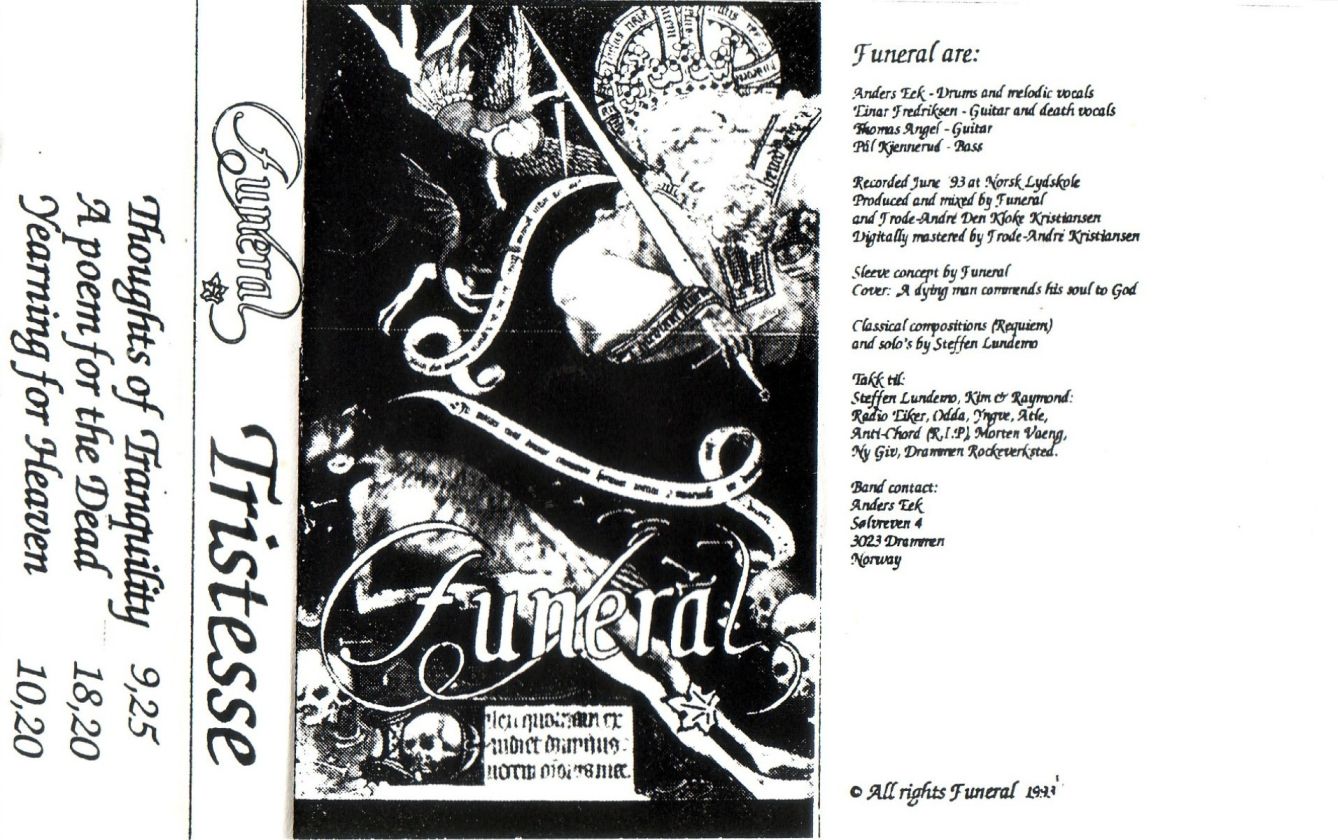
Tristesse by Funeral was released in 1993, before Funeral Doom had a name or an established genre landscape. Initially released as a cassette, it was followed in 1994 by a mini-CD through Wild Rags Records. In the years that followed, the demo was repeatedly reissued, continuing to the present day, both as a standalone release and as part of a compilation with the debut album Tragedies. The recognition Tristesse receives remains undiminished to this day and cannot be reduced solely to its role as a pioneering work or to the proximity of the band’s name to the genre designation that would emerge later. So let us take a look at what makes Tristesse a classic, what role it occupies within the genre and the band’s discography, what qualities elevate it above the primordial soup of the genre, and whether it still holds up today beyond its significance as a classic.
Perhaps the strength of Tristesse lies in a contradiction: the lyrics draw on the language of prayer and create images of salvation without ever fully delivering the certainty of that salvation. Funeral turn toward something transcendent while the experience of despair, loss, and grief remains intact. The state of despair, decay, and withheld salvation finds its counterpart in music that does not work toward resolution, but instead sustains the state itself over an extended period of time. What remains is a feeling of oppression. Tristesse seems to depict a call into an empty space in which the very possibility of finding meaning has already been lost.
Historical Context
In 1993, the year in which Funeral recorded Tristesse, Skepticism also released Aeothe Kaear, followed a year later by Thergothon’s Stream from the Heavens, a release now regarded as one of the canonical works of Funeral Doom. Yet at this point, it is hardly possible to speak of a genre. There was no established idea of what Funeral Doom was supposed to be, let alone a scene that gathered under this name. Instead, numerous bands were searching for means of expression beyond the boundaries that Death and Doom Metal had established up to that point.
The path toward this had already been set in motion several years earlier. Doomcore had introduced a range of different ideas, while releases such as Lost Paradise, Into Darkness, Dusk, Odes, and Fhtagn nagh Yog-Sothoth traced different paths out of Death Doom toward those extremes that would later be described as Funeral Doom. Between 1990 and 1992, various artists released music that in retrospect has likewise been identified as pioneering. These included the Russian group Вой with Krugami vyechnosti, initially known mainly within tape-trading circles, Funeral from Norway, Faltomy and Unburied from Finland, and Gallileous from Poland, each of whom released their own demos. The transition between Death Doom and Funeral Doom was by no means linear. The musical means sometimes resembled one another, but the points of departure and artistic intentions did not.
Mordor experimented with a form of musical introspection, using the means available to them to pursue it. Thergothon, with the aid of Dark Ambient, searched for ways to move away from Metal itself. Disembowelment and Winter, meanwhile, emerged from the Crust and Grindcore milieu. It is therefore just as difficult to identify a single origin for the style as it is to identify a single geographical point of origin. Funeral Doom is a prime example of the rhizomatic development of musical genres. It is almost impossible to determine who influenced whom, when, and to what extent. Esoteric knew Disembowelment, but not Winter. Many knew My Dying Bride, but not everyone did. Ideas emerged in different places, were adopted, transformed, or developed independently of one another.
It was within this network, lacking any clearly traceable linear structure, that Tristesse emerged, a demo that occupies an exceptional position within the band’s own discography and would later become one of the most enduringly significant releases in Funeral Doom. Tristesse is the release on which Funeral come closest to what would later be called the genre. Ironically, this very demo is therefore also one of the reasons why there is still debate over whether the term Funeral Doom derives from the band’s name.
More likely than a direct connection to the band name, however, is the promotional sticker that Red Stream placed on the pressing of Aeothe Kaear. A coincidental or retrospective duplication with Tristesse nevertheless remains possible. One thing is more certain: when Funeral recorded Tristesse in 1993, Funeral Doom was not yet a clearly defined musical territory. The band did not enter this territory as representatives of an already existing style. Rather, they helped make it visible in the first place.
Prayer Without Salvation
Lyrically, Tristesse is relatively cohesive. The three songs revolve around death, loss, grief, and salvation, using strikingly religious language. The demo can also be read as a sequence of different perspectives on death: from the dying person, through the bereaved, to a renewed longing for the afterlife.
In Thoughts of Tranquility, the lyrical voice, in the process of dying, turns toward God in an almost traditional manner, praying, pleading, even begging:
“Oh, hear my prayer”
Later, it says “Pray for my soul.” The prayer appears as a cry from a state of utter despair. “This terrible writhe / I rot away,” “My soul is trying to slip away,” “All hope is gone.” Hope has essentially already disappeared, yet the prayer continues to be spoken. Whether it provides comfort or merely preserves the form of hope remains open. Death ends the suffering and is presented as a transition into another existence. The soul is free, and in the end there is rest, flowers, and green meadows. Death becomes a gateway out of a burdensome existence.
Yet these images cannot necessarily be read as an objective description of an afterlife. They may just as well be the final visions of a dying person. The text does not tell us whether the soul actually rises and reaches the green meadows, or whether these are the images a person clings to in the moment of death. This is where the peculiar ambiguity of the song lies. The religious order offers an answer, but the text does not ensure that this answer is fulfilled. If the certainty of the promise of salvation disappears, the idea that “in death the hardship ends” can transform from a comforting promise into a cynical relief. Death would then not be salvation, but merely the end of what can no longer be endured.
This is a thought that would recur throughout Funeral Doom: life as a test one was enrolled in without consent, and death as the possibility of simply ending that test. Yet Tristesse remains ambiguous at this point. Funeral assert neither a nihilistic way out nor a certain Christian salvation. They leave both possibilities in the room. This indecision is what makes the death of the opening song so effective.
With A Poem for the Dead, Funeral shift the perspective. Moving away from the subjective experience of the dying, the focus turns toward the bereaved. Death becomes the experience of losing someone beloved. While the deceased possesses peace, the person left behind must live with the void created by the loss.
“You, whom I loved
My joy and crown”
The pain arises from attachment. The self that the speaker possessed in communion with the deceased loses its resonance. This, too, is a motif that runs consistently through Funeral Doom: death does not merely take a person, but a part of the world in which one’s own self was anchored.
The religious language remains. The dead are redeemed, their spirit is meant to rest, their soul is free. Salvation is granted to the deceased. Yet for the speaker, this salvation makes the distance between the living and the dead final. The finality of death offers rest to the dead, but for the person left behind it means the loss of love and identity. Despite the sacred language, this certainty cannot dissolve grief. It is not overcome by the hope of reunion, but preserved through pain and through the assurance of grace and peace.
“I cry for you, my love
I breathe, for you, I live for you
I will long rue you, too deeply to tell
A wreath – my farewell
I rue you – grief bites hard
Tears now flow for you”
In a mixture of comfort and despair, the speaker oscillates between affirming the peace of the deceased and experiencing their own suffering through grief. The prayer does not cease because there is no answer. It persists because it preserves the pain and thereby offers a final connection to the deceased. The language of prayer is therefore no longer directed only upward. It simultaneously becomes a language for the person who can no longer answer.
With Yearning for Heaven, this movement finally returns to an experience of death. The lyrical voice imagines angels, falling leaves, the waiting earth, and a soul ascending. Not necessarily toward a merciful God, but perhaps, within the imagination of the lyrical voice, back toward the lost love. Once again, death is arrival and salvation while simultaneously remaining a moment of hope that the lost love might be encountered once more. Beyond Christian longing for death, salvation and pain exist side by side. Death can bring peace and yet remains bound to the loss of what was loved in life, extending even to the loss of one’s own ability to love.
The final lines are perhaps the most revealing:
“My soul darkens
I can not love anymore
In fear of losing you
Forever.”
Here, it is not death as the end of existence that is mourned, but death as the end of the connection to the beloved. Dying becomes a mutual loss. This is at the heart of the demo’s dark romanticism: the true center of despair is not the annihilation of life, but the realization that love always contains the possibility of its own loss. Death does not merely destroy a relationship. For the person left behind, it changes the possibility of entering into such a relationship again at all.
God and paradise are therefore not the actual subjects of Tristesse, nor is it an unequivocal indictment of religion. Rather, the religious images provide a possible order in which death could acquire meaning. The world is not fundamentally meaningless, God is not necessarily absent, and death is not necessarily a final annihilation. Beyond it there may be an order in which the soul finds peace. The tragedy arises from the fact that the human being cannot emotionally comprehend this possible order. Faith can promise salvation and still be incapable of erasing the painful experience of loss.
And this is where text and music meet. The lyrics repeatedly speak of movement: liberation, ascent, arrival, salvation. The music almost completely refuses this movement. The soul can ascend, the riff remains where it is. The text presents a possible afterwards without establishing its certainty for the listener; the music, by contrast, keeps the listener in the state before it. This tension is a central part of the effect of Tristesse. Funeral do not simply give despair a soundtrack. They stretch the state out, slow down perception, and thereby leave the promised salvation suspended.
The title Tristesse is therefore more fitting than the seemingly straightforward longing for death might initially suggest. It is less about death than about grief, less about the afterlife than about loss. Grief is not a state that can be resolved through an insight. Even if the dead are redeemed, even if heaven exists, and even if peace awaits at the end, the living person is initially left with the experience of loss. Tristesse turns precisely this intermediate state into its music. The prayer promises salvation, but the music leaves the listener where that salvation has not yet arrived.
The Music
Musically, Tristesse is a product of its time and its possibilities. Funeral play an extreme form of Death Doom whose impact derives primarily from a consistent reduction of tempo, movement, and dynamics. Three songs spanning almost forty minutes, whose musical development does not follow the conventional Metal dramaturgy of riff changes, build-ups, and climaxes. The musical material is stretched, repeated, and transformed into a state of almost complete immobility. On Tristesse, slowness itself becomes a compositional principle. It is a consequence Funeral would not pursue further, later favoring nuances, subtleties, alternating vocals, and melody.
This constitutes a significant difference from many contemporary Death Doom releases, which sometimes presented slowed-down Death Metal, as with Paradise Lost or Asphyx, sometimes reduced Crust, as with Winter, and even dynamic music with a connection to Grindcore, as with Disembowelment. Funeral do not deny their origins in Metal, but they show little interest in its conventional dynamics. Weight does not arise from the speed of Thrash or the pressure of Death Metal, but from duration. A riff loses its function as a brief musical statement and becomes a space in which the listener has to remain for minutes at a time.
A parallel can be drawn here with the radically opposite and emerging Black Metal of the same period, where repetition likewise strips the riff of its conventional function and turns it into a test for the listener. Yet the two paths lead in opposite directions. Where early Black Metal uses speed, coldness, and repetition to overwhelm perception, Funeral slow the music down to the threshold of stasis. In both cases, the riff is not primarily developed, but endured. In the interplay between riff and time, Funeral create the monolithic quality that connects Tristesse so directly with Funeral Doom and its origins even today.
The demo is by no means static, however, and the frequent description of it as “monotonous” falls short. Funeral introduce a small number of changes deliberately. Acoustic guitars open the first two tracks and cut across the monolithic wall. Heaviness and tempo shift, individual drum patterns alter the movement of the songs, and the bright guitar solos, sitting in the sound almost like foreign bodies, create contrasts that stand out all the more clearly within this highly reduced sonic landscape. Because the musical vocabulary is so limited, every deviation carries considerable expressive force.
Characteristic here is the combination of different layers that Funeral have not yet fused into a coherent style, but place beside one another with remarkable naturalness. The acoustic passages recall traditional Doom ballads, the deep growls anchor the songs in Death Doom, and the almost liturgical clean vocals open up a sacred dimension. The guitar solos, which do not necessarily emerge organically from the rest of the material, reveal that this is still an unfinished band from the early Death Doom environment, still searching for its own voice and not yet reproducing an established genre.
This incompleteness is a historical curiosity, but it is equally part of the character of the demo. Tristesse does not sound like the perfect execution of an idea that already existed. It sounds like the discovery of a musical possibility. Funeral take elements from different areas of the Metal of their time, reduce them to their slowest and heaviest components, and in doing so discover a form of expression for which there is not yet an unambiguous name.
The raw production also proves to be less of an obstacle than it might initially appear from a contemporary perspective. It prevents a precise and differentiated reproduction of the individual instruments, but at the same time reinforces the cohesion of the overall sound. Bass, guitars, and drums often merge into a single heavy mass. Where later Funeral Doom productions would attempt to perfect this mass with deeper frequencies, larger reverberant spaces, and more sophisticated arrangements, Tristesse still possesses something immediate. The music does not sound like a polished representation of a state, but as though it itself were slowly falling apart.
Not every decision made here is equally convincing. From a contemporary perspective, the solos can be irritating because they sometimes seem to come more from traditional Hard Rock or Heavy Metal than from the sonic world Funeral otherwise create. Imagine a Saint Vitus solo in a Thergothon song. The enormous reduction of the material also demands a degree of patience that not every listener will be willing to provide. What one listener experiences as the hypnotic consequence of the album may appear to another simply as stasis.
Yet this is precisely where one of the defining qualities of Tristesse lies. The music demands a change in expectations. Anyone searching these almost forty minutes for a constant stream of new musical information will inevitably encounter monotony. Anyone who accepts that this is not development in the conventional sense, but the creation and prolonged maintenance of a state, will recognize the demo’s actual achievement.
Funeral turn slowness into a mode of perception. The riff is no longer a building block for development, but a place in which time itself becomes musical material. And this gives the music a significance that extends beyond its historical role as an early manifestation of Funeral Doom. The lyrics speak of liberation, ascent, and possible salvation. The music, by contrast, holds on, stretches out, and refuses resolution. Death may offer a movement out of suffering in the lyrics; Tristesse musically makes precisely the state before that movement tangible.
Extreme slowness therefore becomes more than merely a stylistic characteristic of the demo. It becomes an expression of grief itself. Tristesse does not allow the listener to arrive where the characters in the lyrics are sent. It keeps them with what remains: loss, memory, and the time that continues after death.
Conclusion
Of course, Tristesse is heard differently in 2026 than it was in 1993. Funeral Doom has long since become a differentiated genre, whose productions, compositions, and sonic concepts go far beyond what Funeral were able to achieve on this demo. Anyone looking exclusively for technical refinement, sonic depth, or compositional complexity will find numerous later releases that surpass Tristesse.
But that is not what this demo is about. Tristesse possesses something that cannot simply be perfected: the experience of a musical language emerging while it is still not an established language. Funeral felt their way forward, reduced the means they knew, and in doing so found a form of expression for something that is difficult to convey in any other way. The monotony is not always beautiful, the solos sometimes feel like foreign bodies, and the production is far from modern perfection. Nevertheless, the recording possesses a density that many technically more accomplished productions fail to achieve.
Tristesse is therefore unquestionably a classic. Not only because it is one of the early documents of what would later be called Funeral Doom, but because Funeral had already developed their own idea of what this music could accomplish. Death Doom, acoustic passages, sacred-sounding vocals, and traditional guitar solos stand alongside one another and are brought into relation through extreme slowness, creating a context for which there was no established musical grammar at the time. The incompleteness is therefore not a flaw to be deducted from its status as a classic. It is part of its effect.
What carries the demo beyond this is the tension between its lyrics and its music. The lyrics speak the language of prayer, grace, salvation, and a possible life after death, and take this religious imagery surprisingly seriously. Yet their foundation as a source of meaning remains fragile: perhaps there is salvation, perhaps peace awaits beyond death. But the possibility of this afterwards does not alter the experience of loss here and now. The music makes precisely this difference tangible by refusing the movement of which the lyrics speak.
Tristesse is therefore less about death than about what death leaves behind. Less about the afterlife than about the presence of loss. Death may bring peace, faith may promise an afterwards, but the music remains with those who are left behind.
Tristesse gives pain space and time: three songs, almost forty minutes.