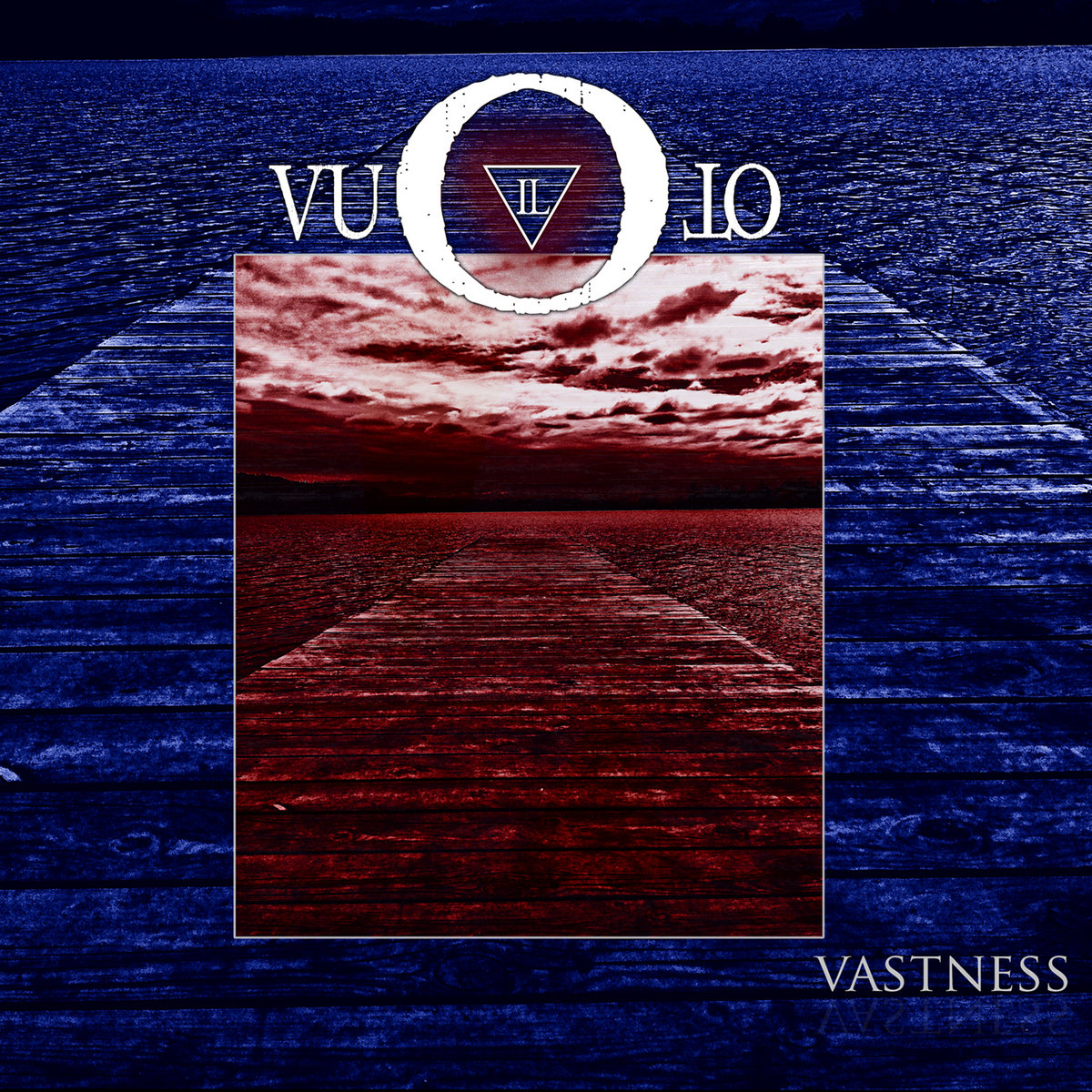
The concept album Vastness by Il Vuoto was shaped by Matteo Gruppi, the project’s sole member, around a “reflection on suffering and lamentation.” In a language rich in symbolism, Il Vuoto enters an exhausting night of circular thoughts. This circularity, characteristic of depressive thought patterns, shapes the album’s musical and lyrical structure and its themes.
The music does not merely provide a melancholic backdrop for the lyrics. Its repetitions, its slowness, its heaviness and its acoustic passages embody the psychological state of the lyrical subject itself.
The thoughts of the lyrical subject revolve around an unnamed point in the past. Again and again, the mind returns to the same starting point. Across five pieces, including one instrumental, it considers suffering and guilt from different perspectives. In doing so, it desperately searches for closure, for a redeeming answer. Five facets of the same fundamental theme form a dense lyrical journey through a mental and emotional crisis.
Heaviness, Melancholy and Acoustic Fragility
Musically, Vastness is firmly rooted in Funeral Doom without restricting itself to its monolithic heaviness. Gruppi combines the sluggish, dragging passages with melodic and atmospheric moments, acoustic guitars and occasional elements of Black Metal and Post-Rock. The acoustic passages in particular lend the album a peculiar fragility. They do not simply stand in contrast to the Doom, but become part of its inner dynamic. A fragile melody may be followed by a heavy wall of guitars and deep growls, while elsewhere cleaner or almost spoken vocal passages pull the music back out of its heaviness. Between these poles emerges a music that is simultaneously oppressive and remarkably open.
Gruppi turns musical lament and mourning into something situated between the anguished elegies of My Dying Bride and Deinonychus. With psychedelic guitar fragments reminiscent of acoustic Pink Floyd, the album also establishes an associative affinity with Tiamat’s Wildhoney. At the same time, Il Vuoto remains much more firmly rooted in Funeral Doom with Vastness than in Gothic Metal, bringing to mind names such as Shape of Despair or Doom:VS without giving the impression of imitation. It is precisely the combination of heaviness, melancholy and acoustic fragility that gives the album its individuality. The long tracks develop slowly and allow their motifs room to breathe, at times pushing them to the limits of stagnation. This persistence can be exhausting, but it is also part of the musical conception. The music seems unable to move forward because the lyrical subject is unable to move forward either.
Thought Loops
The circling of thoughts is the circling around that moment Kierkegaard describes as the moment of despair. The moment when the individual becomes aware of their existential abysses. They stand before the decision either to confront their own self or to flee from it. The lyrical subject comes closest to this confrontation in V (The Fifth Nail):
“Five days of cleansing
The night is drawing near.
Trying to find redemption
Get rid of all this dirt.”
The search for cleansing and redemption ultimately fails. Nevertheless, the will to continue living and to accept one’s own imperfection remains. The album ends with a hint of reconciliation, although it does not dispel the darkness.
Variations on Existential Guilt
Within this symbolic night, the mind uncontrollably varies the central themes of suffering, guilt, self-doubt and the struggle with its own existence. Already in the opener Vastness, a sense of existential guilt is addressed. This guilt remains invisible. It is never concretely named, instead remaining an unspoken, oppressive shadow throughout the album.
Emptiness, suffering and guilt form the thematic poles between which the unspeakable unfolds. Although the lyrics repeatedly articulate pain and guilt, their origin remains in darkness. This is exemplified in Vastness. Here, vastness, whether social, psychological or cosmic, is experienced as overwhelming. At the same time, pain and loneliness manifest themselves against the backdrop of inner emptiness. Lyrically, the texts move primarily through metaphorical imagery. The words remain subjective and vague, repeatedly circling the same realization:
“Today, misery is mine”
(Weakness)
Gruppi does not name a clear thought here. It is not a moment of logical reflection, but an impulsive probing of one’s own abysses. The thought loops and the ineffable, the incomprehensible, the numinous, become the essence of the self, while the guilt remains unspoken.
“‘No deed can be destroyed: how could it be undone by punishment! This, this is what is eternal about the punishment ‘existence’, that existence must eternally be deed and guilt again!’”
(Friedrich Nietzsche)
There is no escape from this circle. In social interaction, life remains an ongoing accumulation of guilt. Vastness shows how this universal feeling of sadness and guilt is mirrored on a subjective level. The album becomes a psychological apocalypse. Toward the end of V: The Fifth Nail, speech samples creep into the music, like voices from a television suddenly calling attention to reality. These voices intrude upon the thought-shrouded self-perception and perhaps prevent the impending catastrophe.
The images of nature that run through the lyrics point toward the monumental and uncontrollable. The emptiness and vastness of the cosmos, fire and the elements of the earth become symbols of overwhelming alienation and guilt.
“No horizon is as empty
As mine will ever be”
(Vastness)
Synthesis
Musically, Il Vuoto reinforces this dynamic through a repetitive structure. The thought loops of the subject are reflected in the music. Like a spiral, the pieces repeatedly return to similar starting points. Yet the music is not completely static. Acoustic guitars, melodic passages and atmospheric openings repeatedly interrupt the heaviness without resolving it. This is precisely where a correspondence with the lyrical subject emerges. Its thoughts, too, never truly move forward, but repeatedly open themselves, if only briefly, to the possibility of another perspective. There is no liberation, only movement within the circle.
The speechlessness accompanying the invisibility of guilt thus becomes the central statement. The unspeakable is the essence of this night. The feeling of guilt cannot be dispelled, neither by keeping it unspoken nor by clearly articulating it. What remains for the individual is to live with the awareness of their own guilt, with the pain and the emptiness. And perhaps it is precisely here that the minimal movement Vastness allows at the end can be found. The darkness does not disappear, nor is redemption achieved. But the thought loop does not necessarily have to end in death. The possibility of continuing to live with one’s own imperfection remains. Ultimately, it is not dissolution but integration that stands at the center. Of music and text, of guilt and consciousness, of shame and being. An elegiac album that seeks and finds its musical home somewhere between Wildhoney and Aeternum Vale.