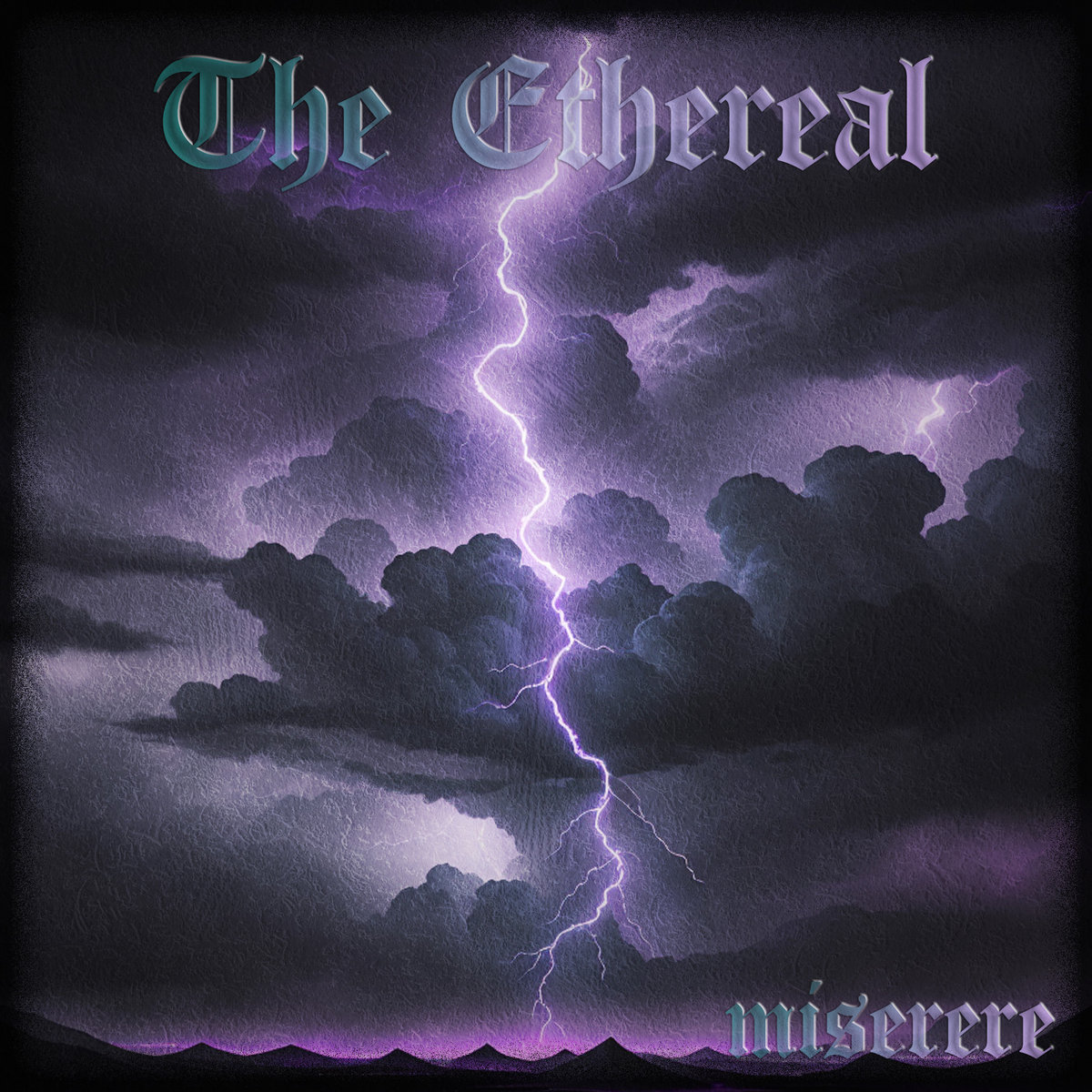
Miserere marks the return of The Ethereal — one of the solo projects of the Belgian multi-instrumentalist Stijn van Cauter, and not least, perhaps my favorite project of his, after what felt like an eternity-long pause. The album combines Funeral Doom and Ambient across six thematically concise, self-contained tracks.
The sound of the album is characteristically dense, melancholic, and oppressive, with a slow narrative that leaves room for emotionality. As is typical for Ambient Funeral Doom, the pieces unfold particularly tentatively and gradually develop into monumental soundscapes. The thematic weaving of deep sorrow and existential exhaustion is carried by simmering drones, dark guitars, minimal percussion, and occasional ambient textures. In “Blessed End” and “Legend”, the Ambient element comes even more to the fore: deeply tuned basses, minimalist rhythms, alienated melodic lines, and vocals that create a feeling of spiritual farewell. The album title deliberately refers to Allegri’s “Miserere Mei”, which manifests in the two tracks “Miserere I/II” as a liturgically dark mood — moving and sonically mysterious.
Compared to “From Funeral Skies”, “Miserere” is less radically minimalist, less crushing, and thus less despairing. I would say “Miserere” is a more mature look back with awareness of one’s own past.
Van Cauter uses a spiritual monologue as a constant textual basis: words like “Dirge-held,” “void-bound,” or “I become the Ethereal” (from Dirge) reveal the eternal existentialist core theme of van Cauter’s early releases. Even before the sci-fi concept projects and albums, this impulse — the awareness of one’s own finitude — was a central thematic pillar of his work, and the question of what comes after, what lies beyond, continues to resonate in all his works. Ultimately, Why Are There Stars? bridges the gap and reflects on the feeling of being lost in cosmic nothingness. Thus, the album forms a concept work of high internal coherence, linking both the early works and the current releases by van Cauter.
The sonic structures — slow drones, almost no movement, monotonous repetition — sound like lived resignation. This is reminiscent of minimalist art: stepwise, almost painstakingly detailed, yet monumental. In Dirge, the concept unfolds in musical form: the slow buildup enhances the impression of being drawn into a black abyss — like an argonian nothingness that reflects itself. The liturgical references recall Krief de Soli, but while the Canadian project mixes revelation themes and vanitas motifs into a liturgical Funeral Doom scenario, “Miserere” acts less sacrally and more inwardly — van Cauter does not celebrate rituals but reflects individual emptiness. It is Heidegger’s thought of being-towards-death and existence in the face of nothingness. The consciousness of death that van Cauter manifests in music directed at emptiness. Yet this consciousness is itself fragmented. It is shattered and, as an inner movement of thought, loose and open rather than philosophically clear. The loss of substance is the consistent expression of a self dissolving into nothingness — here we find another constant in van Cauter’s work: the attempt to understand the coming non-being as a transcendental experience without relying on a theological superstructure.
The tension arc develops organically, avoids external catastrophes, but steadily builds atmosphere. It manifests emptiness as form in both music and language alike. Absence, repetition, omission as symptoms of being lost in nothingness recall Samuel Beckett (Endgame or Waiting for Godot). The atmospheric minimalism that van Cauter has cultivated from the start remains methodical. Tone, lack of tempo, and repetition create an aesthetics of negation — and thus a form of technical substance denial.
Of course, this album remains an ambient Funeral Doom album with a limited potential audience: dark, atmospheric, marked by a literary-surreal play of motionlessness. An emotionally gripping experience with its own afterglow, provided one manages to let oneself fall into it. But those who can engage with this intense listening experience between Funeral Doom, Ambient, and literary pull will find in Miserere a remarkably mature and coherent contribution to the genre.
“Miserere” is a small, unconsciously philosophical testimony in sound form. It structures music and language around the experience of nothingness, recalls Heidegger and Beckett, connects the early work with the spiritual maturity of a modern concept album, and remains a carefully considered contribution to van Cauter’s introspective art.