“In Hinterpommern there is the Demant Mountain, one hour high, one hour wide, and one hour deep. Every hundred years, a little bird comes and sharpens its beak on it, and when the entire mountain has been worn away, then the first second of eternity has passed.”
— Brothers Grimm: The Little Shepherd Boy
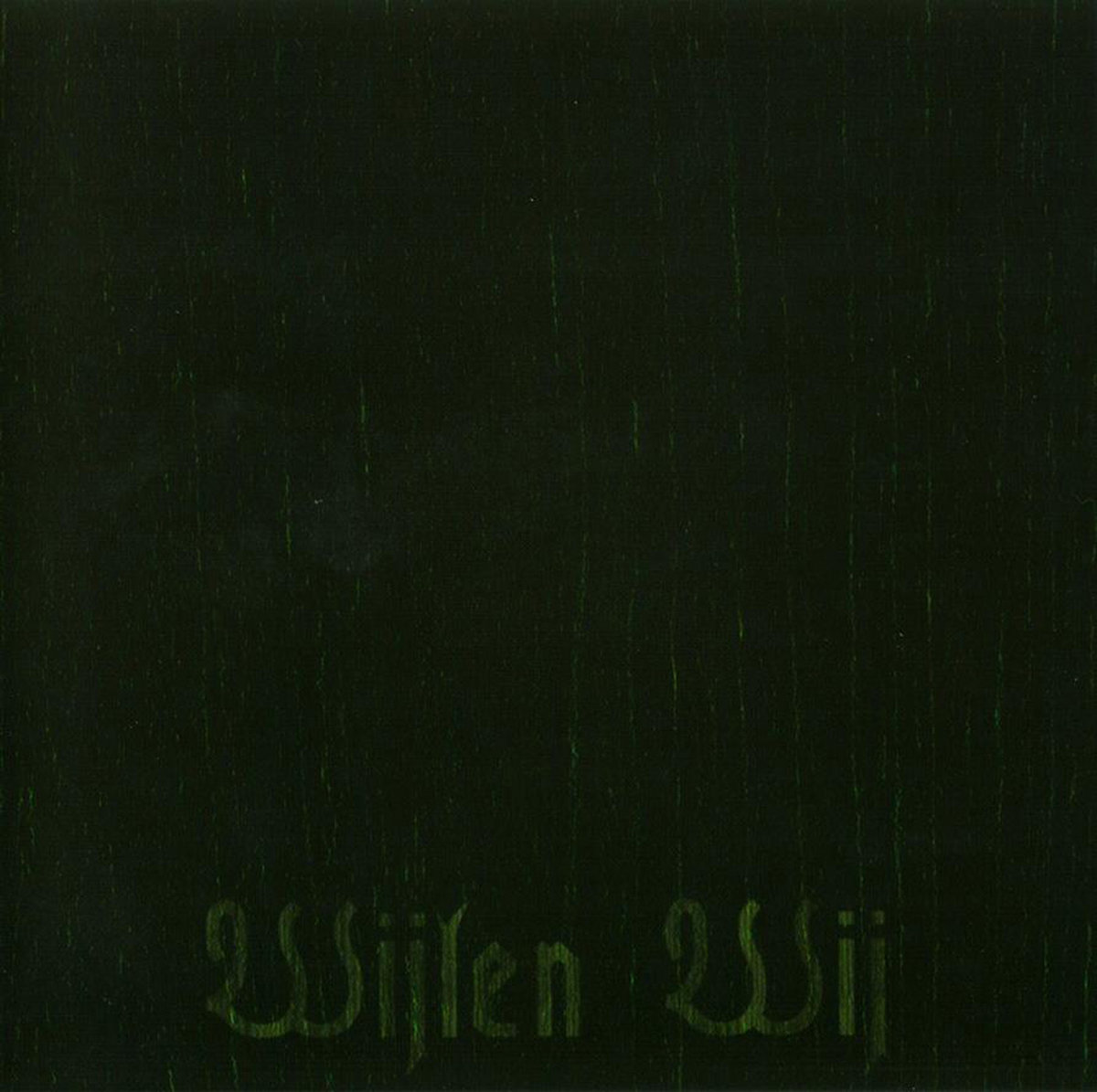
Wijlen Wij is a hidden yet noteworthy cornerstone in the history of the genre—musically situated somewhere between pseudo-medieval resonances and drone-infused references. Upon release, the album was a deserved thorn in the side of an increasingly agreeable genre, employing a Burzum-esque dungeon synth vocabulary while simultaneously aligning itself—through its wavering, partly fuzzy distortion—with drone projects like Black Boned Angel. If one considers the early work of Van Haecke, Van Cauter, and Panagiotou together, Wijlen Wij becomes a radically dialectical counterpoint to the musicians’ main projects while simultaneously continuing their foundational ideas. The album lives from heaviness and monotony, from riffs that refuse to end, and harmonies that unfold with painful slowness. What stands out most is the contrast: while the music conveys a resigned bleakness, the lyrics reveal a philosophical engagement with reincarnation and finitude. Panagiotou’s sacral choral voice opens the album, immediately announcing in French the record’s conceptual framework over medieval-tinged dungeon synth passages: “L’anathème est prononcé” (“The anathema is pronounced”). The album’s lyrics extend this banishment motif—expulsion from paradise and condemnation to the eternal cycle of rebirth.
Musically, Wijlen Wij oscillates—on the basis of a dislocated, anti-modern tonality—between horror-film sensibilities, Black-Metal-adjacent pseudo-historical medievalism, and sacral moments. A piece like Falling Stars, slipping at times into direct Black Metal quotations, wrestles with the recognition of an omnipresent decay. None of the five tracks move toward a conventional climax; instead, each is shaped by drawn-out chord progressions. Falling Stars opens the album with a suffocating weight that sets the tone for the entire work. The slow tempo, minimalist drumming, and sacral keyboards create an almost hypnotic effect. It is this strange fusion of nihilism and grandeur that defines Wijlen Wij. What remains is the despair over eternity—an eternity in which humans are bound to being and decay:
“Trapped in dead withering flesh. / I should not be – but still am.” (Aware of the Void).
Meanwhile, the band constructs a sonic image of desolate timelessness: organ sounds whose synthetic nature is often audible, thin piano strikes, harsh distorted drone-waves, and Van Cauter’s rumbling growl lingering mostly in the background. Wijlen Wij conjures a dark edifice that could have emerged from the malign cult of a fantasy epic or a Lovecraft story—while the lyrics linger on reflections about dying, invoking both Christian mysticism and a Nietzschean thought:
“Let us think this thought in its most terrible form: existence, as it is, without meaning or goal, yet inevitably recurring without a finale into nothingness: the eternal return.”
And yet, dying on Wijlen Wij ultimately tends toward redemption—toward an escape. The album’s closing track Bridges offers, in its acceptance of entropy as apocalypse and with its nod to Christian mythology, a final release—between familiar organ timbres, string arrangements, and a surprisingly conciliatory lead guitar:
“Take my suffering; erase me from the face of this earth / A new era has begun; the King has arisen from his slumber!
Like a bird freed from its cage / Like the prayer of a wounded soul / My spirit flies towards the sun …” (Bridges)
Here the philosophical frame closes. Wijlen Wij does not tell a subjective story of an individual longing for death, nor can it be convincingly read as an apology for Christian salvation. In the end, it gestures toward the finitude of eternity itself. The album’s lyrics embody Deleuze’s idea that repetition is never identical but always differential—that every recurrence is also a becoming. The cycle—from banishment to life in L’Anathème, through the seemingly endless rebirth in Wijlen Wij, the life defined by loss (Offertorium) and decay (Aware of the Void), and the eventual release from the cycle in Bridges—folds back onto the Grimm parable, perhaps subtly referenced through the dying stars and birdlike tones in Falling Stars. Musically, the album stands fully on its own. At times neoclassical, at times black-metal-leaning, at times drone-oriented, it charts a sonic route still scarcely represented in Funeral Doom today. A grimy mirror to Asunder’s Works Will Come Undone, or a distant precursor to the young sub-style Apocalyptic Funeral Doom (Fordomth, Mesmur, Omination).
This sub-subgenre—operating with Black-Metal cross-references, dynamic contrasts, and occasional operatic counter-vocals—is far more dynamic and clearer in the mix than Wijlen Wij. Rough signposts and precursors can nevertheless be found between Bridges and L’Anathème. Still, the band insists on remaining singular—somewhere between anachronistic and timeless. Its strengths, like its rough edges, stem from its anti-consumerist essence.