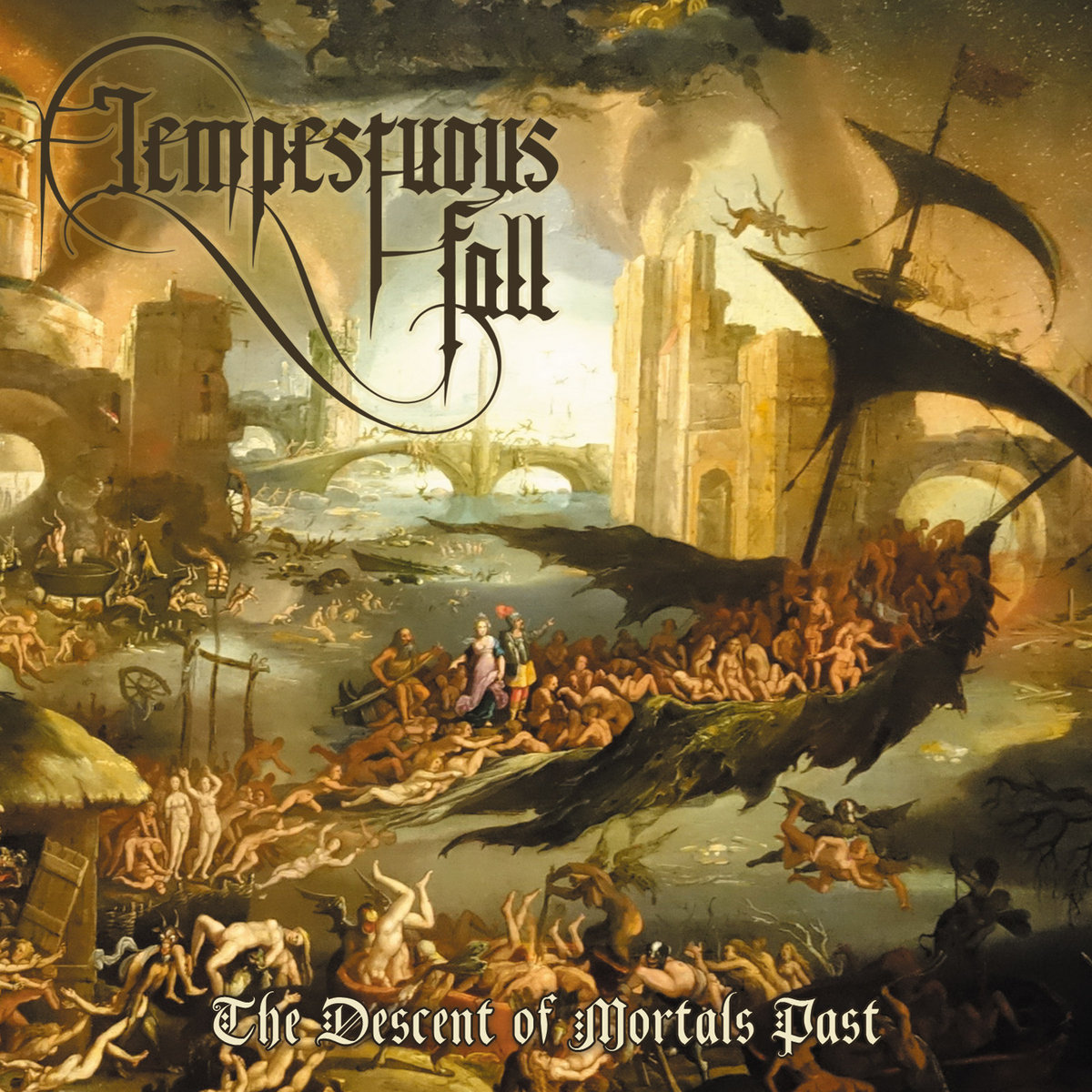
Time for another Versus — this one examining two albums of solemn, sakral Atmospheric Doom. Malicious tongues might call it a comparison between the „original“, Pantheïst (Seeking Infinity), and one of its „follow ups”, Tempestuous Fall (The Descent of Mortals Past). After all, both draw on an analogous musical language: slow, breathing harmonies, expansive tension arcs, sacred textures of vocals and orchestral timbres, all held together by deliberately trance-like repetition. Yet in their conceptual orientation they could hardly be further apart. Seeking Infinity looks upward — into the cosmos, into history, into the intellectual evolution of humankind. The Descent of Mortals Past, on the other hand, pulls the listener downward — into the underworld, into mythology, into trials rooted in the oldest narratives of the Western world. Both albums follow a conceptual journey, a so-called katabasis — a descent.
Katabasis
Funeral Doom, especially its conceptual works, has developed since the 1990s an aesthetic that can be understood as a musical form of katabasis.
Katabasis is the archetypal descent — into the underworld, into despair, into the depths of one’s own self.
Mythologically, katabasis refers to the journey of a hero into the realm of the dead: Orpheus descends to find Eurydice; Heracles to fulfill a task; Odysseus to gain knowledge. As Above, So Below or Valhalla Rising as well as The Seventh Seal engage this tradition. Musically, projects like Mesmur (with Chthonic) or the early, now obscure Krugami vyechnosti by Voj also connect to this narrative.
In literature and film, the descent becomes a narrative passage through darkness and trauma — in works like Jacob’s Ladder, Kill List or The Nameless, reality dissolves to the rhythm of the descent. Analogously in Doom: Until Death Overtakes Me’s Diagenesis or Il Vuoto’s Vastness embody this dissolution. Philosophically, katabasis stands for the turn toward one’s innermost abysses: toward the unconscious, toward fear, toward existential crisis. Films like Stay, Mulholland Drive or The Machinist render this movement visible as psychological collapse. Musically, Esoteric’s Epistemological Despondency or Aphonic Therondy’s The Loneliest Walk exemplify the emotional and psychological descent into one’s own chasm.
Typical features of katabasis include entry into a dark, foreign or hostile space; encounters with shadows, the dead, memories or trials; confrontation with fate, guilt, mortality and the loss of meaning. And always the question: will the descent end in return — or in being lost? In cinema, Pan’s Labyrinth or The Descent are prime examples. The descent — psychological, mythological, existential — becomes a central metaphysical topos. And at the poles of this topos stand Pantheïst’s Seeking Infinity (2018) and Tempestuous Fall’s The Descent of Mortals Past (2025). Although both works rely on Atmospheric Funeral Doom and pursue remarkably similar musical paths, they create entirely different models of descent: one cosmic-modern, the other archetypal-mythological.
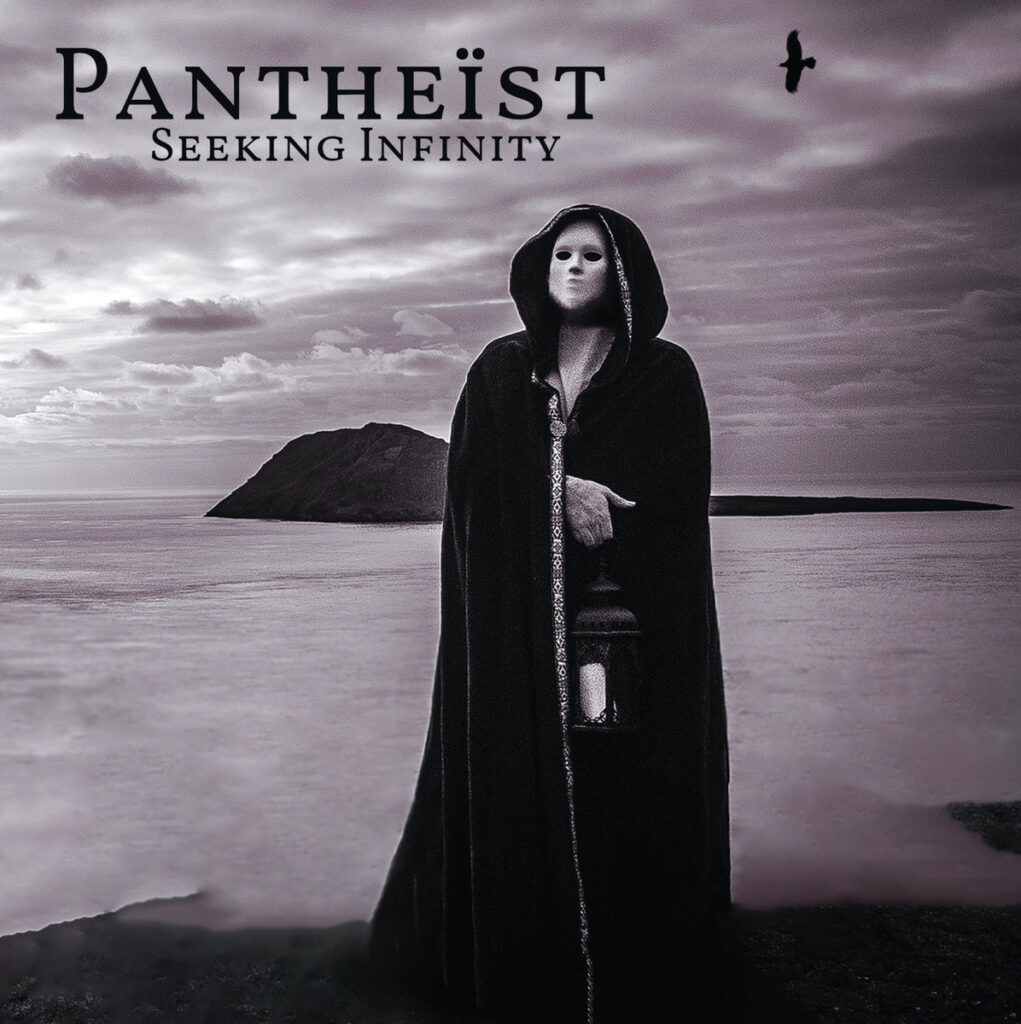
Seeking Infinity
Pantheïst tell a journey through history, the cosmos and subjectivity, shaped by philosophical-existentialist ideas. The album unfolds as a historical spiral (500 BC → modernity → apocalyptic future) combining the search for transcendence and the fear of nothingness with a cosmological downfall. Its narrative follows the time-travelling Professor Losaline, who seeks a universal spiritual and transcendental structure of history by travelling into the past. All tracks draw from this figure, his experiences and reflections. Central to his thought:
“Civilisation is a spiral of eternal revolution.”
With its lush keyboards and the resulting epic, elevated atmosphere, Pantheïst have always held, if not a unique position, then at least a guiding role within Atmospheric Doom. This characteristic persists on Seeking Infinity, including the Gregorian-style chants the band has been known for since its debut. The album blends elements of neoclassicism, gothic metal, progressive rock and progressive metal — tempo changes, dynamically sublime arrangements and varied vocal styles within the gliding pace.
Seeking Infinity functions as a narrative and philosophical spiral: historical episodes, personal reflections and cosmic perspectives alternate and interweave into an existential totality. The central concept — “civilisation as a spiral of eternal revolution” — permeates every layer: musical, political, historical, individual and cosmological. Pantheïst merge Funeral Doom’s atmospheric density with a complex narrative and metaphysical ambition unmatched in Atmospheric Doom. Seeking Infinity lifts Funeral Doom on another Level and this makes comparisons unfair and all the more radical.
The Descent of Mortals Past
But The Descent of Mortals Past practically demands that comparison. Tempestuous Fall reconstruct a complete ancient cycle of katabasis. Each song centers on a mythological figure entering the underworld: Theseus, Psyche, Heracles, Odysseus, Orpheus and Aeneas. Unlike Pantheïst, the descent here does not lead into the absolute of endlessness but returns to the world of duty, as in Roman state mythology.
Musically, the album stands close to Pantheïst — somewhere between Seeking Infinity and Closer to God. It walks the narrow path between classic Funeral Doom and melodic, orchestral elements: strings, piano passages, choirs and church organs. The monumental depth, the alternating growls and clean vocals, the emotional breadth — this seems close to Pantheïst through and through.
The production is clear and detailed; some guitar parts remain slightly raw, which benefits the authenticity. Historically, Dis Pater reconnects with the early Tempestuous Fall album while significantly advancing the songwriting and arrangements. Where earlier the majestic moments of Colosseum or even My Dying Bride were most influential, there is now clearly room taken by Kostas Panagiotou’s influence. The Descent of Mortals Past seems to grow on Pantheïst.
The combination of Atmospheric Doom elements, mythological narration and orchestral grandeur shows a band aware of its own history yet unafraid to open new paths. The result is a powerful, emotionally deep work that renders the tragedy and beauty of mythological katabasis in musical form. It is a comeback that honours Tempestuous Fall’s roots while demonstrating the artistic maturity of Dis Pater — essential for Pantheïst fans and admirers of Funeral Doom and Atmospheric Metal in general. Yet Pantheïst’s monumental Seeking Infinity remains the more individual, more enduring work.
Reflections
Ultimately, the question becomes one of focus: Do you favour the introspective, modern, cosmic — or the archetypal, mythological and tragic?
Tempestuous Fall is easier to digest. The Descent of Mortals Past offers a world full of gods, rules and metaphysical authority, while Seeking Infinity confronts the listener with a world lacking any inherent meaning. Soul-cosmic dissolution stands opposite heroic, rule-bound journey and moral testing. Tempestuous Fall content themselves with cyclic heroic mythology free of modernity, whereas Pantheïst move within a spiralling, de-bordered time concerned with questions of postmodernity and the crisis of the individual.
Pantheïst stand on the side of the modern crisis of consciousness: their katabasis is psychological, cosmological and existential. Tempestuous Fall occupy the side of archaic world-interpretation: their katabasis is narrative, heroic and mythological. Both albums demonstrate how Funeral Doom — especially Atmospheric Doom — could work: as music of descent, of temporal dilation and existential pressure. But the spaces in which that descent unfolds could hardly be more different.
Seeking Infinity 10/10 – The Descent of Mortals Past 8/10