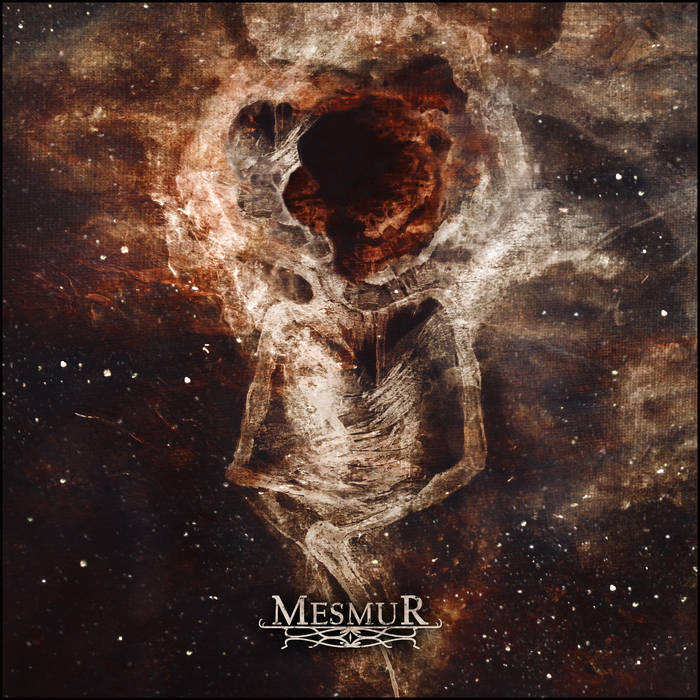
With S, Mesmur release an album that goes far beyond conventional genre boundaries. On the levels of sound, concept, and philosophy, the band explores the finitude of the universe, the inevitability of decay, and the existential isolation of the individual. Between atmospheric death doom, progressive guitar passages, and psychedelic moments, S constructs a soundscape that is at once oppressive and captivating—a musical mirror for the cosmic expiration date of all things.
The Cosmic Expiration Date
The letter S, which Mesmur chose as the title of their second album, stands for the entropy of a system. This indicates how many possible particle configurations correspond to a given macrostate. Metaphorically speaking, it reflects how much freedom of movement the parts of an object have. The purely instrumental fourth track of the album bears the title of the Boltzmann entropy equation: S = k ln Ω. In this equation, k, the so-called Boltzmann constant, provides the scaling between microscopic states and macroscopic thermodynamic quantities. The natural logarithm (ln) shows that entropy is proportional to the logarithmic number of microstates (Ω). These microstates describe the possible arrangements of a system’s particles while the macrostate remains unchanged. The formula shows: the more microstates are possible, the higher the entropy of a system. It establishes a quantitative link between the microscopic world—such as the states of molecules—and the macroscopic world of thermodynamic properties like heat and temperature. Specifically, S = k ln Ω describes the increase of disorder in a system. This inevitable principle leads systems to always evolve toward higher entropy. This fundamental principle shapes the thermal development of the universe—from the Big Bang to a possible heat death. The ‘growth of disorder’ describes not only increasing darkness and rigidity but also the cooling of the universe—driven by the continuous interaction of the micro- and macro-worlds. When a star collapses, disorder increases: subatomic particles disperse while energy, light, and heat escape into space. They spread through infinite space, increasing the number of possible states (Ω). The increase of entropy is a consequence of fundamental physical laws, particularly the second law of thermodynamics: in a closed system, entropy never decreases—it either increases or, under rare conditions, remains constant.
Microscopic disorder drives macroscopic changes, which in turn affect microscopic states. On a cosmic level, the continuous increase of entropy leads the universe from ordered, energetic states to a final state of maximal disorder and uniformity—a cold, dark universe without stability or structure. Entropy is thus the cosmic expiration date of all structures. Every tiny irregularity—be it a perforation, a crack, or a gap—accelerates decay. The disintegration of a single element, such as a beam gnawed by termites in a wooden hut, contributes to the collapse of the entire structure. This process grows exponentially. A collapsing structure weakens its surroundings, causing further decay.
The underlying principle can be reduced to a metaphysical axiom:
Everything decays because nothing is perfect.
From this axiom of cosmological truth, there is no state of perfection in the world-for-us.
World–without-us—a term Eugene Thacker uses—describes a world in which human subjectivity is shaken by the perspective of an indifferent universe. The world-without-us is that conceptual construct of an all-encompassing world in which humans, their knowledge, and their endeavors are negated. From this perspective, humanity is regarded on a cosmic scale as dust within the infinity of space and time.
So, everything drifts apart, decays on a cosmic scale, changes, and is correlated with each other. Microcosm and macrocosm interact and vary the conditions of existence.
In this unceasing movement, the ideal state of perfection is merely a utopia, an illusion that contradicts the natural course of things and serves humans as an escape into the superficiality of a presumed ideal, avoiding responsibility in the here and now. The conditions of existence demand engagement with decay, impermanence, fragility, inconsistency, and inconsequence on a cosmic but also economic, social, societal, physical, and mental level, without the promise of a worldly or otherworldly paradise. The responsibility of the individual is directed toward the global network of relations in which the self is minimal. Yet no self, however small, exists in isolation; each is embedded in a network of relations. From this arises individual and collective responsibility for the present and the future.
Within the global network of interconnected relations, the actions of individuals can influence the being of the world-for-us and the community existing within it. Shaped by simultaneity, uncertainty, and variability, social order demands engagement with the contradictions, fragility, and decay of existence on a global scale.
Amid these conditions, there is no promise of a perfect, worldly, or otherworldly paradise. Instead, it is the responsibility of the individual to play a role in this fragile structure that goes beyond the personal microcosm and follows an awareness of the global and social entanglement of individual actions. Awareness of a world-without-us does not release humans from the world-for-us.
Mesmur and the Madness of the Cosmos
The band Mesmur, formed around Jeremy Lewis, takes up the concept of heat death and uses it to create an album about the madness of the cosmos. The musicians address both the limits of human existence and the unstoppable progress of the universe into emptiness. Musically, the band connects these themes with a blend of atmospheric and melodic elements at the edge of death doom. Progressive guitar work conveys the oppressive realization of emptiness, while guttural growls and moans make the weight of thought tangible.
The music, however, does not remain purely dark. Elements of psychedelia, reminiscent of Pink Floyd, repeatedly break through. Clear, effect-laden synthesizer and guitar tones create motion amid the vast darkness. They make the cosmos appear as both a heavy, oppressive feeling and as a fascinating, beautiful vision. The awareness of entropy and the cosmos pressing into consciousness becomes, as Kierkegaard describes, the moment of existential despair in which the individual becomes aware of freedom and finitude. That moment in which the individual must choose between confronting the self or escaping into superficiality.
From an Astronomical Singularity into the Entropy
The album begins with the track Singularity, which focuses on the astronomical singularity. With heavy, slow riffs and growls mixed into the background of infinite space, it generates a threatening, unstoppable atmosphere. Singularity describes a place beyond space and time, where the beginning and end of the universe blur. Nebulous cosmic keyboard sounds and a floating lead guitar keep the track dynamic and illustrate the journey beyond the horizon of meaning into the singularity.
Exile is dedicated to the existential loneliness of the individual on a cosmic scale. Organic keyboard passages and melodic guitar work lead from serenity and calm through the emptiness of space to the exponential increase of entropy into the iron star era. From the initially gradual expansion and movement of the universe to the condensation into iron stars and the fading into darkness, the track’s dynamics traverse this path. Accordingly, the tempo increases after ten minutes, conveying the urge of gravity, while the oppressive meaninglessness of existence spreads across the empty space.
The transition from Exile to Distension is fluid. The track addresses spreading decay, which inexorably leads to darkness and silence—with a combination of distorted guitars and minimal drumming. The tonal focus is on a gloomy atmosphere that makes the creeping decay up to the ultimate dissolution and heat death in the cosmic void palpable.
The final track, S = k ln Ω, is a purely instrumental conclusion that condenses the album’s cosmic perspective. Ambient sounds and distorted guitar work traverse the final emptiness of a cold, frozen universe.
Conclusion
The album underlies this existential void with a philosophical and scientific undertone. As in the stories of H. P. Lovecraft, where cosmic horror seeps into the lives of protagonists, S unfolds the indifferent cosmology of a universe in which the individual drifts in immeasurable vastness—meaningless and left to themselves. With S, Mesmur thus creates a concept album that depicts the process of cosmic decay and the infinity of the universe, reaching into singularities and states of absolute entropy. An album that makes existence tangible as “bubbles […] in the glass of God’s spirit.” (Martinson: Aniara)