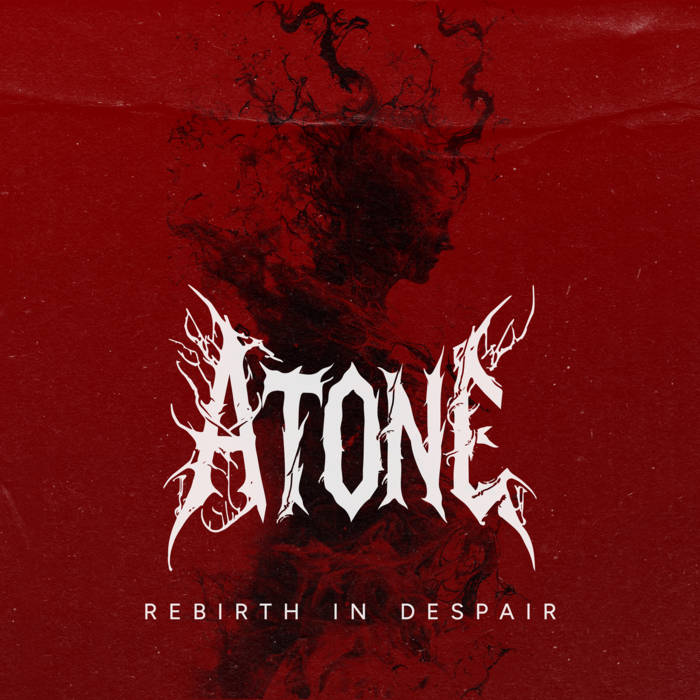
With Rebirth in Despair, Atone deliver a modern take on funeral doom in 2026, integrating contemporary genre eclecticism without compromising their identity. It is not revolutionary, but it is a remarkably confident consolidation.
Music
Majestic leads, elegiac synth layers that rise into the sacral-subtle tones of the obligatory organ, rasped vocals alternating with guttural growls, and generally slow, subtly dynamic drumming form the musical foundation. Yet the leads are not ornamental; contrary to early genre conventions, they are largely structural. They are not only sustained for long passages but act as the melodic framework itself. They are the anchor and the heart of the music. Whereas many classic funeral doom productions treat melody as an atmospheric layer, here it carries the form.
The synth layers do not simply overlay the music; they open the space upward—especially where the organ enters, shifting the soundscape from earthy weight to the sacred. This expansion is controlled, not overwhelming. The music does not rise above its heaviness; it stretches it vertically.
Similarly, the carefully placed blast passages are neither outbursts of aggression nor cracks in a monotonous wall. Musically, they are a clear commitment to dynamic contrast—brief intensifications within an otherwise sustained tempo. Conceptually, they signify the weight of endlessness: no break from the circle, but acceleration within it.
Atone do nothing entirely new to the genre, yet they do it with a quality that resonates beyond the small core scene. More majestic than Gravkväde, more harmonious than Nortt, and less effect-laden than Esoteric. Where Gravkväde wallows in darkness, Nortt seeks self-dissolution through monotony, and Esoteric drifts into psychedelic expanses, Atone gravitate toward grand guitar gestures. In this, they are closer to Evoken and Shape of Despair—but without female vocals.
“Eidolon’s Remnant” and “Living Ghosts in Shattered Dome” exemplify this approach: expansive melodic arcs, bright synth accents, occasional blast intensifications. The tracks are almost catchy—within the limits of the genre. Yet the album remains profoundly dark, heavy, and depressing. In its orientation, it recalls the debut of the Portuguese formation Carma or the mid-phase of Woebegone Obscured—without losing its own identity.
Circular Motion Instead of a Downward Spiral
Rebirth in Despair does not follow a linear descent. The five tracks form a coherent work-cycle of a “cynical vision of an endless loop of suffering and rebirth.” The album deliberately lingers. Brief moments of relief prevent monotony but do not break the state.
The tonal movement reflects this circularity. It evokes Auguste Rodin’s sculpture The Burghers of Calais: no heroic front, no center, no leader. The figures stand close together yet remain inwardly isolated, caught in a hesitant, almost aimless forward movement—as if a decision already made continues to revolve in the circle. The monument does not celebrate sacrifice but illustrates an existential suspension.
Similarly, “Rebirth” signifies not renewal but the continuation of a broken system. Rebirth as burden.
Eternal Recurrence Without Salvation
The lyrics touch on one side of Friedrich Nietzsche’s concept of eternal recurrence—but without affirmation. No Amor Fati. The circularity is formalized through repeated refrains, recurring motifs (spirals, sand, clockwork, architecture), and the absence of narrative development. Time appears not teleological, but as a loop.
The “Architect” is not a salvific figure but a cipher for structure. Meaning does not come from outside. Insight does not lead out. The world reproduces its own conditions, and the characters are aware of this—without gaining agency from it.
Motifs like “wires across where blood should flow” or “synthetic suns” move the album into posthuman alienation. The subject is no longer a humanistic whole but a fragmented, technologically penetrated residue. “Living ghosts” are not metaphors for the dead but a continuation without substance. Identity becomes a residual form—Eidolon’s remnant.
Here, the parallel to the series Dark is striking: a world in which suffering does not escalate but is cyclically stabilized. Rebirth is extension, not hope. The apocalypse is no longer an event but a constant state.
Conclusion
With Rebirth in Despair, Atone achieve something rare in funeral doom: an opening outward without sacrificing internal weight. The album is accessible without softening; melodic yet never tipping into pathos; dynamic without breaking the genre’s statics.
It is not a milestone that reinvents the genre. But it is a work that demonstrates its possibilities in concentrated form—as circular motion, not as a free fall. And therein lies its strength.