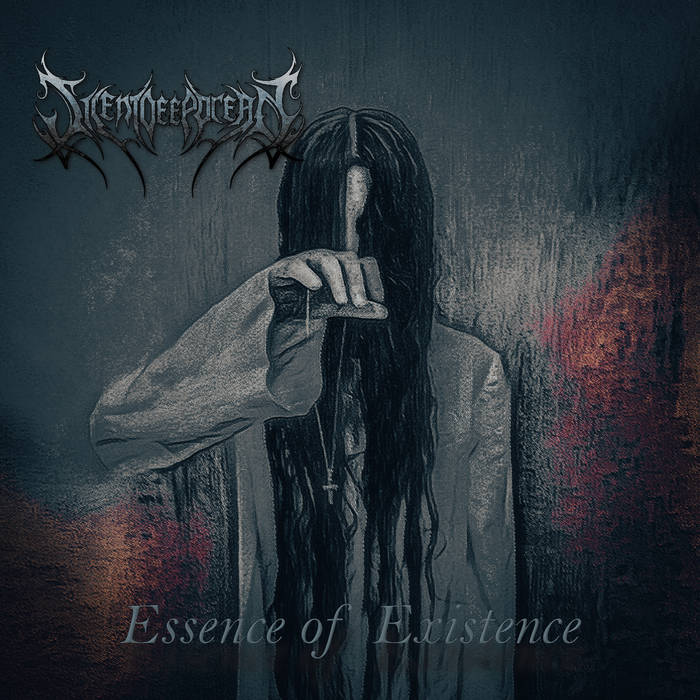
Between Pascal’s wager and Tillichian kenosis, Silent Deep Ocean craft with Essence of Existence a liturgical metaphysics of funeral doom — a musical contemplation on the “broken flesh” of existence that understands the abyss not as annihilation but as a site of radical, remembering presence.
Essence of Existence by Silent Deep Ocean is not a conventional concept album. It is a liturgy cast in sound, set within a fantastical world. The album articulates an eclectic funeral doom aesthetic in which the subject does not revolt against suffering but accepts it as a fundamental structure of the world — a musical contemplation of the tension between human experience and an indifferent universe.
The Liturgy of the Double Death
A common modern bon mot — often mistakenly attributed to Ernest Hemingway — claims that every person dies twice: once biologically and a second time when their name is spoken for the last time. In the vibrant Disney film Coco, this idea becomes the central motif: memory keeps the dead alive in a second mode of existence. When memory fades, that afterlife fades with it.
Essence of Existence follows a similar logic. Gregory Ritchey’s project unfolds a liturgy in nine movements in which redemption does not appear as triumph but memory as the final form of persistence. The album tells the fantastical story of Emberil, a guilty mage who plunges into the depths of the ocean and performs penance within an undersea brotherhood. Yet the myth functions less as escapism than as a defamiliarization of existential experience.
What emerges is a restorative ritual culture: the metaphysical shock of an indifferent world is not denied but symbolically domesticated. In Paul Tillich’s sense, the symbol opens a depth dimension of existence. The abyss of the “Silent Deep Ocean” thus becomes a cipher for the existential condition — a space of guilt, memory, and contemplation.
Communion of the Desolate Broken Flesh
Already the opening piece, Introit – Liturgy of the Desolate, marks this orientation. An Eastern Orthodox prayer is spoken by Tehina Spasova against a rushing, ominous sonic backdrop — listeners familiar with death industrial may recognize echoes of fragments from the work of Marco Corbelli as Kranivm.
“All my bodily sufferings and griefs of the soul I bear with patience as atonement for my sins.”
Here the human being appears not as a sovereign subject but as a broken creature suspended between misery and dignity. Blaise Pascal described this tension as the paradoxical condition of humanity between greatness and wretchedness — a perspective that permeates the entire album.
With In Abysso – Unum Sumus, the actual funeral doom begins. The track initially recalls the aesthetics of early 2000s bedroom funeral doom: wide synthesizer layers, heavy repetitive riffing, and growls that function more as part of the sonic mass than as a dominant expressive force. Bands like Until Death Overtakes Me or Nortt clearly stand as reference points.
The music works with minimalist means, yet precisely this reduction creates a liturgical atmosphere. As the piece unfolds, the sound modernizes: Tehina Spasova’s voice emerges — bright, sublime, elegiac — prominently placed in the mix, while the riffing retreats slightly and a lead guitar begins to sing. We descend deeper, falling through time. Ritchey’s rasping voice, reminiscent of Greg Chandler, intensifies the descent. Thus In Abysso – Unum Sumus unfolds an inevitable fall: “No death, no life — only existence among coral tombstones.”
Here the abyss appears not as annihilation but as initiation. Emberil’s fall becomes a moment of self-recognition — a movement strongly reminiscent of Tillich’s concept of the Courage to Be: existence asserts itself not despite the experience of non-being, but precisely in the face of it.
A poetic turning point of the album lies in the almost gothic-metal-like track Your Last Winter. The explicit reference to Emily Dickinson is not a decorative literary gesture. Dickinson’s “bird of hope” is forced into a dialogue. Spasova carries the fragile voice of memory, while Ritchey responds from the perspective of finitude.
Within a beauty-and-the-beast vocal exchange — over repetitive guitar strokes, elegant piano lines, and subtly jazzy drum figures — memory and loss wrestle with the looming silence of a world that will one day cease to speak. And yet hope asks for nothing. “It asked — nothing of me.” It remains — even in winter.
The vocal dialogue, reminiscent of Angels of Distress, the strongest work by Shape of Despair, quietly dismantles the religious instrumentalization of hope. Hope here is not an obligation but a subtle persistence. Pascal might have said: the heart has its reasons which reason does not know.
The following track, A Nameless Grave for a Dead Bird, introduced by fitting birdsong, radicalizes this motif. The burial is anonymous. No monument, no judgment, no trumpet call. “If God keeps census of the lost / This one escaped His pen.” The text approaches divine absence without collapsing into the genre’s habitual nihilism. Instead of religion, memory and nature assume the liturgical function. “Let the moss pronounce the Prayer.”
Moss, earth, and time become the officiants of a funeral that no longer possesses metaphysical guarantees. In Tillich’s terms, the courage to be appears once more: fragile existence is not saved by redemption but by fidelity in memory.
A massive sonic structure looms before the listener until a lead guitar allows hope to shine through. The piece gradually dissolves into a gentle sonic bed for an elegiac requiem sung by Spasova — a requiem that denies the dead any counter-world.
Burial loses its terror because it marks only the end of life, not the end of remembrance. “A life too slight for Judgement Day / Too true to die again.”
As the album unfolds, the liturgy becomes increasingly personal. In Icon of Sorrow, a mother figure appears as an archetypal icon of memory — not as a sacred saint but as the moral mirror of the self. “I loved her through the poison we became.” The male voice is nearly spoken, the female one gently whispered. Between guitar and piano, amid a sea of self-doubt and accusation, love for the maternal figure remains untouchable. The distorted image of the mother becomes a monument of conscience — a moral instance before which the self fails to live up to its own ideal.
Memory transforms relationships into symbolic images that contain both consolation and guilt. What emerges is not ritual comfort in the traditional sense but a contemplative engagement with loss.
The album ultimately moves through cold transcendence (The Realm Drifter) toward a realization in Prayers Before the Abyssolith. Against the cosmic background of transience, no triumphant redemption remains.
Before the Abyssolith — the monolithic symbol of eternity — faith appears only as assent without guarantee. The individual no longer stands before a personal grave but before the recognition of the eternity of non-being and the eternity of loss.
Here Ritchey celebrates a solemn atmospheric funeral doom that finds a moment of stillness in an elegiac interlude echoing the opening prayer. The broken subject of the beginning discovers a covenant in surrender — a transcendental experience of devotion.
The Wesleyan Covenant Prayer becomes decisive:
“Let me be full, let me be empty.”
This is radical surrender. No claim, no demand — only readiness.
Before the monolith, “voiceless, faceless, wordless,” faith becomes assent without guarantee. It is not triumphant but daring. Pascal would have spoken here of the wager: humanity exposes itself without proof.
And Emberil arrives at the central realization that even on mythological and cosmic scales, happiness lies in the memory of lost joy:
“Its runes carved within its flesh tell me of a time / When joy lay abound.”
In this “Communion of the Desolate” the album reaches its deepest sacred dimension. The motif of Broken Flesh functions as an inversion of the Eucharist. While the breaking of the body in Christian liturgy promises healing and communion with the divine, Silent Deep Ocean leaves only communion in suffering.
Yet here the circle closes with the Wesleyan Covenant Prayer. This prayer is an act of total kenosis — self-emptying. When it says “Let me be full, let me be empty,” this radical passivity corresponds directly with the image of broken flesh. The subject accepts its fragility not merely as passive fate but offers it as active devotion to the Ocean of Silence.
In Tillich’s sense, broken flesh becomes a symbol that opens the depth dimension of existence itself: only those willing to be completely broken can participate in this dark communion, which promises no consolation yet grants a final, unshakable belonging to Being — embodied in the Abyssolith.
Conclusion
The certainty of redemption never arrives. Essence of Existence does not end in resurrectional pathos but in presence — existence and memory as a continuation of the present.
This is not an escape into darkness. It is an attempt to endure a form of being within the darkness.
Thematically, the album remains theologically resonant, existentially honest, and literarily reflective.
Musically, Silent Deep Ocean largely operate within atmospheric funeral doom, recalling Shape of Despair or The Slow Death more than the monolithic austerity of Funeral. Yet this tradition of elegiac vocal interplay is enriched with sharper and darker elements: threatening strings, sacred organ textures, solemn fanfares, harsh riffs, and even a sampled prayer as an interlude.
Essence of Existence refuses to be a mere elegy of pure atmospheric funeral doom. Instead, it stands as a dynamic piece of modern funeral doom that understands its own tradition — and knows how to reshape it.
Emotion precedes virtuosity.
Atmosphere stands before technique.

One Response
Just discovered this album thanks to this review and I’m very glad I did. I’m absolutely absorbed by it.