Woebegone Obscured tells, with The Forestroamer, of a bitter, hateful, yet unnamed figure who devotes itself to renunciation and asceticism.
A Music of Seclusion
The music of Woebegone Obscured had, for this album, evolved into the perfection of an apocalyptic Funeral Doom. The Forestroamer is perhaps not coincidentally the endpoint of a band that has developed and alienated its style to such an extent that the former references to Black Metal remain perceptible, yet no longer in an aggressive-depressive form. Over the years, the style has organically transformed into an atmospherically progressive variant of Funeral Doom. The cold feeling of despair remained, yet the chaotic madness of the early albums was discarded.
Since Marrow of Dreams, the band has moved toward a more progressive overall sound reminiscent of a Funeral version of early Opeth. With The Forestroamer, Woebegone Obscured further increases the proportion of progressive structures. Deep growls and piercing screams stand in contrast to a plaintive, operatic clean vocal. Natalie Koskinen appears as a guest with an ethereal contribution. The rolling Doom Metal is guided into a gently progressive style through passages of ambient and folk. Subtle keyboard and guitar accents, carrying dark and depressive melodies and solos, unfold fluidly within the overall sound. Sound effects—particularly nature sounds, synthesizers, and guest vocals—expand this sonic space.
The Memory and the Thought begins with the cries of ravens, which lay themselves beneath the swiftly entering guitars, becoming part of the music and opening the path into the solitude of the forest. With light-footed guitar chords, the piece unfolds its immersive tone. Deep growls and thunderous riffing alternate organically with subtly folkish, at times jazz-inflected progressive and ambient passages, operatic clean vocals, as well as the distant murmur of Natalie Koskinen.
Surprisingly dynamic for Funeral Doom, the music unfolds a sublimely epic atmosphere. The guitar work moves between slow, melancholic grooves with progressive undertones and powerful riffs, with a distinctive lead guitar shaping the sound. The guest vocals, keyboard work, as well as the sampling of crow calls, flowing water, and footsteps on forest ground intensify both the atmosphere and the dynamic impact of the music.
Closing with the sound of footsteps on a forest path and opening with raven calls, the album frames its own movement: entry into and departure from nature. In between, it carries the pain and sorrow of a separation from it.
The music becomes an evocative metaphor for mountains, winds, and fog. Despite its intensity, the piece feels hazy and introspective, conveying the atmosphere of a solitary forest at dawn. Airy guitars, melodic bass, as well as ambient and natural sounds form a tactile soundscape, while death growls, black metal shouts, and brief clean passages provide contrast. Particularly striking are the shifts between heavy, doom-laden sections and quiet, ambient-like passages, as well as the progressive variations in tempo.
The listener enters a new sonic cosmos and flees into the solitude of nature without romanticizing it. There, one encounters a primal force in which the postmodern human being can only remain a guest.
Asceticism of the Mind
“I went to the woods because I wished to live deliberately, to front only the essential facts of life, and see if I could not learn what it had to teach, and not, when I came to die, discover that I had not lived. I did not wish to live what was not life, living is so dear; nor did I wish to practice resignation, unless it was quite necessary. I wanted to live deep and suck out all the marrow of life, to live so sturdily and Spartan-like as to put to rout all that was not life, to cut a broad swath and shave close, to drive life into a corner, and reduce it to its lowest terms, and, if it proved to be mean, why then to get the whole and genuine meanness of it, and publish its meanness to the world; or if it were sublime, to know it by experience, and be able to give a true account of it in my next excursion.”
(Henry David Thoreau)
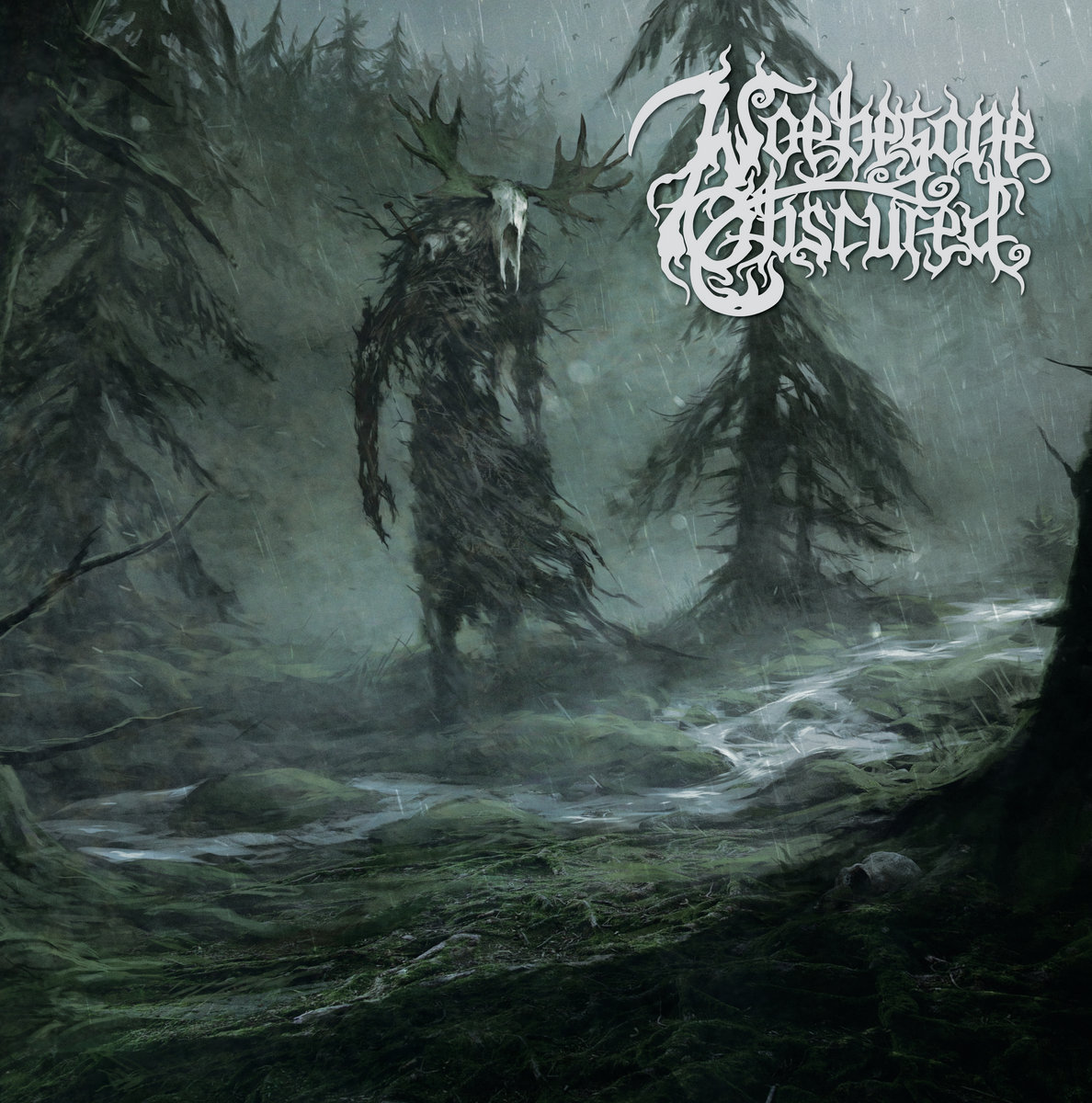
The cover suggests an interpretation between mythological figures such as Herne the Hunter and Cernunnos, yet resists a clear attribution. The figure remains a vague image. In this, a dual reading emerges: on the one hand as an archetype of the primordial fear of nature, on the other as an expression of the human longing for connection with it.
Schopenhauer emphasized this dual nature of the natural world, which can offer consolation through sublime calm, yet at the same time may annihilate the human being as an impersonal and indifferent force.
The Forestroamer created by Woebegone Obscured is a figure that, in turning away from society, devotes itself to isolation. Here, an association with Ernst Jünger’s Waldgänger suggests itself, without implying any ideological proximity. While Jünger’s figure is politically charged, the Forestroamer remains free of any programmatic orientation. Isolation here is not a means, but the endpoint of a movement into the self.
Danny Woe explained in a personal conversation that he was not familiar with Jünger’s writings. Instead, the album is closely tied to his own self-therapeutic practice, in which he sought retreat into nature during phases of insomnia and used psychotropic mushrooms as a means of introspective processing. A field of experience he explored even more intensively in the subsequent project Funeral Chasm.
On The Forestroamer, the retreat into nature becomes an attempt to understand the self in confrontation with fundamental instincts—Eros and Thanatos. While the worn-out mind regards society with suspicion, it seeks, in the depths of the forest, a form of purity and a punctum-experience in the presence of nature.
The forest becomes a space of transformation, in which the figure first confronts its fear of nature, passes through it, and ultimately translates it into a form of acceptance.
Forest at Night
Drømmefald moves deeper into the nocturnal forest. The piece unfolds in a dark, dreamlike, and tension-laden manner. The still airy, light progressive guitar melodies do not stand in opposition to the weight of Funeral Doom riffs—they interlock.
A death metal passage at around seven minutes dissolves into an airy folk/prog/jazz passage. Hypnotic bass lines, string-like synths, and double-bass drumming form a kind of wandering. The interplay of expressive Danish clean vocals and guttural growls reinforces the atmosphere. A monumental bass solo adds further narrative weight in a Funeral Doom context.
The delicate instrumental Crimson Echoes creates, with minimal means (guitar, synth, sound effects, voice), a melancholic transitional mood leading into the title track. The Forestroamer unfolds epically, darkly, and introspectively over twelve minutes. Layers of heavy riffing are set against gentle folk guitar lines, threatening synths against inviting, deliberate drum patterns, and forward-driving blast beats.
Danny Woe’s here seemingly furious growls and shouts, alongside his plaintive operatic clean vocals, are contrasted by the ethereal voice of Natalie Koskinen. The piece thus remains in constant flux, like nocturnal tides. The dynamic interplay between a biting Doom Metal force and expansive ambient passages generates a spatially vast dramatic arc. In the end, the primal fear dissolves, and what remains is a warning withdrawal from society and a lament for human life within civilization.
“Nothing but the dark to live for
Dwell in the darkest Woods
Live on a thousand Seasons
Fear my black heart.”
(Dormant in the Black Woods)
This melancholic, calming piece of just under five and a half minutes features exclusively clean vocals and begins with audible footsteps on forest ground. Guitars, keys, and minimal percussion create a reflective, emotional conclusion shaped by shoegaze and progressive doom elements.
Forgetfulness of Being
Here, another dimension emerges: the parallel to Heidegger’s concept of the forgetfulness of Being. The retreat into nature and the isolation of the Forestroamer can be read as a conscious choice against a technologized and alienating society. The dark forests become a space in which Being itself is sought.
In reference to Heidegger, the Forestroamer attempts, through solitude and inwardness, to detach from the alienating structures of society and to attain authenticity.
The dark forest of the Forestroamer is a space of conscious social renunciation and confrontation with both nature and the self, conceptually close to Jung’s confrontation with the shadow, Schopenhauer’s ascetic denial of the will, and Heidegger’s turning away from alienation. It is a dark, introspective journey that culminates in self-becoming through the experience of darkness. Through the overcoming of the primal fear of nature, the archetypal Forestroamer arrives at the acceptance of a life beyond society.
The isolation of the Forestroamer is not mere withdrawal, but detachment. In the confrontation with an unavailable nature, a tension emerges that is not resolved.
Thus, Woebegone Obscured creates a manifestation of the ambivalence between fear of nature and longing for it. In this way, The Forestroamer appears as an adult, or at least adolescent, work that addresses the self between superego and id, grasping it in its inner division as a whole.