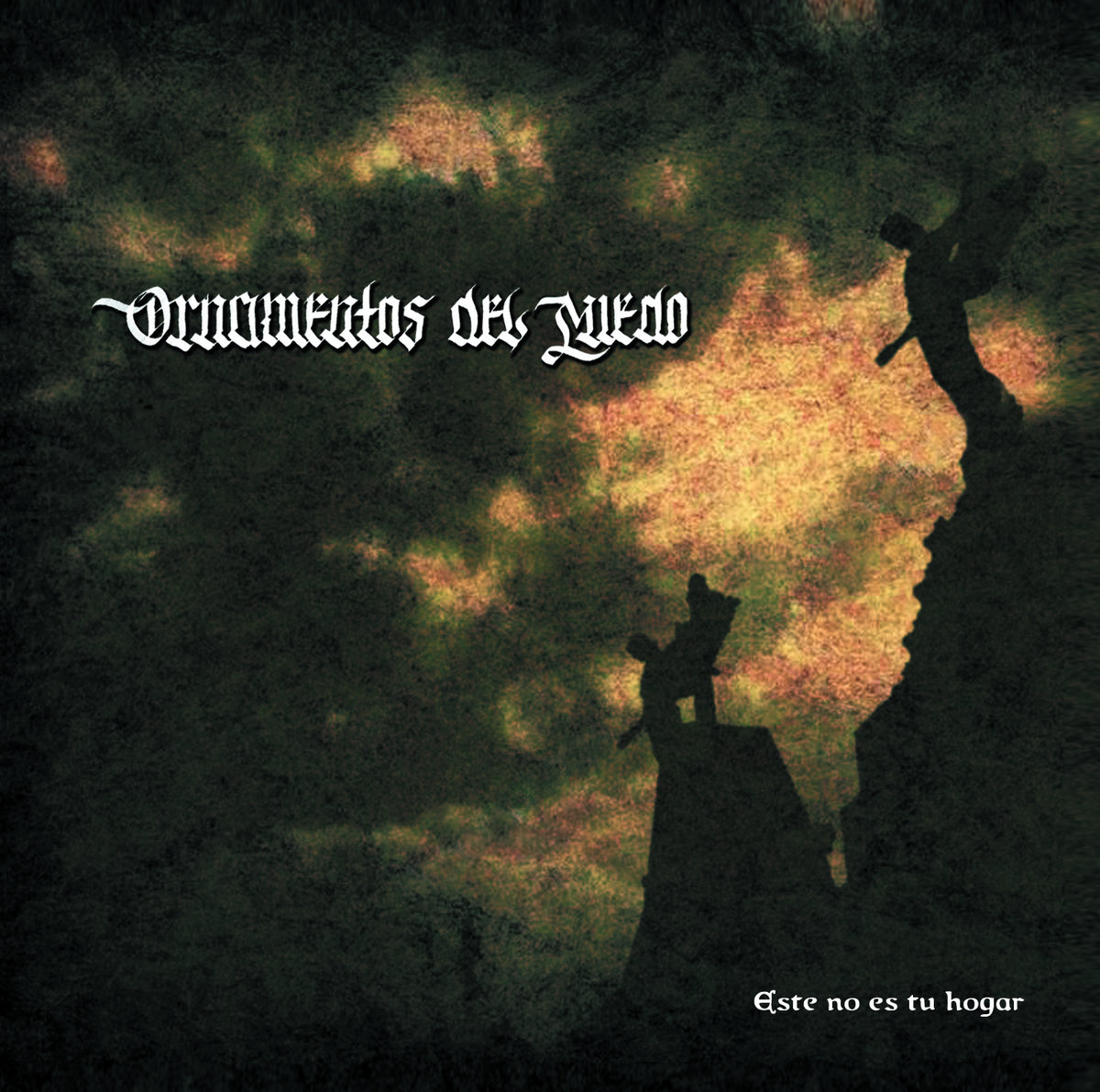
The solo project of Spanish musician Angel Chicote, Ornamentos del Miedo (Ornaments of Fear), was initiated, according to his own statement, in order to “remove all the ornaments and illusions that we have created out of fear and that serve to adapt us to our miserable existence.” Although this fundamental idea reflects a more confrontational stance, the music he plays is less extreme than that of the radically Satanist-nihilistic project Nortt.
The 2019 debut album Este no es tu Hogar does not follow the ideas of Depressive Black Funeral Doom. Instead, Chicote creates a painfully elegiac and atmospheric form of Funeral Doom with songs in Spanish. The conceptual and ideological approach is based on an anticosmic view of being. In accordance with this concept, the album is an approximately hour-long lament for earthly existence, combined with a longing for the absolute dissolution of being.
The Concept: Returning Home to Nothingness
The album title Este no es tu Hogar (This Is Not Your Home) already negates humanity’s attachment to existence and portrays life as a state of alienation. Death, by contrast, appears as a return to a more primordial state.
In the variant of anticosmic thought employed by Chicote, space and time were torn from the Eternal, the Boundless, and the Infinite by an all-powerful being. The act of creation therefore does not appear as the bringing forth of order and life, but as an act of limitation and enslavement. Part of the primordial chaos is torn from its boundless existence and forced into the order of creation. Creation itself thus becomes a prison. In this sense, freedom does not consist in shaping one’s own life within the given order, but in detaching oneself from all norms and values bound to creation and ultimately in abolishing being itself. Death, in this conception, is not merely the end of life, but the negation of the act of creation and thus the possibility of returning to a state preceding separation, limitation, and individualization.
In the cosmological conception underlying the work of Ornamentos del Miedo, a variant of anticosmic Chaos Gnosticism, structural parallels can be discerned with the concept of Tzimtzum, an idea in Kabbalistic teaching according to which the all-encompassing God creates space for creation through a deliberate act of self-limitation. In Lurianic Kabbalah, the infinite En Sof contracts into itself, thereby creating a free, empty space in which creation becomes possible at all. Karl Erich Grözinger describes this process on the basis of the tradition of the Sefer Ez Hajjim:
“And when it arose in His simple will to create the worlds and emanate the emanations, in order thereby to make known the perfection of His works, His names and His attributes, which was the reason for the creation of the worlds…, then the En Sof contracted itself at the central point, truly in the center of its light. Thus a free space remained around the central point, an empty, hollow space… This contraction (Tzimtzum) was of absolute equality all around the empty center, so that the empty space had the form of a perfect spherical sphere… because the En Sof had contracted itself inward from all surrounding sides in the form of a perfect sphere. The reason for this was that the light of the En Sof is of perfect absolute equality.”
The anticosmic perspective formulated by Chicote effectively reverses this logic. Where the Tzimtzum creates the precondition for creation, in Ornamentos del Miedo creation itself becomes the problem. Created space is not the place where freedom can be realized, but the sphere of limitation. The return to the Boundless consequently becomes liberation from an existence that already contains its own imprisonment. The album’s longing for death therefore arises not solely from a contempt for life, but from a metaphysical rejection of separation from the primordial state. Nothingness becomes the counterpart of creation and thus the site of an imagined perfect harmony.
At this point, Ornamentos del Miedo connects with Nortt and his romantically erotic conception of dying. Chicote establishes this connection already in the opening title track, describing death as the true home, whereas life is merely a cold and confusing place:
“Death is our home
Life is a cold and strange place.”
The project’s central message is developed further in Ornamentos del Miedo, where the universe is portrayed as deception and the cosmos as tearful torment.
“They cover their true face and adorn it
Universe of deception, cosmos of tears
Illusion is the door that closes the prison.”
Illusion thus becomes the mechanism of imprisonment itself. Life appears as a state whose promises of happiness and meaning merely conceal the actual nature of existence. Suffering becomes the fundamental condition of life, perpetuated across generations, while only its end opens up the possibility of definitive freedom.
With the track Raices podridas, this nihilistic perspective is complemented by an examination of human desire and striving that bears clear parallels to the philosophy of Schopenhauer. The final attachment to life appears as a fragile collection of desires and memories, combined with the irrational, deceptive, and naïve hope that life might somehow offer something different in the distant future. This is precisely where the connection to Schopenhauer’s conception of the will becomes apparent. The individual clings to an existence that it continually reproduces through its desires, even though this very striving constitutes the source of its suffering. Hope for later fulfillment prolongs the condition rather than overcoming it. In Raices podridas, clinging to life therefore becomes itself an expression of imprisonment.
The Music: Love Songs to Nothingness
Musically, the album moves between stripped-down Evoken and Doom:VS and the less oppressive Lone Wanderer and Mournful Congregation. In addition to these points of comparison, it should be noted that Chicote’s solo project displays somewhat weaker songwriting. The focus of his music lies in the contrast between the lead guitar and the heavy foundation beneath it. Whereas the aforementioned acts vary their playing through dynamic shifts and occasional reductions in instrumentation, Ornamentos del Miedo is more consistent and concentrated.
Like Nortt, Chicote uses music as a vehicle for his artistic idea. Ornamentos del Miedo moves through a form of Funeral Doom that lies somewhere between tragic elegy for existence and the poisonous darkness of hatred for the world. Chicote slowly and majestically conveys the misery of being to his listeners. The brief light radiating from the bright lead guitar is continually captured and confined by the monotonously rolling walls of riffs and minimalist drum figures. The music thus translates its cosmological conception directly into sound. The light is present, but it cannot unfold. It is enclosed by the weight of the music and forced into the same imprisonment that the album attributes to life itself. One possible reading, then, is to recognize the trapped light in the bright lead guitar. Another would be to hear in the majestic playing precisely the Schopenhauerian will that binds human beings to existence and thus to the slowly creeping wall of riffs. A third possibility, finally, would be to recognize in this tension the musical creation of beauty from the longing for one’s own dissolution.
The occasional reduction in instrumentation, the vocals, usually echoing deep in the background and fighting against the crushing force of the music with a distinctly black-metal character, and the cold trembling of the keyboard textures create an atmosphere that accompanies the mind’s lingering between the misery of existence and the hope for redemption. Yet Ornamentos del Miedo remains far removed from Nortt’s oppressive depth. Chicote employs an atmospheric and less slow form of Funeral Doom to reinforce his love letter to nothingness. It is precisely this atmospheric openness that distinguishes his music from Nortt’s radical reductionism. Where Nortt almost completely encloses the listener within the blackness of his sonic world, Chicote repeatedly allows light, melody, and harmony to pass through the mass of sound.
The lead guitar, shining like light, delicate keyboard passages, or isolated drum patterns in particular create, in contrast to the painfully bitter vocals, a sense of harmony, redemption, and eternity. These moments do not merely serve as aesthetic relief. Within the music, they embody the promise of the state demanded by the lyrics. Nothingness does not appear as mere emptiness. It offers peace, harmony, and the final abolition of separation. The music creates beauty out of the longing for its own dissolution, providing a third way of interpreting the sound.
The remainder of the music is a storming maelstrom that mixes chaos in overwhelming abundance with monotony. The music tears and pulls at the body, pushing and drawing at the same time, practically throwing and whirling the listener through life along empty streets that in Caminos Perdidos consistently lead nowhere. It is precisely in this combination of movement and stasis that the conception of an imprisoned existence becomes musically tangible. The music seems to move forward, yet repeatedly returns to its heavy and monotonous fundamental movements. The listener moves without arriving. The paths exist, but they lead nowhere.
The Conclusion: Beyond Existence
Thus Este no es tu Hogar becomes more than an album about death and despair. The music develops a coherent aesthetic conception in which existence itself appears as alienation, limitation, and imprisonment, while nothingness becomes its counterpart. The longing for death is not merely an expression of an individual desire for an end, but part of a cosmological reversal:
Death is not the catastrophe – Creation is.
Life becomes exile and nothingness becomes home. This is precisely what gives the music its peculiar ambivalence. It describes existence as unbearable, yet within this negation it repeatedly creates moments of beauty, warmth, and harmony. The supposed nothingness is thereby aesthetically charged with meaning. Ornamentos del Miedo therefore does not convey a mere love of death, but a love letter to an imagined state beyond suffering, limitation, and individuality. And in doing so, the album touches upon an idea that is also significant for the tension between Sigmund Freud and Erich Fromm, Eros and Thanatos. If the human desire for destruction and dissolution of existence, Thanatos, is not understood as a natural death drive but as a reaction to an existence experienced as alienating, the question arises whether the longing for death articulated in Funeral Doom is actually directed at death itself. Perhaps it is directed instead against a particular form of life, one experienced as unnatural and wrong. In Ornamentos del Miedo, this negation is carried to its metaphysical endpoint: it is not merely social order, not the human body, and not even individual consciousness that are to be overcome. What is to be overcome is separation itself, the separation that constitutes being as individual, limited, and suffering existence in the first place. Ultimately, the negation is therefore directed against being itself. It is in this radical consequence that one of the most interesting philosophical dimensions of Funeral Doom lies.