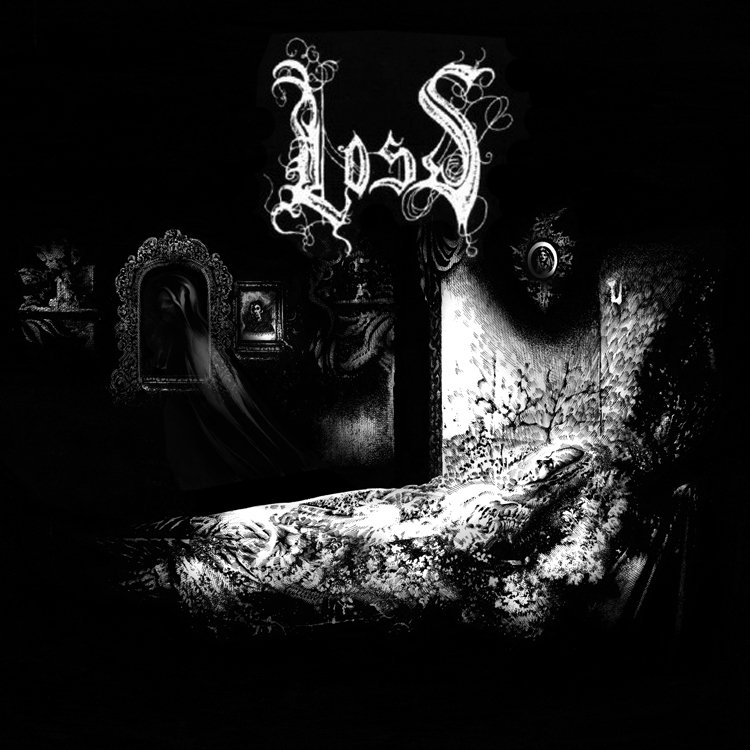
Despond by Loss is a product at the crossroads between depression and suicide: a total negation, a radical rejection of social life, and a requiem for metaphysical existence; and at the same time, as contradictory as it may sound, an offer of togetherness within the exhaustion of life.
Despond as Suicide Soundtrack
Despond is entirely devoid of aggression. The music unfolds as a dark, crawling Funeral Doom featuring cavernous growls, firmly rooted in the tradition of Thergothon, Skepticism, Evoken, and Nortt. Its atmosphere spans from grim despair to a profound, suicidal depression. Heavily distorted, down-tuned guitars alternate with fragile clean passages, where suffocating riffing amplifies the emotional weight of embedded melodies. All the while, the muted drumming acts as the calm, gradually fading pulse of the album.
Considered as a requiem and an absolute expression of depressive suicidality, the sorrowful music – especially the tender and sluggish acoustic guitar work – is consistently aligned with fatalistic pain. Self-revelatory lyrics and the depiction of an existential emptiness find their exact counterpart in dark ambient fragments and tragic blues leads. The vocals, deeply growled and rasping, convey the suffocating agony demanded by the lyrics of self-harm, depression, and dying.
“Death awaits you / What are you waiting for?”
(Conceptual Funeralism Unto The Final Act (Of Being))
Thus, Despond begins with the depicted struggle of a lyrical “you” with itself:
“You sat alone / You sat so long / Your words make very private scars / You suffered down low / And you saw no light / Made knots of your fingers / While weathering the blight.”
(Weathering the Blight)
And the album ends with an invitation addressed to the lyrical self: to surrender to the waiting death.
“If you saw the darkness before death / Life fading before its last breath / Then you would know / If you saw life without hope, death without reason / Then you would know // Then you would know / The meaning of fear / Watching them live is killing me / Living on my time / Self-sacrifice / Worth the loss of life.”
(Shallow Pulse)
Between this initial contemplation and the final invitation lie eight further tracks testifying exclusively to the suffering of life and the longing for death, devoid of petty conflicts or accusations.
Despond as a Biophilic Project
Lyrically and musically, Despond forms a radical suicide soundtrack. The term carries a rich history: from Nico to Leonard Cohen, popular music devoted to the proximity of death has long worn this label. Despond radicalizes this tradition into an existential boundary experience. In a cybernetic society where the social role of the individual dictates the self, the self vehemently resists this accommodation—this reduction and reification. It is at this exact intersection that Loss operates: utilizing the longing for death as the ultimate desire to escape persistent external definition and determination.
Despite its thematic proximity to Depressive Suicidal Black Metal (DSBM), Despond stands apart from the genre. While DSBM often emerges from a youthful identity crisis and processes social pressure through public self-harm, autobiographical angst, and an aesthetic of self-staging, Despond shifts focus away from the search for identity toward the fundamental failure of the self before existence itself:
It is a biophilic project under suicidal premises.
Free from adolescent identity formation or the search for higher meaning, Despond is not necrophilic in the Frommian sense. A necrophilic aesthetic would transform the dead, the rigid, and the mechanical into objects of love. Despond does not do this: it mourns the living rather than glorifying their end. Rather than celebrating destruction, it represents the tragic reaction of a biophilic individual failing to transcend the banal reality of merely sustaining life.
The rejection of the drive toward life and the despair of an irreconcilable humanity are interpreted through the album’s inner logic as a moral absolution of the self. Suicide becomes an act of radical liberation, relieving the self from the burden of forced meaning. Schopenhauer’s negation of the will and Thacker’s acceptance of the void function as a moral defense against the logic of Foucault’s biopower. While Schopenhauer and Thacker ground negation metaphysically, Loss simultaneously locates it socially: as a refusal of a biopolitical framework that reduces human life to an administrative task.
By rejecting the assumption that life possesses an inherent purpose, and by accepting emptiness as an unavoidable truth, the individual is liberated from existential demands. In this detachment, a paradoxical freedom emerges: Loss transforms the explanation of survival into a quiet, actuarial audit of mere existence.
Despond as an Offer of Togetherness
Despond rejects adolescent anger and offers no answers or consolation for life’s disturbances. It provides purely subjective insights into a personal hell without claiming universal truth, yet achieves universal emotional accessibility. Loss rejects universal validity by formulating the subjective as an isolated horizon of understanding: one that cannot be fully grasped even by the lyrical “you”.
The offer of togetherness hinted at in the beginning is thus fulfilled: as a consistent presentation of a symbolic suicide that simultaneously provides an experience of transcendence, a universally accessible substitute action emerges. Within the cathartic nature of the album and the revelation of shared vulnerability lies the potential to break through felt isolation – drawing solidarity directly from the shared weight of human suffering.