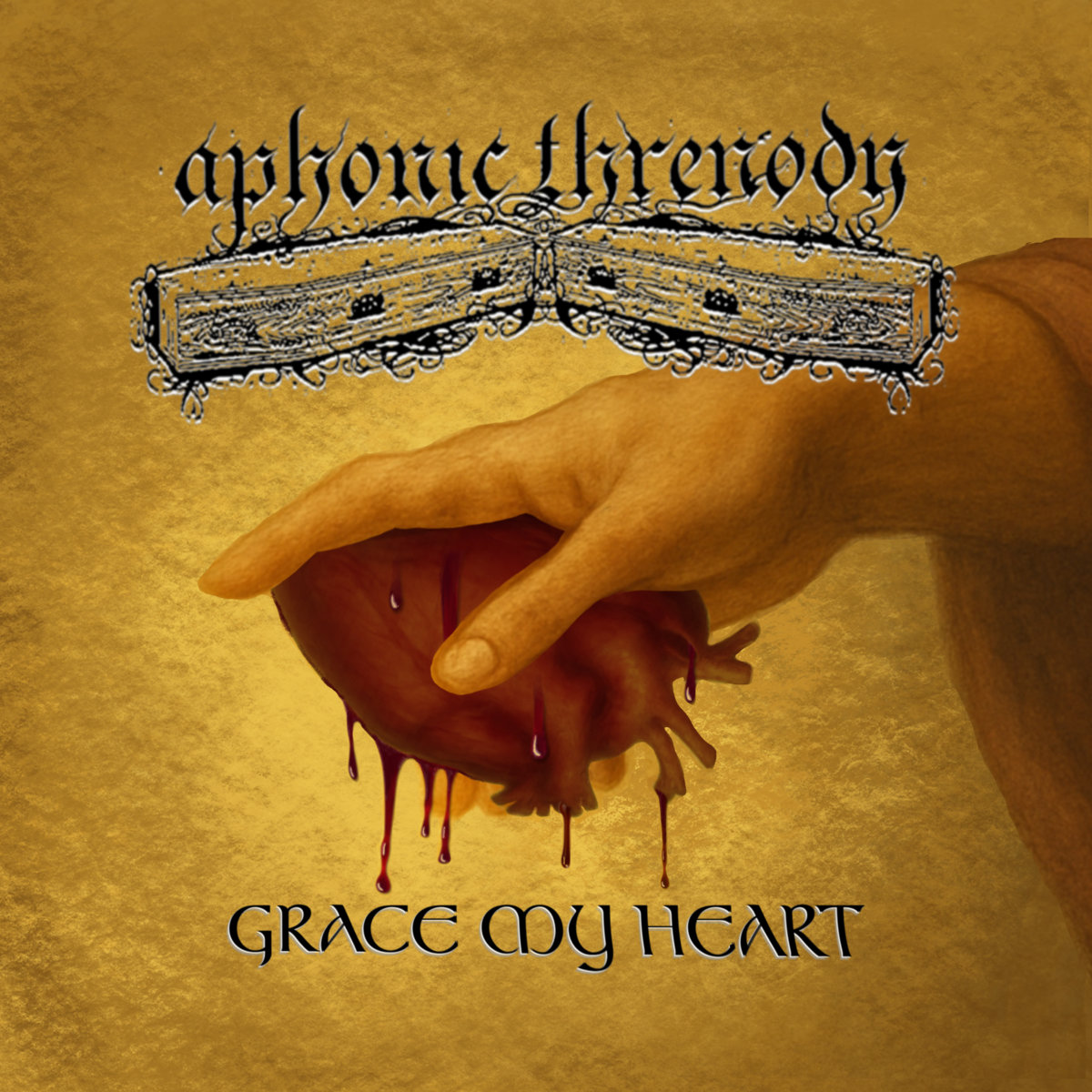
Aphonic Threnody have taken a step further with Grace My Heart. Since the last album A Silence too Old, the band appears to be walking a path of change without abandoning their musical identity. The heavy, death doom infused Funeral Doom of their earlier releases has increasingly become an elegiac hybrid of Funeral Doom and Gothic Doom. A particular strength lies in the dynamic interplay. Voices, harmonies, rhythms: everything builds itself up in contrast to one another, without slipping into the fast slow and loud quiet gimmickry of Post Metal. In its vocal dramaturgy, Aphonic Threnody moves close to acts like Shape of Despair or The Slow Death, and through Déhà’s vocals in particular possesses a distinctiveness that sets it apart from many comparable formations. His voice ranges from growling to rough, deep and heavy, to clear, to shrill, pained screams, to the point where one might point to the album Human Antithesis by Void of Silence, with Alan Averill on the mic, as a reference. Déhà manages to lament, to plead, to narrate and to seem vulnerable. Together with the further voices of Delora Ingrid and Gévaudan, this creates not a mere beauty and the beast contrast between an abyssal growling male voice and an ethereal female one, but a dialogue in which different states of loss and pain become audible.
Across eight songs at around 66 minutes, none of which reaches eleven minutes, the band is more song oriented than in the past. The pieces possess forms that are more distinguishable from one another and feel like individual stations of a journey. The album is less a state than a process. It is not the stasis typical of Funeral Doom.
Here, the path through the collection of different voices matters, because Grace My Heart does not only take a musical step beyond its predecessor, A Silence Too Old. That album was, at its core, a memento mori. It confronted the human being with finitude and suffering, and found its dignity less in redemption than in the willingness to endure suffering as part of human existence. A Silence Too Old could be read as close to a Schopenhauerian stance in which the world promises no redemption, because suffering is not a temporary disturbance but a fundamental condition of existence. Grace My Heart remains faithful to this darkness, inherent to Aphonic Threnody, yet it nuances the perspective. It is no longer primarily about the pain of existence, but about the pain of having to keep existing after a loss. The metaphysical vacuum of the predecessor becomes the psychological space of identity loss. Death is not merely a universal certainty affecting every human being. It becomes concrete. Someone is missing. A relationship has vanished. A voice no longer answers. A shared world no longer exists in the same form. And with that, the subject who experiences this loss also changes.
The concept: the reconstruction of the self
“A promise to heal through pain
A promise to bear through loss”
(A Promise)
The album’s eight songs are not only stations of a journey; the tracklist itself forms a development. The opening song places the immediate loss and the plea for grace at its center. Blood of Gods leads into the border zone between memory and death. And Solace I Did Not Find searches in vain for transcendent redemption. Destroy Your Will to Die sets continued existence in the other against the death wish. Hooded Claw rebels against a divine order that does not explain the pain. Why Did You Go brings back the very concrete experience of incompleteness. A Promise formulates explicitly enduring the loss. And My Fire Will Live Eternally finally ends at passing on and continuity.
Grace My Heart touches an insight from modern grief psychology. Robert A. Neimeyer’s constructivist understanding of grief regards loss not merely as emotional pain, but as a disruption of one’s personal world of meaning. The loss of an important person can destabilize one’s prior self narrative and require a reconstruction of meaning and identity. Meaning making and identity change are among the central processes of this reconstruction.
This can be read as the subject matter of Grace My Heart, even without assuming that Riccardo and his current collaborators would need to know the theory; they grasp it:
Grief does not apply exclusively to the person who was lost. It applies to the self that existed in relation to that person. The self is never entirely independent of its relationships. We are also who we were for other people, those who, through their presence, held certain roles, hopes, memories, and visions of the future. When a significant other disappears, part of the self’s prior present therefore also disappears. Grief, in this sense, is not only the experience of having lost someone. It is the experience of no longer being able to be exactly who one was before. Grief is always also the process of a lost self. It is not the reconstruction of a self, but the path out of the trauma of destruction and into deconstruction. A path into a new facet of a self, a self of the surviving void of a past we.
(Oh damn Riccardo, if you knew how much this album is hitting a sore spot right now. Thank you)
Already in the opening title track, this state is formulated. The lyrical I believes it has mistaken grief for love, has kept the remnants of the lost person, and does not know how the person who is gone could go on living without its own presence. It is not only the dead who is missing; the survivor also lacks the ability to find themselves again in the old relationship.
The self of the we was destroyed in the vanishing of the other.
In Why Did You Go, the experience of one’s own incompleteness through loss is named concretely: “Incomplete, I wander, lost, aimless.” The world continues to exist, yet for the lyrical I it no longer holds the same meaning. People can take part in a world of joys. But for the grieving, this being has lost its self evidence. This can be understood as the psychological core of the album: loss changes the meaning of the present.
That explains why Grace My Heart, despite its extreme heaviness, feels less like a pure album of despair than the band’s earlier releases. The music remains monumental, slow, sacral, and painful, but it possesses a different direction. The band itself describes the album as a work about endurance, and about how grief can become grace when one allows it to stay. This notion is remarkably close to modern grief models, which do not assume a linear overcoming of loss. Not repressing the pain, but integrating it as part of one’s own being.
This is a path rarely handled as skillfully in popular culture. Many products of pop culture either celebrate pain and perpetuate it, or show paths of repression toward a new beginning. An integration of grief’s pain as strong as that in Grace My Heart can be found in the horror film The Babadook. There too, by the end, the confrontation with loss remains part of the protagonists’ lived reality. Here as there, life with the awareness of loss results as actual being.
Stroebe and Schut’s Dual Process Model describes grief as an oscillation between loss oriented and restoration oriented processing. The grieving person confronts the loss, but also repeatedly withdraws from it in order to engage with the changed reality of life. Adaptation arises precisely from this movement. The Babadook shows the path into this movement, out of repression. Grace My Heart, by contrast, can be understood as the musical equivalent of a lived process. It repeatedly sinks completely into death, memory, guilt, and longing, yet just as regularly finds itself back at a point where the question is no longer what was lost, but how the self can go on existing with this loss.
And a piece like Destroy Your Will to Die expresses this ambivalence particularly clearly. The lyrical I stands at the beloved’s grave and initially asks for release through death. At the same time, the decisive appeal at the end reads: “Wake up, my love, destroy your will to die / For I live in you, and I’ll die with you.” The line is so powerful because it dissolves the boundary between the deceased and the survivor. The dead woman is not simply gone. She continues to exist within the survivor, while he has, at the same time, lost part of his old self along with her.
With this, the album touches a second important concept from modern grief research: the so called Continuing Bonds. Grief does not necessarily require dissolving the inner relationship to the deceased. A persisting bond can instead be part of a successful adaptation to loss. What matters is not whether the relationship continues, but what form it takes and whether it leaves room for going on living.
This is how My Fire Will Live Eternally gains its significance as the album’s closing point. Here, the loss is not undone. The dying person says farewell and, at the same time, declares that their knowledge, their scars, their love, and their inner strength will live on in their children. This is not a Christian notion of redemption, nor a claim to personal immortality. It is a psychological form of continuity. The deceased remains part of the identity of those who were connected to them. It is the integration of grief, the deconstruction of the self.
The religious backdrop of grace
This makes the title Grace My Heart less religious than it appears at first glance. Grace here does not mean being saved by God. It lies in accepting that one’s lost counterpart will not return, and yet does not vanish from one’s inner world. Grief need not be healed by forgetting. It can change by transforming the relationship to the lost person into another form.
Accordingly, the album’s religious imagery is ambivalent. In And Solace I Did Not Find, the path to the altar does not lead to unambiguous redemption. The wish for rest remains bound to death. In Hooded Claw, the religious order is finally openly rejected. The outcast reject the claimed divine love and declare themselves opponents of that order. And in Grace My Heart itself, the supposed saving instance appears by no means clearly as a redeeming force. It promises salvation while simultaneously naming the soul as an object of its own obsession.
The album’s sacred quality should therefore not be mistaken for comfort. Rather, it describes the magnitude of the loss. The religious imagery gives grief a cosmic dimension without dissolving it metaphysically. Aphonic Threnody remain faithful to a fundamental skepticism toward easy answers. God, like death, is not accepted as a form of redemption. The very idea of redemption remains problematic; here the circle closes back to the predecessor. This makes Blood of Gods an important piece on the album. The crossing of the Styx becomes a metaphor for movement into the interior of one’s own grief. The voice warns against diving into the sea, because the attempt to sink completely into pain would carry destructive consequences. In Blood of Gods, death appears less as a longed for goal than as the danger of fully sinking into grief. Again, the movement between loss and going on living emerges, the same movement the Dual Process Model describes. The grieving person must expose themselves to the loss, but must not disappear completely into it.
The music: tides of grief
Musically, this ambivalence is reinforced by the growing importance of different voices. Funeral Doom traditionally uses the voice often as an extension of its instrumentation. The growl remains deep, physical, and anonymous. It embodies an instrumental heaviness that, in extreme cases, can hardly be distinguished from noise and drone.
On Grace My Heart, however, this function shows itself expanded. Already the predecessor drew on a vocal variety that has, for some years, been characteristic of the Apocalyptic Funeral Doom subgenre (Woebegone Obscured, Solemn They Await, Omination). Here, this idea is pushed to its extreme. At times, Déhà’s voice still seems to function as part of the monolithic guitar walls. Yet his singing does not remain limited to that; rather, he draws on a broad repertoire of singing, guttural, and clear vocal techniques. And together with the other voices, a multivocality emerges that supports the record’s psychological character. Delora Ingrid appears as an ethereal counterfoil in the best Natalie Koskinen manner, while Gévaudan offers a venomous black metal shrieking. Loss is not told by a single voice. It is negotiated between voices and the instruments, this time played entirely by Riccardo Veronese.
Despite all closeness to Shape of Despair or The Slow Death, the shift between voices is not merely the counter color to the growl, nor is the growl merely the dark counterpart to the clear vocals. Aphonic Threnody does not use vocal dynamics as good versus evil, grief versus spirit, angel versus demon, beauty versus beast. The sides can embody different perspectives of the same grieving process. That makes the vocal interplay a narrative instrument.
Grace My Heart does not turn Funeral Doom into a less heavy style, but into a more mobile one. The music remains slow, monumental, and crushing, yet within this heaviness, openings emerge: melodic guitars, piano, fragile clean vocals, choirs, and increasingly differentiated vocal exchanges. A step already visible on the predecessor, but taken here a degree further still. The music moves like the lyrical I itself. It sinks into loss, finds distance for a moment, remembers, feels its way forward, and is then caught again by the heaviness. An organic process perhaps best compared to a play of tides, which likely comes closest to the emotional truth of a grieving process.
Hooded Claw seems to be a particularly good example of this. The song works heavily with growls, melodic guitars, and only sporadically deployed clean vocals. Notable is the elegance of the guitar playing, while the monolithic sound, after about four minutes, gives the impression of swallowing time and space entirely. Here, the clean vocals do not appear as a permanent counter model to the heaviness, but precisely at the points where they unfold dramaturgical effect. And here I had to correct an statment from the beginning of this Review: Grace My Heart cannot simply be described as Funeral Doom with Gothic Doom and beauty and the beast vocals. The clean vocals prove to be a compositional tool of perspective shift, a dialogic element of the grieving process itself. Why Did You Go exemplarily carries this principle into emotional form. Slow, deliberate, and emotionally devastating, written with monumental riffs, pain laden harmonies, and a measured composition, moments of fragile beauty appear dynamically within the darkness. The songs do not want to communicate their emotion immediately. They let it arise. My Fire Will Live Eternally seems to formally conclude this development. After about four minutes, powerful growls burst against rising clean vocals, followed by a minimalist instrumental passage, before the piece returns once more to its desperate energy. This is the entire principle of the music:
Within the monolithic heaviness of pain, an opening arises; this enables an encounter, upon which a return to the heaviness that pain follows takes place. Grace My Heart musically describes this tides of grief.
Conclusion
So Grace My Heart does not lead out of the darkness. Rather, it changes what this darkness means. A Silence Too Old looked at the finitude of the human being and found, in the acknowledgment of suffering, a form of dignity. Grace My Heart looks at the loss of a concrete other and discovers within it a different, more complicated task: the self must be reassembled after the loss. To this end, Aphonic Threnody have developed their Funeral Doom from an aesthetic of finality into an aesthetic of movement within finality.
Modern grief psychology describes this process as a reconstruction of meaning and identity. Aphonic Threnody do not formulate it as a psychological treatise, but as Funeral Doom. That is precisely why the idea works so well. The genre’s monumental slowness takes on a new function. It no longer only depicts the heaviness of death or the burden of grief, but the time a human being needs, after a loss, to develop a new form of presence.
The album is about the fact that a person can learn to live with a loss, without having to remove the lost person or the loss itself from their story. The self is not put in the other’s place. It is newly created out of the relationship to them and their absence. The grace that Aphonic Threnody ask for is not salvation from pain. It is the possibility of keeping the pain, without being destroyed by it.
And since A Silence Too Old felt like the album the band had been working toward for ten years—an album that, for me, ranked among the best of last year—Aphonic Therondy pulled off a real feat: Grace My Heart doesn’t simply continue in the style of the previous album; it builds on it, remains true to itself, and ultimately delivers an album that’s even better than the one before it.