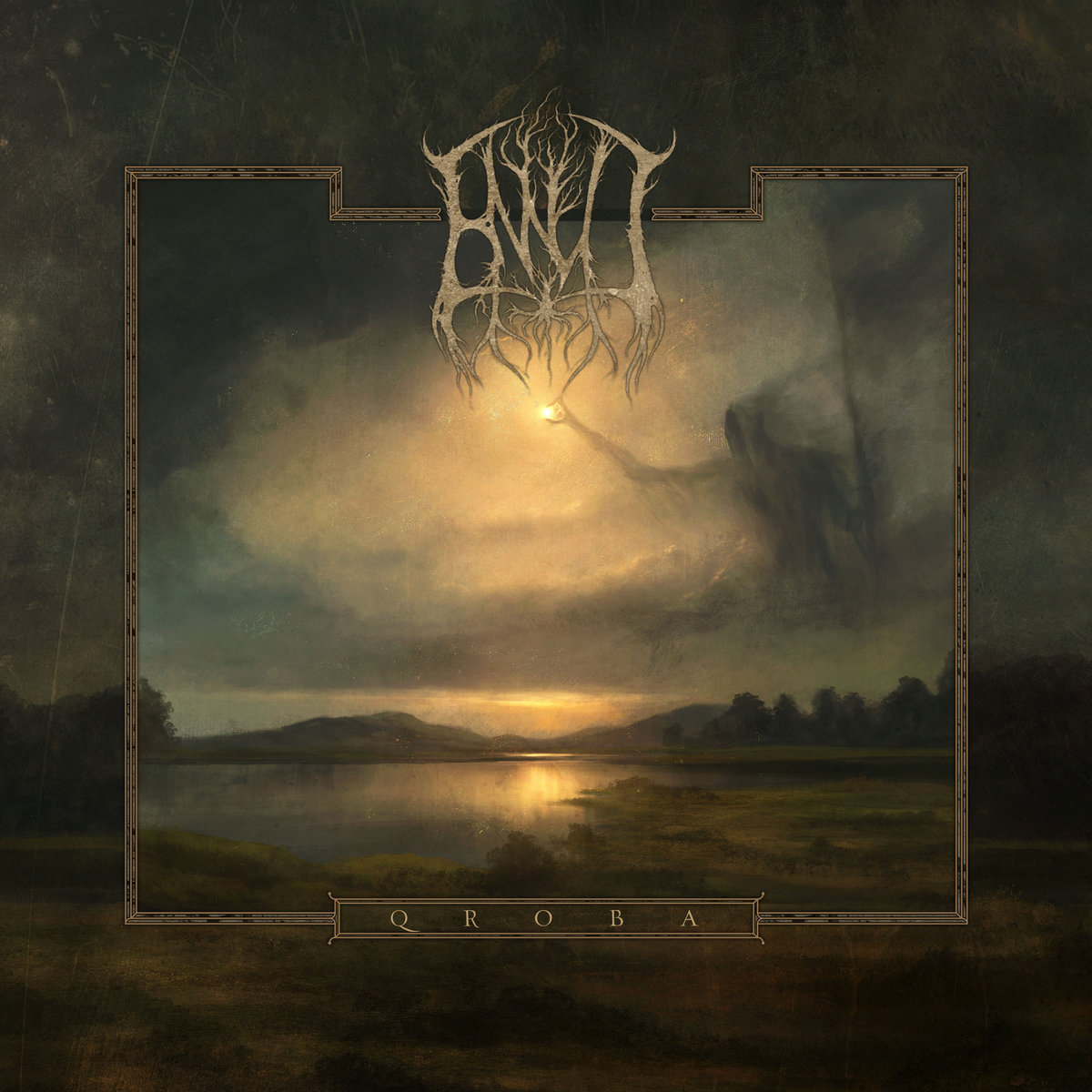
Qroba by Ennui is an album about ontological exhaustion. It is not dramatic death that stands in the foreground, but a slow extinguishing, a disappearance: physical, mental, ontological. With a central piece like Antinatalism, the duo Serj Shengelia and David “Unsaved” refer to a philosophical stance that questions birth itself. Three of the five tracks adapt the poetry of Konstantine Makashvili, a poet little known in the West, whose lyrics can be situated between late Romantic tradition and Symbolist modernity. His texts maintained the emotional and national framework of Romanticism but adopted Symbolist methods of creating atmosphere and shifting meaning.
Ennui align themselves with Makashvili’s poetry at the point where Symbolism begins to experience the connection between man, nature, and spirit as fragile—the point where the melancholic basic structure of Romanticism loses itself in hints and ambiguities. The inherent doubts about the meaningfulness of existence, suffering as a fundamental condition of life, and the question of whether non-being would be preferable develop into central aspects of the album. Thus, everything about Qroba feels heavy, almost fatalistic. And yet, Ennui succeed in not plunging themselves—content-wise or musically—into the total negation of depression or delivering a generic funeral doom album.
Sublime Negation
In sad melodies accompanied by echoing, leisurely drumming, a cultural layer of depth emerges through the use of the Georgian language and traditional instruments, giving the work character and individuality. It is a character that places the handling of life and death in the light of the duo’s home culture. Heaviness and sadness remain a sublime note that continuously forces self-knowledge. Bright keyboard sounds—impressively minimalistic, for example, in Decima—and mostly melancholic growling, as well as somber spoken-word passages at the end of Down, the Stars, pair with Georgian instruments and a funeral doom that connects to the melancholic-melodic tragedy of artists like The Howling Void, Helllight, or Doom:VS.
In Georgia, mourning is an emotional and relatively public process that brings family and community close together to say goodbye and keep the memory of the deceased alive. The awareness of passing—one’s own and that of relatives—is thus to be understood as part of a cultural capital that leaves its traces on Qroba. The emptiness growing out of the album’s contemplative monotony becomes a metaphysical space of sublime beauty without cathartic discharge. The end of life becomes as much the end of suffering as the end of happiness, and being in the “now” becomes a transition into non-being.
The album’s lyrics revolve around this fundamental metaphysical movement: the decay of world, meaning, and identity in the face of a reality in which even time, light, and eternity no longer endure. In terms of content and aesthetics, they move between cosmic nihilism, symbolist melancholy, and the vision of ontological exhaustion. Images of dying suns, decaying stars, ash, snow, darkness, and silence function as expressions of a radical loss of world. They describe an existence in which the conditions of experience itself shatter. The intoning text of Antinatalism strips reality of all contrasts and differences. Everything is negated: pain and joy, light and darkness, faith and fear, life and death. Not only does suffering fade away, but also comfort, memory, identity, and meaning. The vision of “eternal non-being” appears not as peaceful salvation, but as complete ontological neutralization. Non-being becomes the approaching absolute state. Here, Ennui serve a negative theology that depicts an all-encompassing world—a world that increasingly eludes man and his explanations and finally loses its own structure.
Darkness as Ontological Reality
Carried by a transparent production, every instrument remains locatable within this massive monolith. No sound becomes blurred; the music never turns into the mere noise of drone. The clarity transports the necessary vastness and inner emptiness. The use of traditional Georgian elements, such as the panduri, sets targeted color accents without diluting the overall impression. They do not seem folkloristic or anachronistic but act as an organic aspect embedded in the melancholic mood of the extended compositions.
The riffs are massive, often monolithic; the drums are restrained and controlled; the growls are deep and somber. Yet, no mere heaviness for heaviness’ sake arises. Qroba musically reflects the lyrical idea. Space, repetition, and minimal shifts create an atmosphere that is simultaneously contemplative and crushing—more melancholy than depression, more fatalism than resentment.
Light dies for the birth of darkness. Darkness becomes the actual ontological reality. Stars decay, eternity dissolves, time itself becomes nothing. The lyrics of Becoming Void summarize this program as the liberation of being. Crucial here is the formulation that the stars “unweave” themselves. The entropy that Mesmur described on S as a physical process becomes a metaphysical reality. The structure of the universe slowly dissolves. Ash still preserves a silent memory of the dead for humanity. The concluding sentence, “Lux fuimus, nunc umbra sumus” (We were light, now we are shadows), condenses this movement into an existential formula of de-realization.
Completion of Being
In its entirety of music and text, Ennui design a reality in which metaphysical order decays and even eternity no longer remains stable. Recurring motifs such as ash, night, snow, silence, or dying stars function as symbols of a world that is slowly emptying. Nevertheless, the lyrics are not merely expressions of personal depression. Rather, they attempt to find a language for the experience of a disenchanted modernity in which traditional systems of meaning have lost their viability, yet the need for transcendence persists. It is precisely here that their proximity to thinkers like Cioran, Schopenhauer, or Thacker lies. In the union of music and text, salvation no longer appears as the completion of being, but as its dissolution.