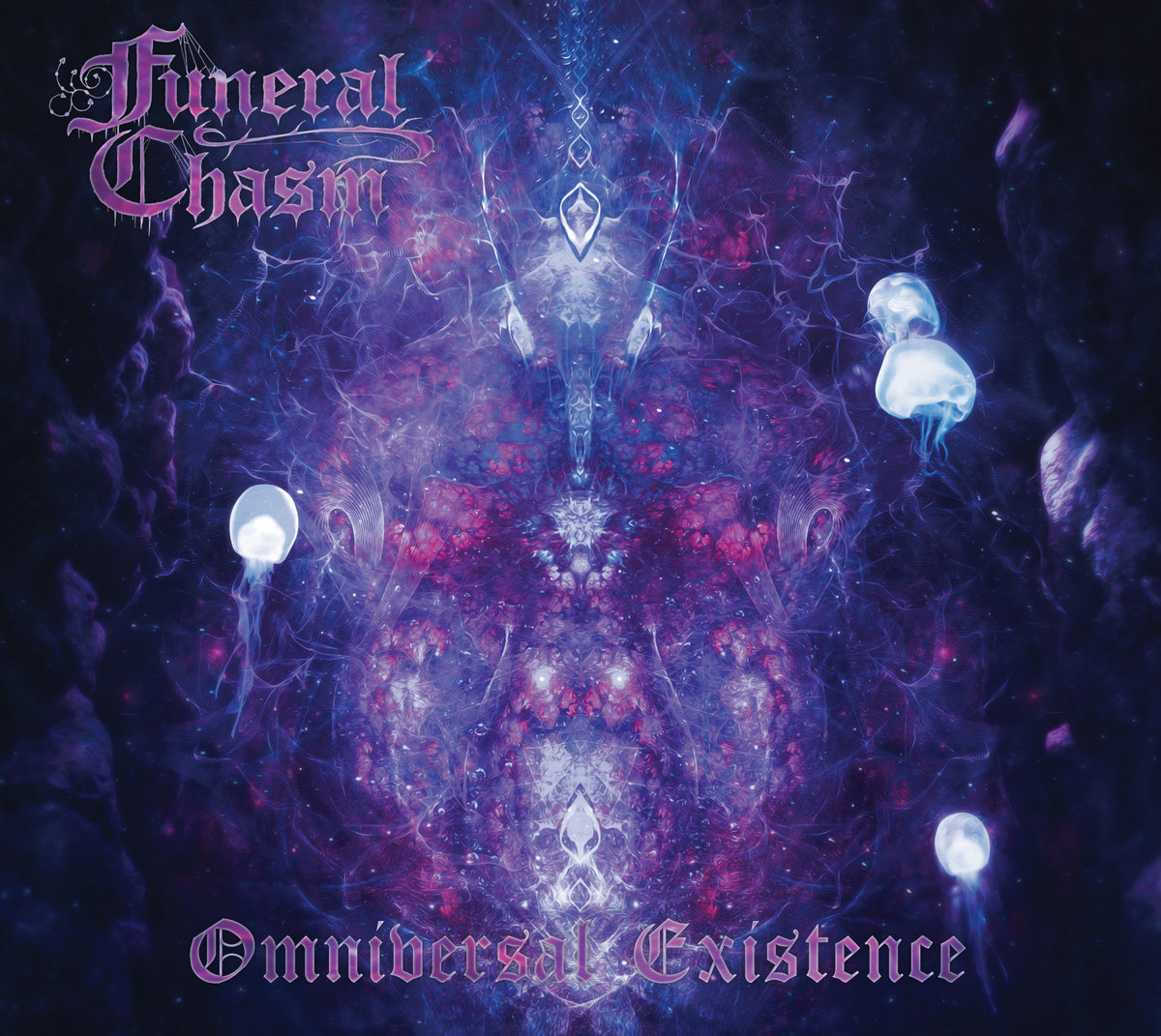
It is certainly not enough to simply call Funeral Chasm’s with the debut Omniversal Existence THE Woebegone Obscured follow-up project. The duo offers something different, and thus more, than Woebegone Obscured. Yes, Danny Woe’s voice is a cornerstone and trademark in Funeral Doom – perhaps the most important constant in Apocalyptic Funeral Doom altogether – but beyond that, Funeral Chasm takes a different direction. On their debut, the band embraces an expression of a different emotionality with more personal performances, especially in content and form.
Beyond Musical Conventions
With the debut album, the duo exceeds the high expectations raised by their EP I, delivering a heavy Funeral Doom album with a surprising range of stylistic influences. In a very short time, the project freed itself from the need to conform to specific references, proving itself to be unconventional and boundary-expanding in a way that is independent and meaningful. The transformation that Funeral Chasm undergoes reminds one of the moment when music breaks free from the narrow confines of the genre – a musical manifestation of Jean-Paul Sartre’s concept of freedom. Sartre emphasized that humans are “condemned to be free” and bear responsibility in this freedom. Similarly, the band frees itself from predetermined norms and develops an expressive power that creates its own subjective reality without paying heed to genre categories. This freedom is conceptually inherent to the album: in content – more on that shortly – and musically.
Tiamat’s Wildhoney meets Esoteric’s The Manical Vale would be an appropriate reference to indicate the conceptual direction and quality. A wealth of influences from Gothic Rock, Dark Wave, Psychedelic Rock, and Black Metal runs through the music in an organically flowing dynamic, its foundation still being something like Apocalyptic Funeral Doom. Starting from the strong EP I, Omniversal Existence marks a quantum leap, with the band expanding the genre boundaries and perhaps leaving them behind with one foot. Subtly psychedelic arrangements, wistfully dreamy leads, and expansive synths provide – expertly arranged and played – space for Danny Woe’s vocals, shifting between wailing, almost operatic singing, growling, and Black Metal shrieks. The duo’s true skill, however, lies in subordinating their technical prowess to the atmospheric expression, making the album as a whole subject to the concept of depersonalizing mushroom trips, insomnia, and their aftermath.
A Journey into the Self
Yes, the “mushroom trip” and depersonalization in the concept could be understood as symbolic expressions of this existential freedom: The person who engages with the shadows of their own psyche in the music is searching for a deeper, personal meaning in the face of indeterminacy. Remember C.G. Jung. As a result, a symphonic as well as lyrical immersive dream world unfolds – the experience of the Sublime, as described by Immanuel Kant. The “terror” of the music, the sense of being overwhelmed by the gloomy soundscapes and the existential themes the album addresses, creates a tension between fear and the recognition of a higher intellectual freedom. Kant saw the Sublime as an experience where one recognizes their own helplessness in the face of nature or the sublime, yet experiences an intellectual elevation in that very helplessness. This elevation can be seen as a musical experience in Funeral Chasm’s debut, where listeners find a deeper access to their own existence and freedom through the fascination with terror.
Beyond this philosophical dimension, it is remarkable that the conciliatory, positive tenor in the album’s lyrical concept offers a catharsis precisely in its darkness. The music could be seen as an act of sublimation, where the band transforms painful, dark emotions and experiences – perhaps even the “freedom” of failure – into an artistic form of expression. This kind of catharsis is revealed in the shift from a grim, fear-laden state to a more reconciliatory perspective that arises not from fleeing the terrifying, but from confronting it. It is more a journey into the self than a confrontation with emptiness or meaninglessness.
Sartre’s Freedom and Its Shadows
In Sartre’s concept of freedom lies a fundamental anxiety, linked to the realization that humans are solely responsible for their lives – that they constantly have the freedom to choose, act, and create. Likewise here: The freedom to transcend genre conventions might have been for the band an unconscious confrontation with their own artistic responsibility, turning the album into a philosophical and emotional journey. However, this freedom is not without its shadows: it challenges the artist to question themselves, to think freely from the conventions of the genre, and at the same time urges the listener to engage in a self-determined confrontation with their own darkness. The cathartic mushroom trip becomes the collective experience of individual freedom, a journey into the self.
Conclusion
The result is an intriguing blend of the Sublime and existential freedom, making the album an immersive experience. By freeing itself from traditional expectations, Funeral Chasm not only creates space for its own musical and emotional expressions, but also challenges the listener to confront the fundamental questions of human existence.
“Omniversal Existence” is an album of perfection, not because of its technical quality, but due to the congruent experiential world of a journey into the self. It is the musical equivalent of a transcendental experience – one that you cannot just observe, but that, if you truly allow it to, you live through yourself. This fascinating duo has created an atmospheric perfection in music that no longer needs genre conventions, that shatters every convention – lyrically and musically – and is only accountable to itself. Again, this is a seal of quality that can be most closely associated with albums like Wildhoney, A Tragedy’s Bitter End, or Angels of Distress within this extreme Doom spectrum, far beyond genre-defining releases and personal favorites from the deepest underground.