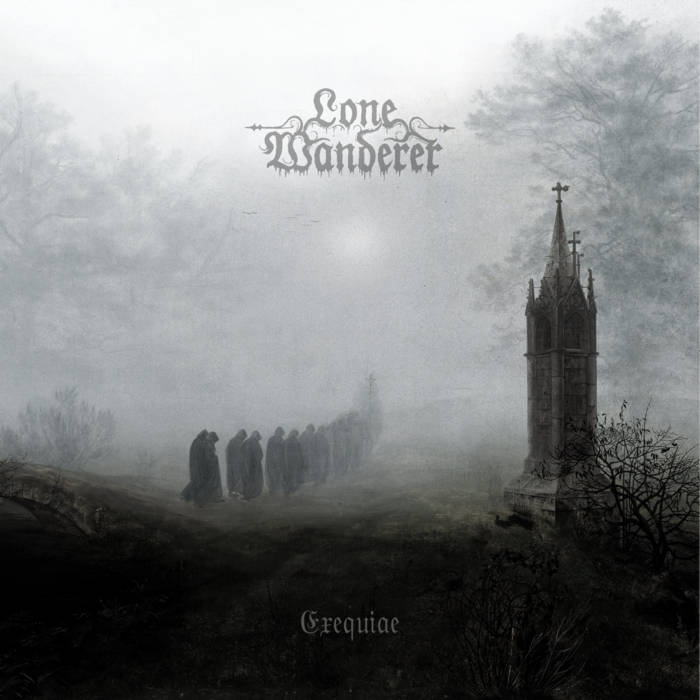
With Exequiae, Lone Wanderer release their third album, continuing their Schopenhauerian approach to Funeral Doom. Breathy, reverberating growls, spoken passages, massive walls of riffs, circling guitar patterns, and sluggishly reverberating drums keep the band close to the work of Mournful Congregation. Occasionally, quieter passages open space for a striking, at times trembling lead guitar.
Funeral Doom does not operate against the logic of the pop economy but outside its measures. A 24-minute opener like To Rest Eternally is not a demonstrative refusal of radio formats or playlist culture but an expression of the genre’s DNA. In a field structurally immune to commodification, extended durations are no affront—they are self-evident. Within metal, Funeral Doom constitutes a heterotopia—a space within a space—where existing norms are not negated but slowed and shifted in intensity. Precisely because the genre has never occupied the center of metal discourse but consistently asserted its value as an extreme form, it offers a perspective that can distance itself from what is taken for granted.
With Exequiae, Lone Wanderer present a work that commits fully to this tradition. The album stretches the CD format to nearly 72 minutes, relying not on variation or dramaturgy but on concentration.
Time, Death, and Reduction
Here, time functions not as a tool for escalation but as a state. The compositions move with measured gravity; chords are sustained until their emotional substance is revealed. The riffing remains heavy without ever becoming merely massive and carries melodic lines oscillating between elegiac clarity and resigned melancholy. The drums structure rather than drive, and the production reveals harmonic detail without descending into clinical coldness. This creates a statics in which minimal shifts gain meaning. The sonic stretching acts as a constant hovering at the edge of stillness—aural correspondence to the themes of death. The listener is not swept along but compelled to slow down.
Lyrically, the album initially aligns clearly with a Schopenhauerian pessimism. Nature and time appear as an indifferent framework of existence (“Days march on / In total indifference”). Worldly promises—“gold,” “glory,” “idols”—collapse as projections of an inherently insatiable desire. Death is conceived as a moment of relief, the cessation of being driven by the will, the end of individual manifestation. This perspective remains free of pathos; it is not brutal but crushingly detached.
Crucially, Exequiae does not maintain this pessimism in strict terms. Where phrases such as “final knowing,” “true knowledge blossoms for the dead,” or “in realms of death, Truth resides” appear, death is epistemologically charged. For Schopenhauer, the cognizing subject ends with death; there is no transcendental knowledge, only the dissolution of individuality. Lone Wanderer shift this position. Negation is aesthetically elevated: the grave gains a quiet allure, and death becomes a return to a form of transcendence that exceeds mere negation of the will. In this way, the metaphysical emphasis shifts from sober pessimism toward a poetic positivization of entropy as redemption.
Musically, this stance is mirrored in strict reduction. Cross-genre experiments are absent; the album relies on the archetypal vocabulary of slowness, weight, melancholy, and a subtly surreal atmosphere. Dynamic ruptures are avoided. Relief comes only through subtle nuances—delicate melodic brightening, almost contemplative passages—that prevent the work from hardening into monochrome. The focus is less on expressive despair than on dignity in the face of transience.
Conclusion
Regardless of its proximity to or divergence from its philosophical reference point, Exequiae stands as the band’s most coherent statement to date. It demands patience and a willingness to slow down internally. Funeral Doom is not reinvented here; rather, it is taken seriously in its purist form and articulated with sufficient individuality, without collapsing into mere reference to Mournful Congregation.