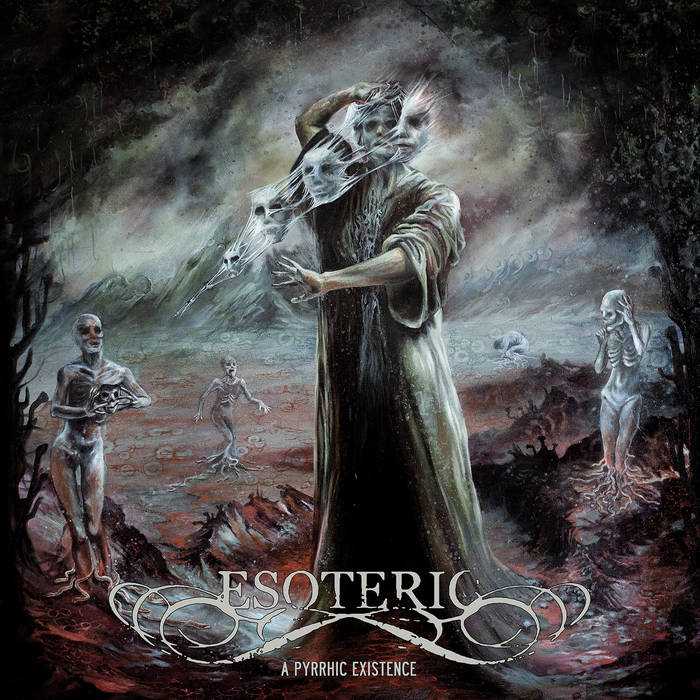
With A Pyrrhic Existence, the British funeral doom institution Esoteric released their first studio album since Paragon of Dissonance (2011) in 2019. The long production period is less an expression of creative crisis than a result of biographical realities: families, professional obligations, and the organizational complexity of a six-member band significantly slowed the work process. However, this delay does not manifest as a break but rather as a condensation: A Pyrrhic Existence appears as a work that does not reinvent Esoteric’s aesthetic parameters, but modernizes and develops them further with remarkable consistency.
Existence as a Pyrrhic Victory
The album’s title refers to the concept of a pyrrhic victory—a victory that causes such high losses that it is effectively equivalent to a defeat. As on previous releases, the lyrics revolve around psychic extreme experiences, the disintegration of the self, and the confrontation with existential meaninglessness.
“I exist only for the sake of existence” (Sick and Tired).
The album does not follow a closed concept; rather, the “collapse of the psyche” forms a loose thematic core around which motifs such as death, lies, suffering, and tragedy revolve. It is a consistent particularization of subjectivity and identity—the postmodern identity that no longer knows how to form an “I.” The visual design also reflects this idea: a central figure symbolizes the psychic collapse, while several smaller figures represent the forces surrounding and driving this process.
A Pessimistic Anthropology
Applied to human existence, A Pyrrhic Existence formulates a pessimistic anthropology: the mere continuation of the individual appears as a process of increasing damage. The longer life lasts, the more loss, suffering, and tragedy accumulate. Existence itself is thus described as a struggle, whose survival does not mean salvation, but merely the continuation of a destructive process. Esoteric here draws on Schopenhauer. In Arthur Schopenhauer’s main work The World as Will and Representation, the world is the expression of a blind, insatiable will to live, which manifests in all phenomena of nature. This will generates a permanent state of lack and tension, so that existence is fundamentally marked by suffering, competition, and struggle. Survival or continuation therefore does not mean salvation, but merely the further continuation of this painful process of will.
“Life, with its hourly, daily, weekly, and yearly, small, larger, and great adversities, with its deceived hopes and its accidents thwarting all calculation, bears so clearly the stamp of something that is meant to make us discontented, that it is difficult to understand how one could have misperceived this and allowed oneself to be persuaded that it is there to be gratefully enjoyed, and that man is to be happy.” (The World as Will and Representation)
Unlike many doom albums, the lyrics do not function primarily as individual song stories but as a progressive psychic process: from inner decay through social disillusionment to a resigned, exhausted final stance. The starting point is the experience of an inner descent, in which perception, identity, and reality become increasingly unstable; the subject experiences itself as alienated from itself and trapped in a state of mental decay. “And it spirals out of control,/Descending into some riotous state.” (Descent) This individual collapse is not presented exclusively as a private crisis, but simultaneously as a symptom of a culture stabilized by lies, ideologies, and consumed illusions. Humans do not live in truth but in ideologies, media illusions, and consumption—the grand narratives are compromised, and the subject resorts to inadequate substitute actions it itself does not trust, which only briefly satisfy its own needs, desires, and longings.
A Nihilistic State Description Of a Postmodern Society
The major systems of meaning lose their legitimacy (Lyotard), reality is increasingly mediated through simulations (Baudrillard), social structures create substitute needs (Marcuse), and the subject lives within ideological interpretive frameworks (Marx), while being existentially confronted with loss of meaning (Camus). Humans no longer live within a world perceived as true, but within functional structures of meaning that provide orientation but in which they no longer fully believe. Awareness recognizes the structures of this deception without being able to gain a liberating perspective. Instead of a cathartic resolution, this insight leads to a stance of existential exhaustion: the struggle for meaning ultimately appears futile, and the mere continuation of life itself becomes a pyrrhic victory—a survival whose price is the loss of meaning, certainty, and psychic integrity. Hannah Arendt said in an interview with Roger Errera in 1973, “a people that no longer can believe anything cannot make up its mind. It is deprived not only of its capacity to act but also of its capacity to think and to judge. And with such a people you can then do what you please.”
What Esoteric thus uses as a lyrical framing is a nihilistic state description of a postmodern society that robs itself of its truth and thereby increasingly of its democratic capacity to shape itself. “Dead is the will to believe / Crushed is the hope…” (Rotting in Dereliction), “Consuming lies like rats desperate to be fed,/With no regard to the shit they are eating.” (Consuming Lies) Humans remain as powerless objects in a societal machinery of forces acting upon them. “The dawning of nature’s indifference/We are but ants without purpose” (Culmination) This pessimistic perspective integrates seamlessly into the thematic continuity of the band.
Compositional Architecture
Musically, the album operates within the framework established by Esoteric of an extremely slowed, atmospherically dense funeral doom. With a total runtime of over 98 minutes and only six tracks—including the short ambient interlude Antim Yatra—the work unfolds in extended forms, often exceeding fifteen minutes in duration.
In the layered construction of the tracks, long-sustained chords, deep droning bass and synthesizer registers, and heavily reverberated guitar surfaces create a sound space that relies less on linear song structures than on gradual transformation. Within these soundscapes, slow-motion leads and dissonant riffs appear, shifting slowly against each other and creating a form of musical tension reminiscent more of orchestral dramaturgy than conventional rock. Exceptions and points of contrast are placed within repetitive monotony, complementing the music and connecting it into a cohesive whole. The limitations of the musical and material format are thus structurally exploited. A resulting proximity to cinematic or classical sound dramaturgy emerges as a characteristic feature of the album. The tracks develop through atmosphere, dynamics, and timbre. Funeral doom proves to be a structural foundation from which progressive and psychedelic elements unfold—not as a limitation of the band’s musical vocabulary. That tracks like Consuming Lies and Sick and Tired function as potential hits within these cornerstones of the influential and genre-defining Esoteric sound cosmos is a fascination in itself.
Definition and Expansion of the Genre
A Pyrrhic Existence is a renewed demonstration of the aesthetic possibilities of the genre. The atmospheric density of the work and Esoteric’s ability to evoke intense emotional impact despite extreme length remain unique. The consistency with which Esoteric releases outstanding albums remains unmatched. The ability to simultaneously serve, expand, and define the genre is unmatched by any other group. Predominantly celebrated in expansive slowness, the music is by no means static. The tracks move between calm, meditative passages and more eruptive moments in which distorted guitar walls and disharmonious riff structures dominate. This dynamic creates dramaturgical movement, giving the long formats of the tracks a clear internal development. And Greg Chandler’s filter- and effect-shaped vocals reinforce this impression. His growling on this album appears particularly deep and massive, while sporadic screams function as expressive outbursts. The vocal level thus contributes significantly to the portrayal of psychic extreme states: the vocals act less as narrative articulation than as an acoustic manifestation of inner disarray.
Conclusion
The album stands alongside the band’s most important releases (Epistemological Despondency, The Pernicious Enigma, and The Maniacal Vale) and thus some of the most significant albums in the genre overall.
It is a further examination of the genre material, its structure, and systematics. It demonstrates—precisely because it does not concern itself with the conventions of the genre and instead tests only its own musical vocabulary—how far funeral doom can extend as an aesthetic form. A Pyrrhic Existence thus appears less as a stylistic break than as a consistent continuation of the aesthetic Esoteric has developed since the 1990s. The album condenses central themes of the band—psychic disintegration, existential tragedy, and metaphysical despair—into a work of monumental weight. In its combination of extremely slowed sound architecture, progressive dramaturgy, and introspective thematic content, it confirms the band’s claim to regard funeral doom not merely as a genre form, but as a comprehensive aesthetic experience.