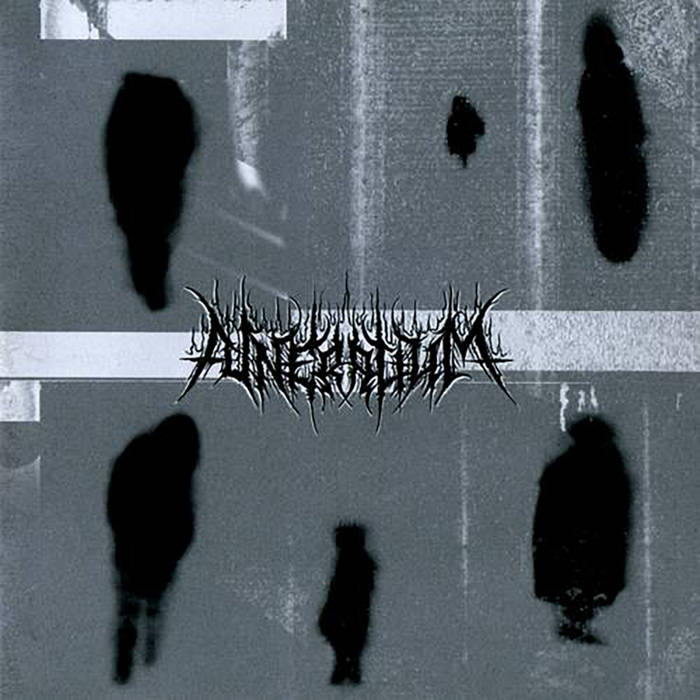
Funeralium began as a collaboration between the groups Ataraxie and Heol Telwen. Over time, the band established itself as a long-term side project of Ataraxie vocalist and guitarist Jonathan “Marquis” Théry. Released in 2007, the band’s self-titled debut arrived amidst the brief flare-up of Torture Doom—a subgenre of Funeral Doom focused on pain and torment. It distinguished itself from the otherwise elegiac genre through tortured screams, noise elements, and dissonance.
Ultra Sick Doom
Funeralium is not an entry point for genre newcomers or casual listeners; it demands patience, strong nerves, and a specific affinity for extreme, depressive, and delusional soundscapes. A connection to Jürgen Bartsch’s Bethlehem is evident. However, Funeralium eschews ciphers and artistic complexity, sounding more direct and personal as a result. Yet, the delusional quality of Bethlehem remains, making it no surprise that the band labels their music “Ultra Sick Doom.”
The debut proves to be heavy, ultra-slow Extreme Doom that weighs heavily on the chest. It serves as an impressive example of the genre’s capacity to translate feelings of despair, gloom, and existential “end-time” moods—not just into lyrics, but into the music itself. The production of this “Ultra Sick Doom” is intentionally raw and unpolished, contributing to the album’s oppressive effect. This is no slick, sterile studio sound; rather, it is an earthy, distorted representation that heightens the impression of being held captive in a dark cave. There are no catchy hooks or melodic highlights—instead, one sinks into a sonic landscape reminiscent of strangling despair rather than entertainment.
Despite the overall sluggish tempo, Funeralium manages to remain varied within their monstrous structures. Tension arises at times through minimalistic, almost whispered sections, and at others through dragging crescendos or repulsive masses of distorted guitar. What the listener experiences are elongated, hypnotic passages with hardly a moment to breathe—a monolithic sense of heaviness.
The Tragedy of an Existentialist Dystopia
The primarily sluggish, brachial morass that the band presented on their debut develops a torturous dynamism. Up-tempo passages and moments of “shivering” folklore—over which Théry screams in agony—are juxtaposed with heavily distorted and down-tuned Black Sabbath riffs (particularly prominent in Light Crisis), as well as repetitive rhythmic figures and chord progressions. Théry’s vocals vary between growling, screaming, and howling, while the instrumentation maintains a multi-faceted dynamic that oscillates between disgust and pain, anger and depression.
The tragedy of an existentialist dystopia shines through in the lead guitar moments, shadowed by the snarling and wailing of the depressive individual. The existentialist dystopia presented by Funeralium is not a vision of a looming societal order. It is a subjective, distorted, and agonizing perception of life—the inner cosmos of the self dominated by isolation, depression, and nihilism. In a fragmented anthology of human loathing, the album indulges in the total decoupling of the “I” from meaning, humanity, and existence. Music and lyrics spin a complex, interwoven abstract painting of existential emptiness—a void that the individual perceives within themselves and the world through their depression. The sluggish rhythm, in all its fragmentation, pushes the “I” deeper into a confrontation with the disturbed self. Where, for example, Vastness by Il Vuoto circles around such a confrontation, on Funeralium, it screams directly into the face of the “I.”
At the center of these differing perspectives on the internal monologues surrounding the confrontation with the self stands Light Crisis—the heart and starting point of the dystopia. Existential encapsulation is freely chosen through a conscious withdrawal from society. With the line “Hiding away from the sun,” Théry describes this isolation and the renunciation of warmth, light, proximity, and life as a rejection of a reality that feels incomprehensible and hostile. Trapped in a sense of pointlessness, the order of things decays; time, space, and pain overwhelm the self. The world becomes disfigured and distorted, turning into the experience Sartre described as Nausea—the sickness felt in the face of naked existence.
Fragments of a Shattered Psyche
In a thematic parallelism between Funeralium and the later Ataraxie album Résignés, Funeralium adds another facet to the desire to withdraw from cybernetic society—or at least the feeling of living under it. The album offers a uniquely misanthropic approach to depression that differs significantly from other examples within the Funeral Doom canon.
While the central track Light Crisis reveals the state in which the depressive individual finds themselves, creating a parallel to Résignés, the rest of the album provides fragments of a shattered psyche. Like looking into the shards of a broken mirror, these perspectives of depression on the world and the self are supplemented. There is no clear beginning or end, but rather a collection of moments oscillating between self-destruction, escape, and projection.
In First Symptoms, reflections of a body scarred by self-harm glisten. These externalized images of anger, self-hatred, and pain testify—analogous to Schopenhauer’s nihilism—to a life characterized by endless suffering and eternal striving. A metaphor of “black bile” suggests not only immediate disgust, anger, and melancholy but also cites the ancient doctrine of the four humors, in which an excess of black bile defined the melancholic.
With a look into the shards of the burst psyche, the piece Transcendance #26 reveals an attempt to escape the self. The attempt to transcend escalates into the continuous fragmentation of the “I”—an “I” that, in trying to rise, further shatters the mirror’s shards. The desire to dissolve the boundaries of existential pain, presented in the language of drug use and esotericism, ends in self-deception, total dehumanization, and a distancing from reality within the void of a metaphysical nothingness.
Let People Die projects personal suffering into a radical manifestation of an apocalyptic call for the end of humanity. The pleading, apocalyptic wish for the extinction of all life is the logical conclusion of a dystopia of an existence that knows only suffering and cannot even—like Vanha in Within the Mist of Sorrow—look back on brief moments of happiness. In the inability to wring any meaning from their own suffering, the album’s depressive nihilism reaches its zenith, demanding absolute destruction to end the pain. With lines like “Please let people die / Please, please cease their suffering,” Benatar’s antinatalist perspective comes into view: the idea that the absence of bad things, such as the feeling of sorrow, is good even if there is no one to benefit from it.
Nearly the End connects to this mixture of depression and antinatalism. With the final line of the album, the depressive individual conceived by Funeralium dismisses the audience with a nihilistic message of a life that is not only meaningless but a burden to all of creation: “The stench in your coffin sums up your whole life.” All human life is declared the metaphorical stench of cosmic reality. The most positive attribute the individual still ascribes to humanity is decay itself, culminating in a “magnificent rebirth in a thousand worms.” The dissolution of physicality that accompanies decay remains the only purpose of life. This reduction to functional biomass is simultaneously a liberation from an existence as a “stench” that burdened both the self and all of existence. The stench in the coffin represents a final image of human life, ending not just in physical decay but in a metaphysical insignificance that Thacker identifies as one of the central dimensions of human existence. In this context, the “stench”—as a “secretion in a state of extreme boundlessness”—becomes a symbol for a senseless and fleeting life in a cosmic context that offers no ultimate goal or salvation; a complete emptying of meaning, captured impressively and painfully in the world of the Funeralium album. To this end, Funeralium employs a morbid image that reduces the cycle of birth, life, and death to an absurd biological end-in-itself, resulting in a grotesque celebration of the passing of consciousness. Thus, Nearly the End offers no way out and no redeeming insight. Instead, the track draws a fatalistic line under life. In this reduction of the human being to an equation of death with senseless but purposeful decay, the piece closes the circle of the depressive dystopia: a life that is not only meaningless but also burdensome, and whose only legacy lies in its decomposition.
The title track, Funeralium, is positioned as a look between the shards of the shattered mirror of the psyche. Looking beyond the boundaries of the internal gaze that otherwise unfolds on the album, the piece takes an unnervingly detached view of the “Christian void of salvation” through a lens clouded by depression and nihilism. In a direct inversion of the Sermon on the Mount, the meek are not denied the kingdom of earth, but the suffering inherent to that kingdom is promised to them in full brutality. Elsewhere, the effort to find light in the darkness is characterized as cowardice in the void—as self-deception. That Christian path of meekness and faith, which the track circles with all its refractions, is a diametrical counter-model to the state of being within the reality drawn on the album. And so, in juxtaposition to Christian faith, the piece offers a final truth of nihilistic life: “A meaningless existence implies an arbitrary end.” Beneath the depression and the pain, as well as after the anger and the contempt, there stands an acceptance of the self in confrontation with the alternative of a supposed promise of healing. Meanwhile, referencing the encapsulation and flight in Light Crisis, the desire for absolute passing in Let People Die, and the realization of life as insignificant biomass awaiting its purpose in Nearly the End, Funeralium reveals that “other path” of contempt and truth. It is this other path that is presented throughout the album.
In the Persistence of Cosmic Entropy
In its entirety, Funeralium oscillates between observations of a personal existentialist dystopia—ranging from the fragments of human existence and the abysses of the psyche to the final negation of all life—and an antinatalist manifesto of nihilistic self-abandonment. The title track provides the thematic framework in which the entire absurdity, senselessness, and burden of human life are condensed as an option for a confrontation with the self in the Kierkegaardian sense, but with a completely different result.
Man remains only the “stench” in a final symbol of a nihilistic, depressive existence. A metaphysical symbol of the “world-without-us,” characterized by the total negation of all values and meanings as a consequence of subjective brokenness. In a fatalistic reckoning with the “world-for-us” shaped by depression, only the cosmic void remains, in which man—at most—carries significance as interchangeable compost. Both the intact and the shattered “I” transcend, after passing away, into a vapor that merges between being and non-being in the persistence of cosmic entropy.