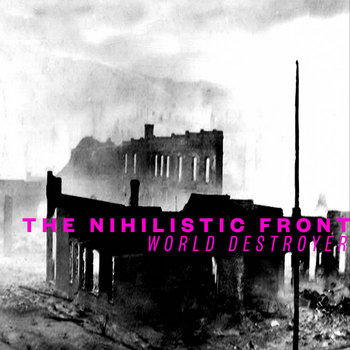
For a long time, things remained quiet around The Nihilistic Front. In 2014, the duo Gaz Martin and Chris Newell brought in drummer Paul Mazziotta (Disembowelment) and bassist Nick Warren (Asbestosisis) for a one-off live performance. An announced album release never materialized, the drummer disappeared from the project again—and what remained was the track World Destroyer. Martin and Newell later reworked this piece, expanded it into an EP, and eventually released it via Bandcamp.
Already the title points toward a form of destruction that is not primarily external, but aimed at the dissolution of an inner, subjective world. The lyrics negotiate socialization as a process of adaptation—as the integration of the self into a religiously shaped order that offers less stability than it imposes structure and limitation. Martin emphasized early on that lyrical and musical intentions do not necessarily coincide. While Newell formulates an angry indictment of Christian institutions, the music unfolds a partially detached, more radical level.
Lyrics
The text appears as a nihilistic manifesto against religious meaning-making. In the tradition of Friedrich Nietzsche and Ludwig Feuerbach, religion is exposed as a human construct and a destructive illusion. In a Marxist sense (“opium of the people”), it is framed as viral manipulation (“Cancerous your poison”) and as a construct built from “excrement.”
Newell spews a bile-laden mixture of rage and mocking laughter toward the “sycophants”—the submissive believers—whose prayers echo into history, while he himself adopts a cold, almost clinical autonomy, placing his own moral code above divine law. The apocalyptic framing of the “World Destroyer” elevates this critique to a level of cosmic destruction. There is no room for compassion or transcendental consolation; instead, cold logic triumphs over blind faith, culminating in total annihilation.
Inspired by the existential despair of Emil Cioran, the text refuses any form of hope and finds a dark “purity” in absolute isolation. The end of the religious era is not lamented, but presented as the collapse of a structure of lies, leaving behind only the silent, material reality of a world stripped bare.
This critique of religion does not lead to liberation. It opens no space for new meaning. Instead, it leaves behind a void that remains unfilled. The “World Destroyer” marks no transition, but an endpoint: the annihilation of all transcendental reference systems without replacement.
Sound
Musically, the EP radicalizes this idea. What is articulated here is not merely the absence of God, but a condition in which God has become structurally obsolete. World Destroyer stages the destruction of the world-for-us by the autonomized world-of-us.
The drum machine is central. It does not function merely as a stylistic device, but as an expression of a mechanized, decoupled structure that escapes human control. The repetitive riffs, the monotonous pounding, and the eruptive screams do not appear as expressions of a subject, but as symptoms of a system perpetuating itself beyond the subject.
Hollow still offers a comparatively accessible entry into this structure. Dead Hymns intensifies into a prolonged condition of sonic attrition, before the title track dissolves any remaining expectation. There is no catharsis, no rupture, no escape. The music consistently operates on a narrow edge between monotony and cacophony—a state of permanent overload without resolution.
Conclusion
The true strength of the EP lies in the fact that it does not merely translate early 1990s black metal religious critique into sound. Instead, it demonstrates what remains after its collapse: not liberation, but a reality in which human-made structures persist and turn against their creators.
he Nihilistic Front do not articulate rebellion against this dimension of the world-of-us; they expose the individual’s loss of agency within it.
The experience recalls I Have No Mouth, and I Must Scream: a closed, inescapable space in which the subject no longer acts, but merely endures. Destruction does not occur through an external, transcendent force, but through the immanent operations of an autonomized world-of-us..
World Destroyer is therefore less an apocalypse than a diagnosis: the world-for-us does not collapse because of the world-without-us, but because of the world-of-us itself. What remains is not emptiness as possibility—but emptiness as condition.