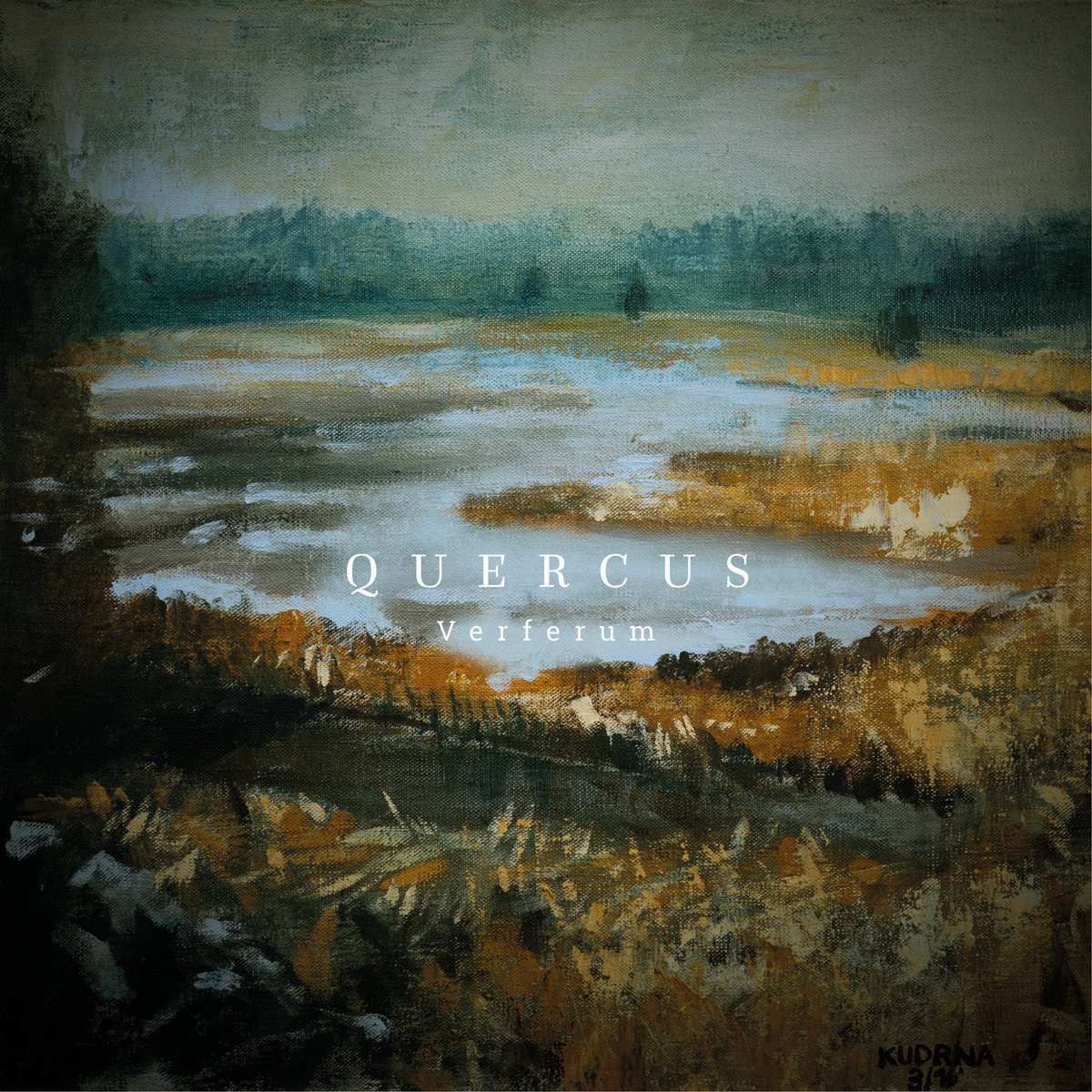
Verferum by Quercus presents itself as a haunting and unusually sacral interpretation of funeral doom: within extremely slow, heavy compositions, a dense and melancholic soundscape unfolds that focuses less on traditional song structures and more on atmosphere and impact. Particularly distinctive is the use of the real church organ, which lends the pieces a dark, church-like, almost liturgical aura and sets them apart from typical genre releases. Supported by deep, sustained guitar work and varied growled vocals, the result is a sound that feels both oppressive and meditative—an austere yet fascinating album whose strength lies not in accessibility, but in its unwavering mood and originality.
The trio once again proves to be one of the few representatives of the genre whose use of the organ goes beyond cliché-ridden decoration or dark, sacral showmanship. Quercus integrates the instrument with the compositional skill of seasoned church musicians. The sense of playfulness and emotional expression conveyed by the instrument—especially evident in the first and last tracks—particularly recalls The Dead End by Abandon within the realm of extreme doom.
Experience of Nature
Nature—or more precisely, the selective immersion in nature—becomes, on Verferum, a redemptive element in the discovery of the self. In contrast to a search for being and a confrontation with archetypal primal fears and existential darkness, Quercus places the experience itself at the center. Quercus, with Verferum, develops a perspective in which nature is not a mirror of inner fragmentation, but a place of inspiration, escape, and regeneration.
Verferum draws on Thoreau’s transcendental philosophy, presenting it in a postmodern way—shaped by subjectivity and intertextuality, yet influenced by Romanticism. Nature becomes a path back to the individual self, in an effort to resist a technologized, alienated, and alienating society. Lyrically and musically, Quercus juxtaposes this Romantic view with the everyday alienation of the modern technological world. Through the nocturnal experience of nature in Ceremony of the Night as both escapism and self-discovery, the band sketches an image of individual departure that, in its youthful longing and intent, parallels Thoreau’s Walden.
In this return to the natural, to the original, a path toward the dissolution of the self is sought—a transcendental experience that resists the depersonalization of a cybernetic society. Yet this approach remains incomplete, as described in Friedrich Wilhelm Joseph Schelling’s idealism:
“Our highest striving is the destruction of our personality, the transition into the absolute sphere of being, which, however, is never possible for eternity. Therefore, only a practical approximation to the Absolute.” (Schelling)
This connection between Romantic longing and spiritual search shapes the album and is particularly explored in the track Journey of the Eyes. The rasping scream into which the otherwise deep growled vocals collapse toward the end of the piece reflects emotional fragmentation arising from the loss of youth, the impending death of the father, and the confrontation with the responsibility of becoming a father oneself. Nature, however—much like in Thoreau—remains a place of inner retreat and inspiration, though here it is less joyful and more marked by conflict between personal freedom and the desire to care for others. This ambivalence shows that Quercus does not seek Thoreau’s harmony, but instead embarks on an introspective journey in encounters with the absolute Other in nature, where the goal is not knowledge, but the forgetting of the self.
The regressive-psychedelic drug experience explored in The Pu-erh Exhumed stands in stark contrast to the search for naturalness and inner contemplation. Here, the motif of intoxication is linked with a broad intertextual palette of literary, musical, and cultural references from funeral doom. In this context, intertextuality refers to the conscious play with references and quotations placed into new contexts. Quercus draws from a cornucopia of genre stereotypes, referencing Lovecraft and Esoteric, weaving these elements together with ironic allusions to Romanticism, nostalgia, and postmodern self-reflection.
Rather than relying on explanatory models of grand narratives—what Lyotard calls those universal stories or ideologies that aim to provide meaning and orientation—the subjective and fragmentary take center stage, accompanied by a skepticism toward explanation itself. In a simplified sense, Lyotard defines this very “skepticism toward metanarratives” as the essence of postmodernity.
This approach is realized not only thematically but also musically in The Pu-erh Exhumed. Modern production techniques and the influence of post-rock deliberately break with the traditional stylistic means of funeral doom. In its nostalgia and deliberately excessive intertextuality, Quercus performs the piece in a style far removed from the heaviness and gloom of typical funeral doom. Instead, musically it aligns more closely with modern prog and post-rock, similar to the gently light compositions of Callisto’s Providence or The Ocean’s Heliocentric. The irony is further deepened by the fact that the lyrics are performed in lush melancholy by Don Zaros, the keyboardist of Evoken, one of the genre’s most prominent bands.
At the end of the album, with Passacaglia D Minor, White and Black Darkness, stands a memento mori that breaks away from youthful longing for the Absolute and the idealized vision of nature. Instead, transience is accepted, and a turning toward life—with all its pains and joys—becomes the central motif. Here, one can observe a departure from Thoreau’s idea of harmony in favor of an existential reconciliation with the imperfection and finitude of the self. In Lyotard’s postmodern perspective, this acceptance can also be understood as a rejection of explanation in favor of living in the moment. The individual accepts postmodernity—its deficiencies, uncertainties, fragmentation, uncontrollable forces, and the insignificance of identity within the universe—without seeking to resolve its inherent conflicts.
Sacred and Sublime
The music reflects this development. From the sacred and sublime sounds of the early pieces, through the nostalgic and ironic intoxication, to the final melancholy and acceptance, Verferum unfolds as an emotional journey. It is not only a farewell to youth, but also a celebration of Nietzsche’s insight that true happiness lies in the acceptance of the moment:
“The smallest happiness, if it is continuous and makes one happy, is incomparably greater happiness than the greatest, which comes only as an episode […] amid nothing but displeasure, desire, and deprivation.” (Nietzsche)
With this development, Verferum reveals itself as a work balancing between Romantic inspiration and postmodern irony. It thus embodies an acceptance of postmodernity through the conscious experience of the present moment. The band strives to praise living in—and experiencing—the moment in nature as a personal way of dealing with the fragmentation and division of the self under postmodern conditions.
This perspective recalls William Blake, who understood nature not merely as an external space, but as an element of spiritual and emotional self-realization. Nature, as both mirror and guide, reflects the fragmentation of the self as well as the longing for transcendence. The search for inner wholeness—perpetually suspended in Blake’s works between harmony and chaos—also appears in Verferum. The album bears witness to a process of confrontation and self-discovery through the experience of nature. Nature becomes an existential space and a means of reflection in the engagement with the world, the self, and the Absolute.