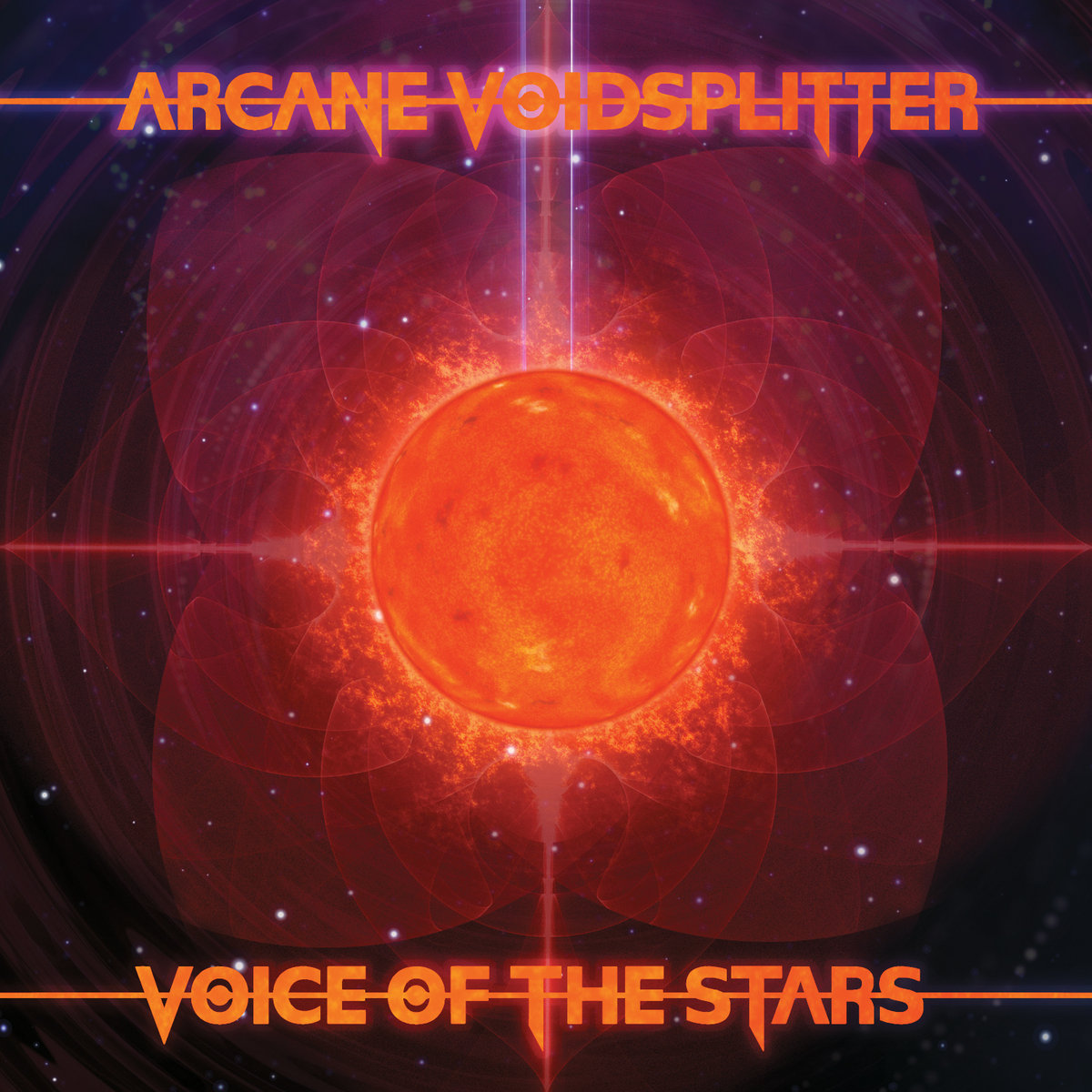
With the project Arcane Voidsplitter, Stijn van Cauter sets to music, within a science-fiction scenario, the journey of the splitter of the void: an artificial object cutting through space. The origin and function of this object, moving through the infinity of space, are unknown to any living being.
With Voice of the Stars, van Cauter thus delivers an album consisting of a one-hour journey through the depths of space. The album dispenses almost entirely with conventional song structures, relying instead on monumental drone surfaces, slow guitar walls, and floating synthesizers that place the listener within an almost timeless sonic space of endless emptiness.
The three tracks Arcturus, Betelgeuse, and Aldebaran differ from one another only subtly, relying on the hypnotic effect of the continuity of instrumental ambient funeral doom. The music unfolds close to old Faust or Can, in subtle variations that take effect only after several minutes. It is the idea of a minimally shifting infinity in which form here carries content. The massive sound waves feel like the acoustic translation of gigantic stellar bodies and endless emptiness. The cosmic concept remains no mere trapping here, but shapes every minute of the album’s more than hour-long runtime.
A Bubble in the Glass of God’s Spirit
This musical embodiment of a cosmic construct becomes an emblem of a philosophy of impermanence and loss, like the Ark at the end of the album Ark, or the Aniara at the end of the film adaptation of Martinson’s poem Aniara. The Arcane Voidsplitter, too, is a relic, an artifact emptied of meaning, whose purpose and context vanished long ago along with its builders. And thus emptied — empty of meaning, of life, of consciousness and significance — it glides through the void as that already-cited “bubble […] in the glass of God’s spirit” (Aniara), through the greater emptiness, purposeless, in the nothingness of swelling entropy.
These interstellar traveling objects are relics of past civilizations: monuments that can testify only to the hubris of their creators, comparable to the pedestal inscription on the stone figure in the wasteland in Percy Shelley’s Ozymandias. Like the crumbled monument in the desert, which testifies only to the former greatness of a long-fallen empire, the Arcane Voidsplitter, the Ark (from The Slow Death), and the Aniara (Martinson) lie amid the nothing as silent witnesses to a compulsive desire to defy time, passing, forgetting, perhaps even entropy itself. Yet what remains is nothing but emptiness. The machines, once built to sustain life, generate meaning, or promise immortality, now drift emptily through a universe that has long since forgotten them. The future of the Ark and the Aniara is the present of the Arcane Voidsplitter.
These objects remain as forgotten heterotopias (spatial other-places – Foucault) that no longer serve any purpose. The Aniara, the Ark, and the Arcane Voidsplitter are places without function, without consciousness, without life. They exist only as meaningless constants within a universe that is itself drifting ever further into nothingness.
The emptiness within aligns itself with that of the cosmos. Without meaning, idea, or will only a constant movement toward final passing. At the end of the 2018 film adaptation, the Aniara is empty; only dust and bones drift through weightlessness in the light-cones of wandering sunbeams. Hope aboard the ship died out over the years. What remained of humanity was a dead planet and an empty vessel somewhere in a cold desert of nothing. Likewise, the Arcane Voidsplitter is a space without life, its unknown function long since emptied of meaning: a fragment of a forgotten past.
In the end, only nothingness remains. The nothingness Heidegger describes as the experience of the finitude of being is here no longer a threat but a state. Being-toward-death loses its existential content here. The constructs themselves do not die — they pass away at some point, dissolving in the steady increase of entropy toward a final state of maximum disorder and equal distribution. As stated in the review of Mesmur’s S:
Everything decays, because nothing is perfect.
Like Shelley’s Ozymandias, of whose kingdom, for all its supposed greatness, only the ruin of a single monument stands in the desert, the Arcane Voidsplitter is a symbol of the compulsive desire to attain eternity, and of the inevitability of failure. The Arcane Voidsplitter drifts on as a splinter in the cosmos, without a single spark of life. Its fate is to pass away in the great emptiness. What remains is the journey of a dead object through endlessness.
Unnoticed and silent, the flight of the Arcane Voidsplitter is set toward the heart of a distant galaxy. An object without history, whose purpose lies hidden in the past. Whether tool, ship, probe, or weapon remains uncertain. Voice of the Stars is the second document of this journey. It describes the impressions gathered by the Arcane Voidsplitter – the endless, crashing amplitudes of epic stars and entire galaxies. While the debut turned its attention toward the Arcane Voidsplitter itself, capturing space and the object together, on Voice of the Stars the object travels past the stars Arcturus, Betelgeuse, and Aldebaran.
A Cosmic Meditation
Betelgeuse, whose immense presence even outshines Arcturus, unfolds across a 35-minute sonic journey that blends sublime ambient with dark, monolithic funeral doom. Through the constant stream of writhing, low guitars and synthesizers, the weight of the stars becomes almost tangible. Manifesting the vastness of the universe, the ambient glides through the void.
Voice of the Stars ends with Aldebaran, a less prominent yet still fascinating star. Its slow fading closes the album in a musical farewell that is at once intimate and heartrending. The track glides through a gently fading sorrow, in which guitars and organs softly die away.
Without ever plunging into loud, dramatic accents, the album generates a monolithic, calm energy. This cosmic meditation on the journey of a lifeless object through the emptiness of space unfolds a sublime beauty alongside the life-hostile cold of an all-encompassing nothing. It is the imagining of the sublime emptiness of space that makes palpable that of the world, of society, of the human being itself.
In this unhurried construction, Voice of the Stars demands attention from its audience. The slowly unfolding, minimal variations and the album’s enormous runtime may feel wearying to listeners seeking melody, dynamics, or clear climaxes, while the high degree of harmony in the unfolding tracks, which brings the album close to classical ambient, may strike an audience accustomed to contrast, provocation, or pressure as too agreeable.