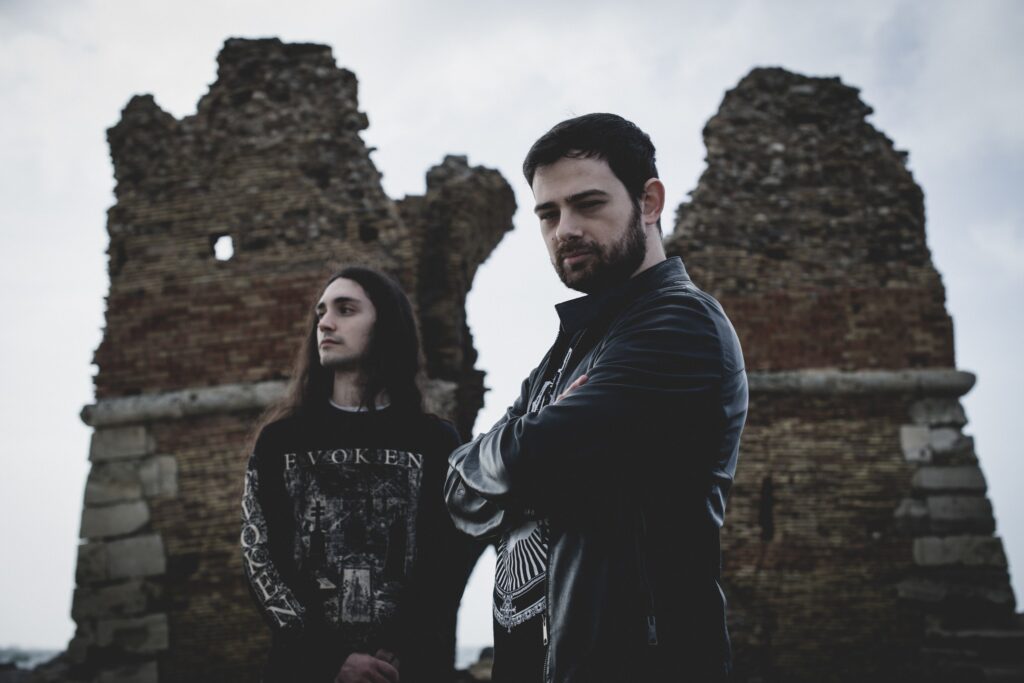
Atlantic Ridge sits at some distance from classic funeral doom. It’s far more black metal at its core, but the funeral doom influence is woven throughout the release in ways that feel genuinely interesting, which is why I decided to include it.
Editor’s note
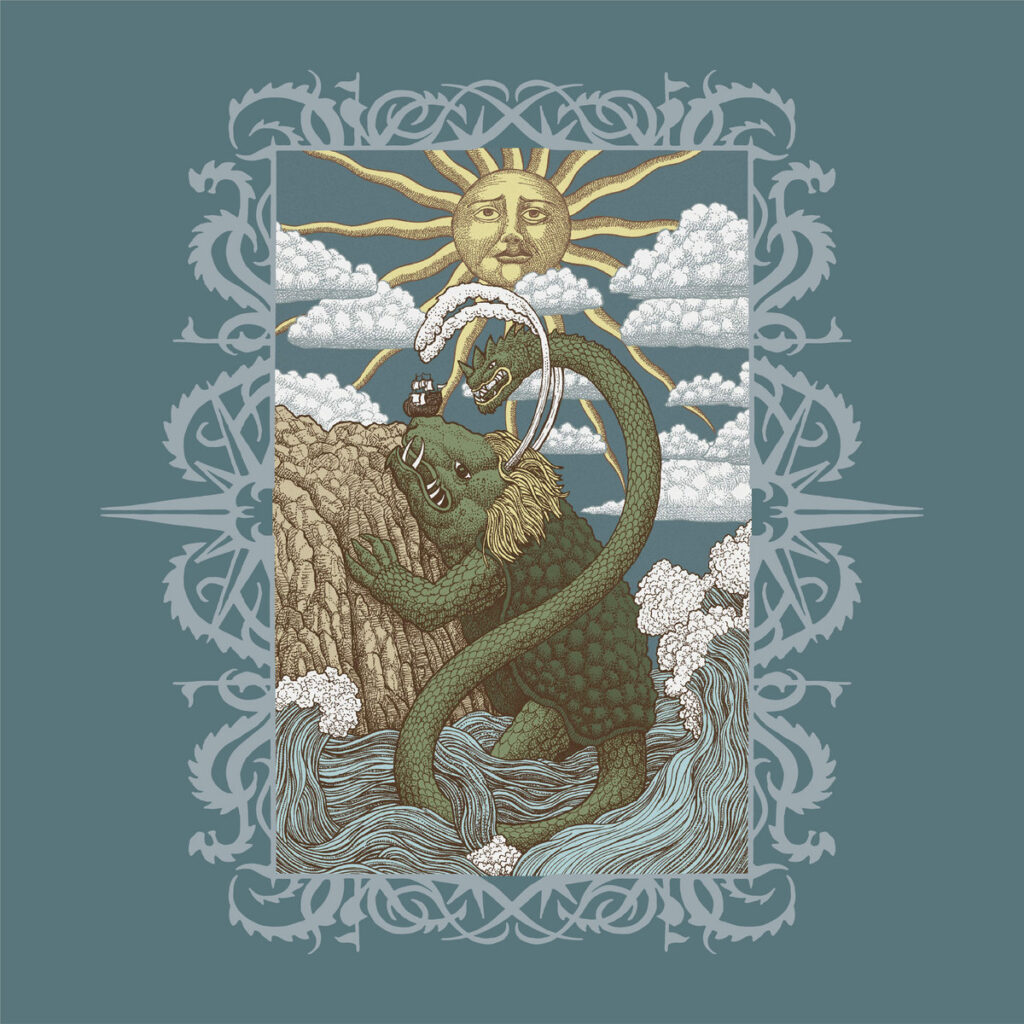
Hello, Giuseppe. Welcome to Funeral Echoes! I’ll dive right in. Let’s start with the artwork. The cover immediately brings to mind the “here be dragons” imagery style of old map illustrations. The border, the human-faced sun, and especially the creatures themselves, with a relatively tiny ship completely at their mercy. It seems unlikely to me that this is a coincidence given the theme of travels to distant lands. How intentional was this choice and what else would you like to share about the artwork?
Hi, first of all, thank you so much. The cover was created by the talented Italian illustrator STRX, and I commissioned it myself. As you rightly noted, the main theme of the album is an imaginary journey through real (or even unreal, as in the case of Freezeland) geographical locations, on the edge of reality. Fundamentally, it’s an album based on utopia, in the Greek sense of the term (“οὐ” + “τόπος” means “no place”).
For this reason, for the cover I asked STRX to draw inspiration from the illustrations found on geographical maps from the medieval era or the early modern period, where cartographers often embellished maps by adding fantastical sea monsters and the like.
STRX came up with this depiction, which in turn draws inspiration from the legend of St. Brendan, and I think it’s very much in line with the conceptual idea behind the Atlantic Ridge album.
The legend of St. Brendan is a fascinating reference — a monk sailing toward the edge of the world and encountering strange creatures and islands along the way… and even an island that turned out to be a creature. Does this legend inform the album beyond the artwork, or was it purely a visual inspiration for STRX?
No, it’s just a visual inspiration. But as I was saying, I think the idea of drawing inspiration from medieval or early modern maps works really well because it captures that sense of “distance in time and space” that I wanted to convey with the album.
I think it certainly does capture that quite well with the cartographic reference, the otherworldly aesthetic, and the fact that the only man-made object in the frame is tiny compared to everything around it. Now, moving on to the concept: what immediately struck me about the lyrics is how purely descriptive they are, which is very atypical for metal, where lyrics tend to be either very expressive or very philosophical. They seem to be born from a deep and honest desire to share these wonders and the history and mythology surrounding them, and your fascination shines through the words. Can you give me a rundown of what you wanted to convey with the album and what inspired you to take on this theme?
Let’s just say that the idea of writing lyrics that are more descriptive than suggestive isn’t new to me, since it’s also the foundation of my “best-known” band, Thecodontion (even though in Thecodontion another member writes the lyrics). In any case, I wanted to create a sort of “bridge” between reality and fantasy, between concreteness and imagination, providing real physical and geographical references through an imaginative reworking. Mind you, I do like a more allusive, allegorical, and philosophical approach, but with Atlantic Ridge I wanted to try to emphasize this dimension that perpetually straddles imagination and reality. As I said before, it’s almost like there’s always this subtle “utopian” thread that almost gives the idea of being able to imagine yourself anywhere, yet nowhere at the same time.
The utopian thread keeps surfacing in how you talk about this album, you’ve mentioned it twice now. Was “utopia” the conceptual starting point, or did you arrive at it gradually as the project took shape?
The second one you mentioned! Quite simply, the starting point for this project was my passion for geography. When I was 6 or 7 years old, I had my parents buy me a globe, and around that time I started memorizing all the capitals of the world. It was as if learning the names of those cities, which sounded so distant and exotic to me, took me far away in my imagination, almost into another dimension. I also believe that, to some extent, many metalheads are interested in some geographical aspects: if you think about it, many of us love to delve into specific music scenes, and and we’re used to thinking of these scenes as divided by country or geographical area. And I don’t think I was the only one who, especially during adolescence, spent hours and hours on Metal-Archives searching for bands from somewhat unusual countries.
But getting back to the original question, the idea of linking this project to a personal conception of “utopia” came about gradually. As you can see, though, this space-time dualism between place and non-place has always fascinated me, even when I was still too little to be fully aware of it.
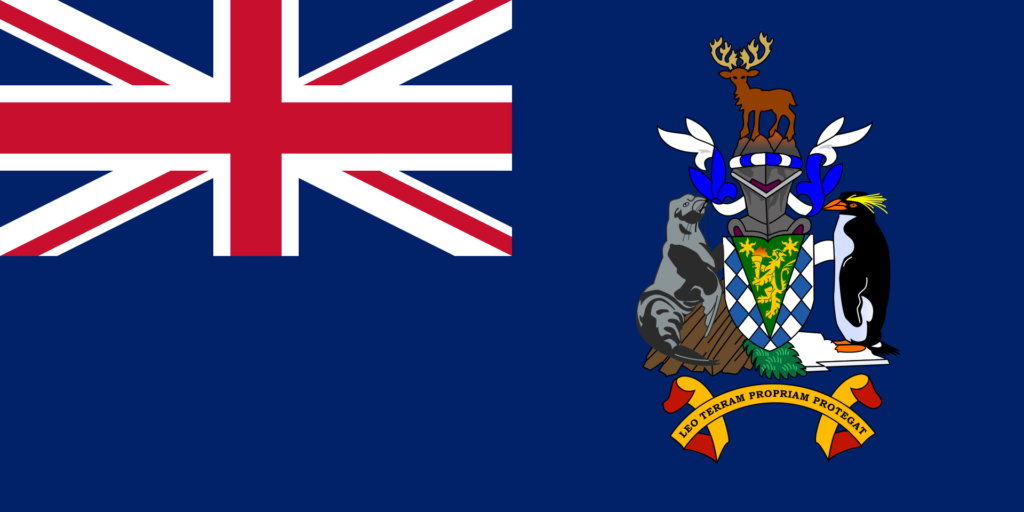
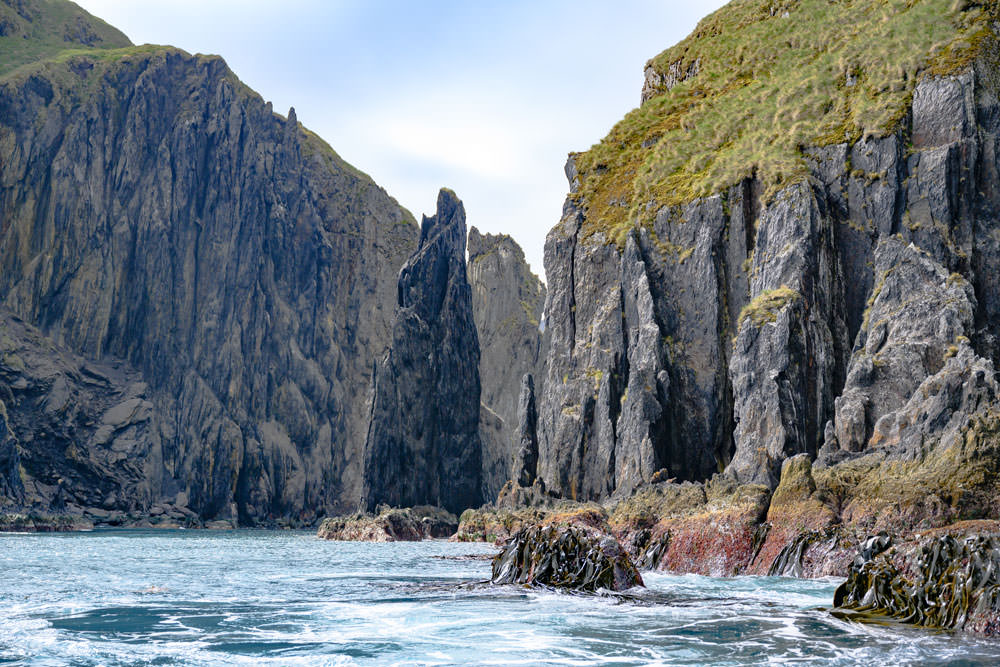
The entire lyrics for the opening track repeat the single line: “Leo terram propriam protegat,” the Latin motto from the coat of arms of South Georgia & the South Sandwich Islands, while the other tracks build their lyrics a lot more around describing history, culture or lore surrounding the places they depict. What made you choose to open the album with just that one line and what does the phrase mean?
The answer here is very simple: basically, that track started out as a simple intro, so it was meant to serve purely as an introduction. Later, however, that intro was developed into a full-fledged song, while still building on a single riff. Given its minimalist structure, the repetition of a single phrase (as if it were a mantra) was, in my opinion, perfect for the context.
As for its meaning, “Leo Terram Propriam Protegat” in Latin means “The lion protects its land”, and as you rightly pointed out, it is the motto of the territory of South Georgia and the South Sandwich Islands.
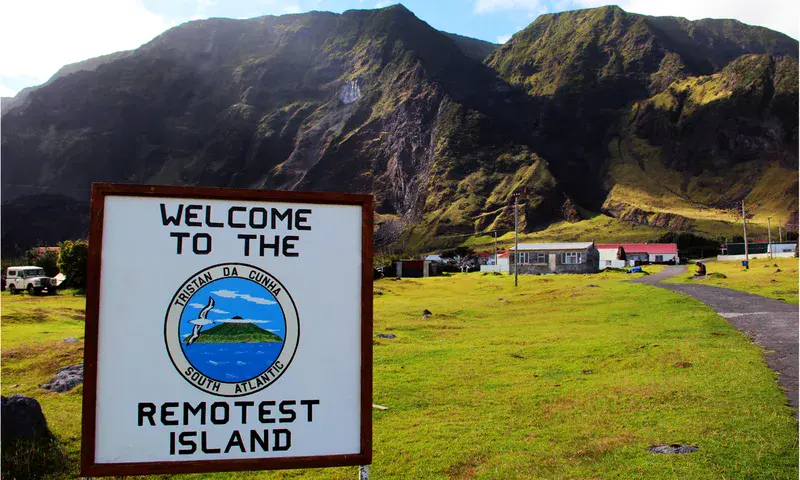
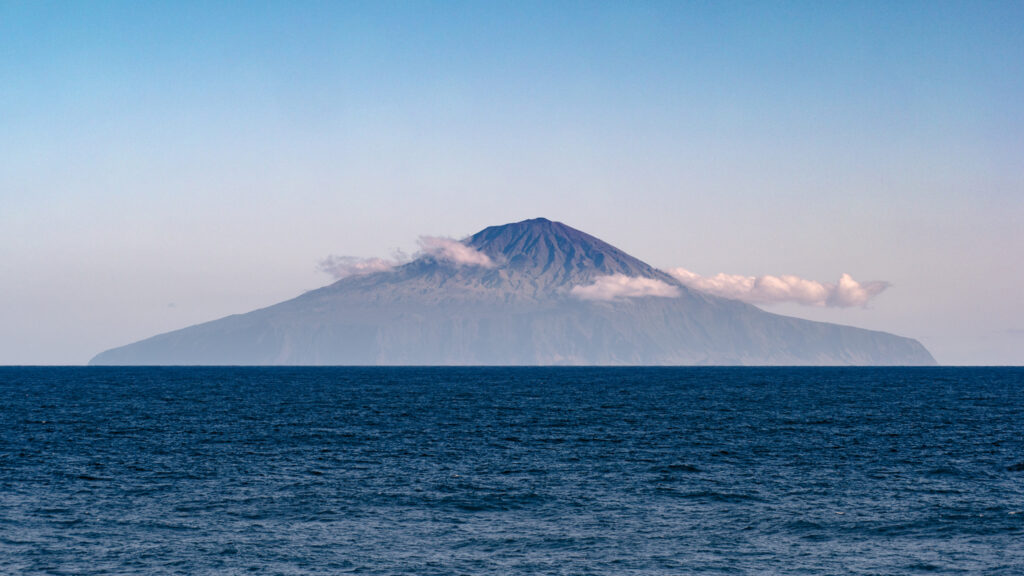
Reading about Tristan da Cunha, almost everything in the lyrics can be traced back to a specific, verifiable source; the coat of arms description, the rock lobsters in the surrounding waters, the naval crown, the longboat, the island’s extreme remoteness. The one line that doesn’t seem to come from any official source (at least not one that I could find) is “total isolation means total freedom.” Was that your own interpretation of what the island represents? And what drew you to Tristan da Cunha specifically?
Yes, it’s basically a very descriptive text. The line about isolation draws on the history of the inhabitants of this small island, because, in fact, it was their choice to isolate themselves and create a very small community. Incidentally, in 1961, Tristan da Cunha was struck by a series of earthquakes and volcanic eruptions that forced the population to evacuate, effectively emigrating to England (to Southampton, if I recall correctly). When the situation had calmed down, in 1963, almost all the islanders decided to return to Tristan da Cunha, so as you can see, it’s a strong bond driven by a deep sense of community and freedom, or at least that’s how I interpreted it.
I also think that the concept of “utopia” fits very well with Tristan da Cunha, this time in a much more literary sense: the idea of such a small community, which effectively lives in self-government and whose economy is based on barter, reminded me in some way of the setting of Thomas More’s novel “Utopia“.
Beyond that, several years ago I had a short-lived musical project called Turdus Eremita (named after a bird native to the island), which was specifically about the island of Tristan da Cunha. Although with a different lineup, more specific themes and a rougher musical approach, that project is, in a way, a sort of “ancestor” of what Jacopo Gianmaria Pepe and I later developed in Atlantic Ridge.
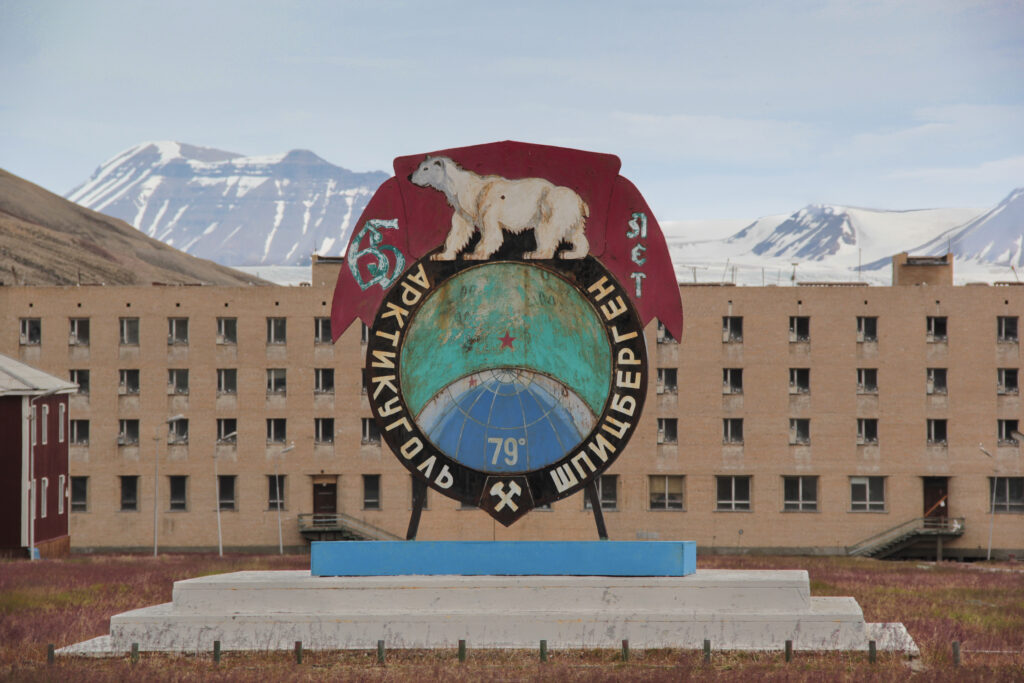
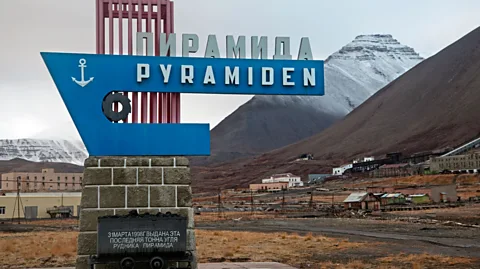
The lyrics describe Pyramiden with a single haunting detail: it was abandoned in 1998, and “no one knows why.” From there you move to the Arctic preservation timeline — buildings still visible 500 years from now — and close on the northernmost Lenin monument standing alone in a ghost town. It’s a very sparse portrait but an evocative one. What drew you to Pyramiden, and what does a place like this represent to you conceptually? And do you have a hypothesis or an educated guess about why it was abandoned?
The depopulation of Pyramiden was due to the fact that it was essentially a Russian settlement in the Svalbard archipelago (although it was originally founded by Swedish miners), and that the Russians used it for coal mining. After the collapse of the Soviet Union, however, funding dried up, and in 1996 there was a plane crash that killed many people. From then on (the last residents moved away in 1998), it became an abandoned settlement. The reference to the Lenin monument, in fact, isn’t political: it’s more of a symbol of the past standing over a ghost town. Although, as far as I know, for a few years now there have been efforts to exploit its niche tourism potential, let’s just say that right now it’s semi-deserted.
Here too, I was inspired by this duality poised between different aspects: a ghost town, extreme climate, hard to reach… in short, a perfect setting for the album we created.
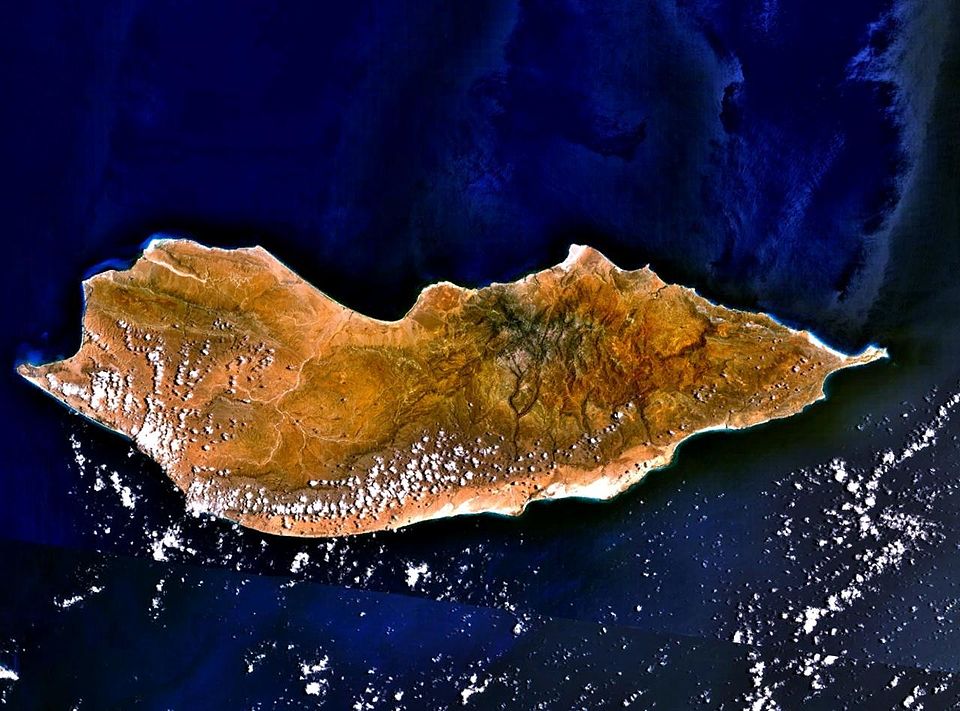
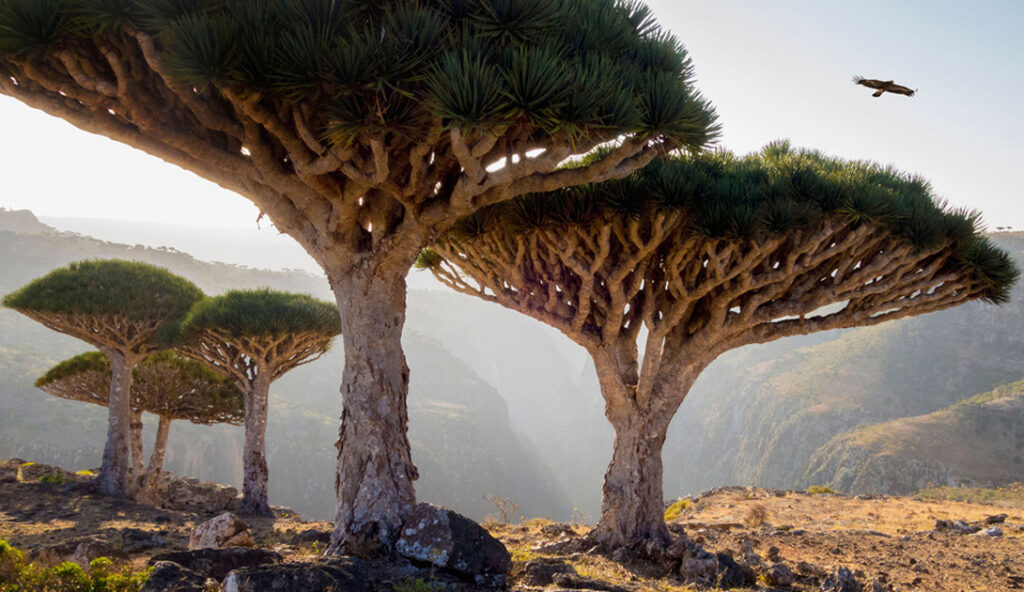
I looked this place up and it’s absolutely stunning. Socotra gets described in you lyrics as both “the most alien-looking place on Earth” and “the last paradise on Earth” — two very different ideas that the lyrics seem to hold simultaneously. The climate stanza also repeats, almost like a refrain, which gives the track a cyclical quality, as if the monsoon season keeps returning regardless of anything else. How did you approach writing about a place this visually extraordinary, and what does it mean to you to call something both alien and paradise at the same time? Also, you should look up pictures of Landmannalaugar in Iceland and tell me what you think.
Socotra is simply a unique place. It shares some common traits with the other locations I’ve mentioned so far: its uniqueness, its remoteness, and the fact that it’s difficult to reach—partly because it’s at the mercy of the winds… It also has a very distinctive geographical location, straddling Asia and Africa while belonging to Yemen. We’re also talking about one of the places with the richest biodiversity in the world, a fact that shouldn’t come as a surprise, given that remote islands generally offer just that. In my writing, I tried to draw inspiration from the beauty of its landscapes and the richness of Socotra’s colors, simply relying on my imagination. As for Landmannalaugar, well, Iceland is simply one of the countries I love most from a geographical standpoint, so I was already familiar with that place. Simply breathtaking, like many Icelandic landscapes, for that matter. I’ve never been there yet, but even though Iceland has become much more touristy than in the past, I hope to go there sooner or later. And who knows, maybe one day I’ll even get to play there (not with Atlantic Ridge, since that’s not a project we’ll be performing live).
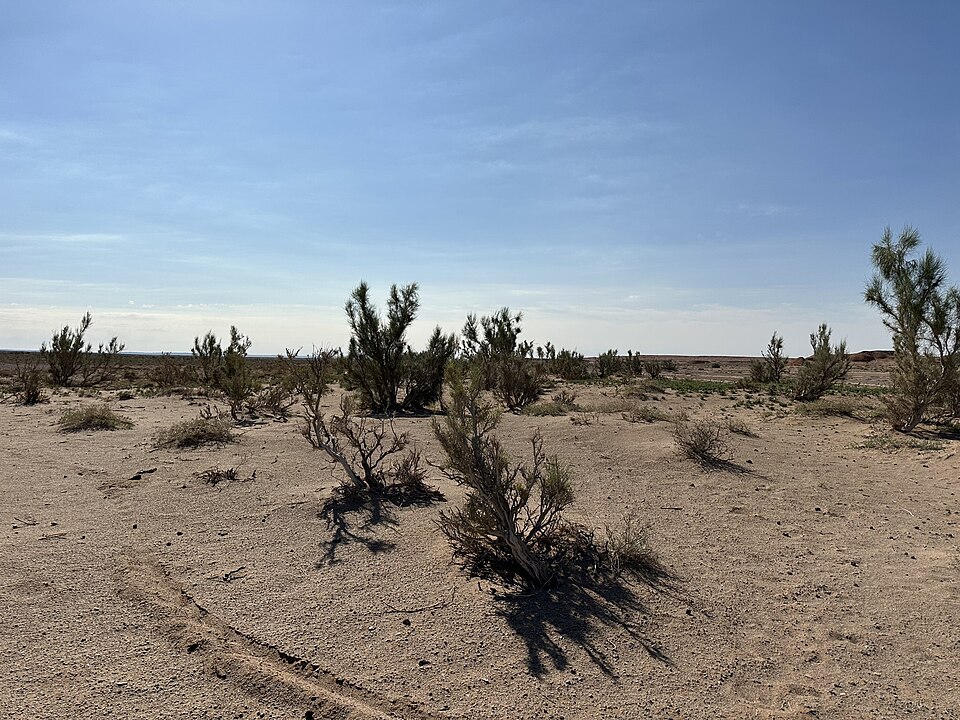
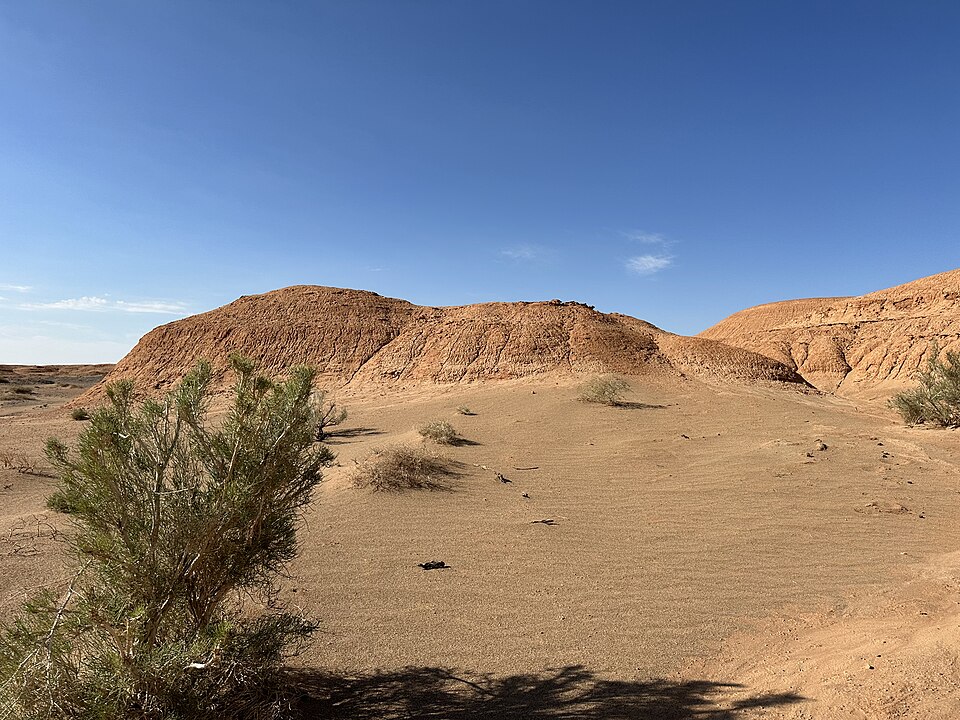
The closing track is the only one written in first person,which I found quite interesting — we have five songs of outward observation and suddenly there’s an “I” losing itself in the Gobi Desert. It also contains one of the most striking musical moments on the album: around the four-minute mark the guitar mix drops down completely and the mix becomes entirely low-end, stripping away the melodic layer the listener has been anchored to. Was the shift to first person a deliberate choice for the finale — the traveller finally turning inward after the journey — and was that moment of sonic emptiness at minute four intentional? I also found the instrumental outro to be very interesting, it goes from erratic synthwork to a funeral doom passage, and finally moves on to a nice clean part before fading out. What prompted these creative decisions? Why did you decide to go for a more “immersive” type of approach to the lyrics here?
I’ve always been really fascinated by albums that, with a long track at the end, almost try to encapsulate the entire album’s content into something all-encompassing. The first-person lyrics are also deeply introspective, something that tells you, “I imagined this album; this is my imagination; this is what you see through my imagination when I picture myself in Mongolia in the Gobi Desert”. The creative decisions are also driven by a similar idea: there was an urgency to create something that served as a conclusion, at times almost “progressive” as you’ve noted, even though there are obviously repeated sections. After all, I’m someone who loves cyclicality and hypnotic sensations in songwriting, especially in metal, even extreme metal. Even the emptiness you rightly noted is partly dictated by that sense of disorientation you feel when you realize your journey is ending and you’re on the home stretch. If you will, it can also be interpreted as a metaphor for life and death, though in this case my aim wasn’t so much tied to that but more to the journey, discovery, and introspection.
Freezeland is the only place on the album that never existed — a phantom island that appeared on North Atlantic maps for a century, traced back to the Zeno brothers’ navigational errors. Yet the lyrics close on “but in the hearts of those seamen, Freezeland is the non-existent island” — which reframes the error as belief, something real because people needed it to be. Given everything the album explores about the border between reality and imagination, was Freezeland always going to be on this album? And does a place that exists only in the imagination feel more or less utopian to you than the real but unreachable places elsewhere on the record? And finally, do you think it might be based on something real? Maybe something lost in time?
Those are all excellent questions and insights, and I actually asked myself the same things while working on the album. I definitely wanted to talk about Freezeland from the very beginning, because I’d known its story for many years and have always found it fascinating how a simple mistake can sometimes give rise to beliefs and legends so compelling that they even get officially confirmed. If you will, a precursor to fake news, haha! But I believe that, precisely because the island doesn’t exist, “Freezeland” is the track that best embodies the concept of “utopia” (again, understood more as a “non-place”) that I wanted to express from the very beginning. So: yes, perhaps this is precisely the pinnacle of the concept of utopia that permeates the album, precisely because it is a place that never actually existed. As for whether it was based on something real… well… yes, in the sense that back then there weren’t the tools we have today, obviously, and navigational errors could happen. I imagine the Zeno brothers were truly convinced they had discovered a new land.
You describe Freezeland asa precursor to fake news, which isa fascinating angle. There’s something almost tragic about it too though: the Zeno brothers were genuinely convinced they had found something real. Do you find yourself more sympathetic to the believers or more fascinated by the mechanics of how the myth perpetuated itself? And is the album in any way, partly maybe, a satire of the modern media landscape?
I wouldn’t exactly call it a satire of today’s situation: perhaps more than fake news, it’s actually more accurate to say it’s a mistake that became truth for about a century. If I had been a navigator of that era, I certainly would have been acting in good faith: after all, who wouldn’t want to discover a new land? But I also don’t rule out that there were those seeking a certain “sensationalism” in their maritime expeditions: after all, navigators set out on these missions on behalf of the rulers of the time, and I imagine they were well rewarded in the event of major discoveries. But beyond that, I’d say that history’s various “mistakes” have always been fascinating: they’re the things we’ve now dismissed, but which for a time were certainties for the people of that era. Think, for example, of how many people in the Middle Ages believed the Earth was flat: today, almost anyone would laugh at that.
You mention loving cyclicality and hypnotic sensations in songwriting. How much of that sensibility shaped the album as a whole?
I couldn’t tell you exactly “how much” it influenced the album. I just think it’s an approach that’s been a part of me ever since I started writing music. I tried to tone this aspect down a bit on the album because I also needed to find more or less melodic variations, but I have to say that, in my opinion, the repeated riffs on this album work well. In general, both a certain type of doom metal and atmospheric black metal lend themselves well to the cyclical nature of riffs or sections.
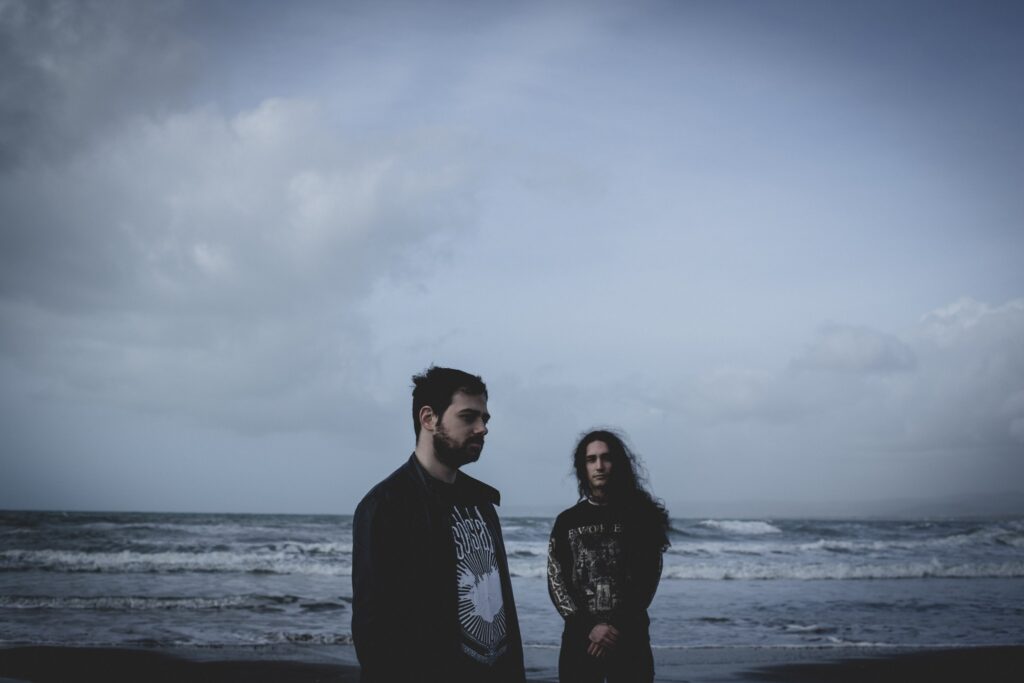
We’ve spoken in detail about the concept and the lyrics, which are your domain. But Jacopo is responsible for the guitars,bass, keyboards and arrangements, essentially everything the listener actually hears. How did the collaboration work in practice? Did you bring him the concept and locations and he built the music around them, or did it develop more organically than that?
I didn’t limit myself to just the lyrics and the concept: I wrote most of the music myself. I have to say I’m not a great musician: I mean, I can barely play bass, but that experience was useful because it enabled me to compose. This means that I presented Jacopo not only with the concept, but with the entire album already composed. Then I left it up to him to rearrange some parts, and in any case his contribution was fundamental because he smoothed out some of my rough edges, given that, as a self-taught musician, I have some theoretical limitations. He also played an important role in choosing the right sound for the album, so I’d say his influence is very much felt, even though I was the one who actually wrote the music.
The album also features Gabriele Gramaglia on drum programming and Elisa Mucciarelli providing female vocals on the opening track. How did these collaborations come about, and what did each of them bring to the record?
I’ve known Gabriele for many years; I certainly don’t need to introduce him, since he’s a well-known name in the Italian extreme music scene. I really wanted to collaborate with him in some way, which is why I asked him to contribute on the drum machine. Elisa, on the other hand, is my partner: but there’s no favoritism here, in fact, I asked her to participate in this project before we even got together. Back in 2020, she sent me some of her old material, and I immediately thought her voice would have been perfect for a small part on this album: the rest is another story.
Different listeners seem to hear it very differently… one reviewer described it as disjointed but my impression was the opposite, the two genres felt very intertwined. Were you consciously working toward a specific balance between black metal and funeral doom? Is that the sound you had in mind before you started working on the album?
Yes, I remember that review. Even though almost all the feedback was positive, it’s understandable that someone might have had a different impression. I tried to do black metal in its most atmospheric form to depict wilder landscapes, while the doom sections helped me give the album a more ethereal aura. At the same time, I tried to write believable transitions, because I don’t like it when slow sections follow fast ones without any smooth transition: it would feel too forced to me. The idea of combining the two genres had been there from the start, especially in this particular form: after all, black/doom isn’t a very popular mix, but you can approach it in different ways. Think of bands like Barathrum, Bethlehem, Beherit themselves… at their core, they’re all black metal bands with doom elements, but with a completely different approach from the one I use in Atlantic Ridge. More than the genre, however, what was even more important was the “feeling” we wanted to give the album, and I think this was Jacopo’s main role on the album, because he managed to create a sound that was ancient, yet atmospheric and cinematic at the same time. All without ever betraying our old-school roots, which are still the foundation of my compositions (in general, not only in Atlantic Ridge).
What were your main influences for the overall sound and atmosphere of the album, in terms of the 2 interwoven genres?
I should start by saying that my musical interests in black and doom metal were a bit different back then compared to my current tastes. After all, when I wrote this album, it was before the pandemic; a lot has changed since then, and I’ve found myself increasingly drawn back to ’80s/’90s extreme metal. My main influences for Atlantic Ridge were “modern” atmospheric black metal bands with long, sustained riffs, like Wolves in the Throne Room or early Altar of Plagues, but with the sense of tragedy and slowness found in certain death/doom or funeral doom bands, such as Evoken, early Ahab, and Loss. There are bands that have blended these genres, which I really appreciate, like The Ruins of Beverast or Elysian Blaze, from whom I might have drawn inspiration for the album’s most epic moments. I think, however, that the best thing about the album is that, deep down, it doesn’t really resemble any of the bands mentioned, except for a few elements here and there. I think that in the end, it turned out to be a fairly original album, beyond whatever I might have been listening to at the time. In general, though, on a personal level, my first interest in extreme music has always been black metal, which remains my main area of focus.
What does the future look like for Atlantic Ridge? Do you have another release planned out, and if so, what can you tell me about it?
The future is always uncertain. Over time and through experience, I’ve learned that plans don’t always work out, and that things often change along the way, so it’s wise not to say too much about future plans and ideas. I’ve already mentioned upcoming releases in interviews in the past that never actually materialized, so I prefer not to unveil too much. What I can say is that I wrote another album around 2020, so that one is pretty dated now too: I’d like to revisit it and finish it. Without stress, but also without taking another eight years, hopefully, haha. If so, it would be a concept album centered on a very specific geographical area, but we’ll see. Otherwise, I’d like to continue in a similar direction, without changing too much but still delving deeper into what we achieved on the first album. I’d also like to give more space to female vocals in the future, because I think they can add an even deeper and more personal dimension to the project.
What are your favourite contemporary black metal and funeral doom acts?
As I was saying, my tastes have changed a bit over the last ten years. Paradoxically, I’ve gone “backward”: after really appreciating the experimental and avant-garde approaches in extreme genres during my early 20s, I’ve rediscovered the pleasure of returning to the genre’s roots. I’ve also embraced the concept of “origin” in another way: after all, that’s also why I’ve created several bands/projects centered about prehistory, in various forms (Thecodontion first, then Clactonian and Sunken Monolith). This means that now I really enjoy those contemporary bands that look at the past (even from a sonic point of view) and re-shape it with their own personality. For example, in black metal I’m an avid listener of the projects from Goatprayer and Black Moon, the two Finnish guys behind bands like Witchcraft, Moonfall, Necromonarchia Daemonum, and others. Another great example would be the bands from the small Ancient Hounds collective: damn, that Selenite Scrolls album that was released recently is so good. I also enjoy stuff like Regere Sinister, Hail Conjurer, Caedes Cruenta, Caixão, Forbidden Temple, Perverted Ceremony, just to name a few. Luckily, there’s a lot of good black metal which is clearly inspired to the glorious past of the genre, but with great personality. As for funeral doom metal, I must admit I’m not too informed about recent bands – even though I enjoyed Dauðaró’s album Svarthol -, so my listenings are similar to those of years ago: my favorite funeral doom metal bands are probably Thergothon, Mournful Congregation and Wormphlegm.
You mentioned that you asked Elisa to contribute before you were even together. Did working on the album play any part in bringing you closer?
No, actually Atlantic Ridge was in a stale fase in that period (around 2020), so she did her parts years after we became a couple. So, I don’t think the project really contributed in bringing us closer.
Now it’s time for the playground questions: What is your favourite flavour of ice cream and your favourite colour? And… if you could choose any superpower, what would it be?
Haha, that’s not the kind of question I’ve expected! I like all fruits/berries ice cream flavours, particularly strawberry, blackberry and blueberry. If I could choose a superpower, I’d probably go with extra speed.
And finally, is there anything you’d like to add that we haven’t covered yet?
No, I don’t think I’ve anything else to add. I just want once again to thank the labels (Dusktone & Void Wanderer Productions) and people involved in the realization of the album. Without those people’s help, the album might never have been released.
Thank you so much for doing the interview, Giuseppe. It’s been a real pleasure.
Pleasure’s all mine! Thanks a lot for the interview, it was very interesting.