Funeral Echoes contributor Jacob Simpson sits down with Marc’hvran, the young one-man force behind the atmospheric funeral doom project of the same name. In this interview, Marc’hvran opens up about his self-taught beginnings and the philosophy behind his songwriting.
At what age did you first start writing and making music?
I got into Metal music in 2019 when I was around 13–14 years old. 2021 was when I started actually making music myself, but I was only making chiptune stuff with this software called FamiTracker. It was pretty terrible at first but eventually I figured out how chords worked, what sounds good and what doesn’t, how to pace songs with different beats, stuff like that. The urge to play guitar and actually make Metal music never hit me until 2023, when I was 17. I picked it up and was almost entirely self-taught, but despite my horrendous playing ability I was recording things immediately, because I just wanted to make stuff.
What musical influences do you have that might surprise your listeners?
Perhaps a convoluted answer, but a little bit of everything and nothing. In terms of Metal, there are a lot of bands that I can say have influenced the structures of my songs, my tendency to use synths, the production, etc., but as far as the composition itself I try to remain uninfluenced and just do what feels right to me. There are probably some subconscious influences in there, but I think my sub-par guitar skills have given me a playing style that translates into unique sounding music.
As far as Marc’hvran specifically goes, of course it’s intended to be funeral doom but the influences could range to a bunch of different things. Thergothon, Skepticism, SLOW, Celestiial, Eloy, Goblin, Tangerine Dream, Raison d’Etre, Cult of the Lizard God are all what I listen to the most nowadays. The purpose of Marc’hvran is to make dark, ethereal, and mysterious music, and funeral doom is just the best vessel for that.
How did you arrive at the band name — is there a story behind it?
It’s not really anything other than I found it and I thought it would represent this type of music the best. It’s the Breton word for “Raven”. I’m partly Irish so the Celtic aesthetic really appeals to me, and while Breton is more of a French-Celtic language, I still find the name to be very appealing.
This project is the most special to me so I went through a lot of trouble picking the best name for it. Originally I had a long list of names inspired by the degenerative eye disease “Stargardt”. So that was weird. I definitely don’t see that working as it is now, but who knows.
How do you balance time in the studio with other commitments like work and family?
Luckily I’m a very quick writer. There are dead moments where nothing motivates me to write, and then all of a sudden it’ll hit me like a train and I have a million ideas that just flow. Writing an album doesn’t take that long, the painstaking part for me is just recording and mixing and adding all the little extra parts I like to add. But it’s painstaking in a good way, the reward is heavy, or else I wouldn’t be doing it!
I’m a college student in engineering so there is not a lot of time throughout the semester to pick up the hobby, but that gives me a bunch of built up energy and ideas when finals are over and I can finally go back to writing again. Family is very important to me and I have a good relationship with everyone at home, so I spend a fair amount of time with them. The best time to write and record is when it’s dead at night and everyone is asleep, haha.
How has your sound evolved since those early days, and what prompted those changes?
I’ve gotten better at guitar, still not great, and hardly any endurance to play fast music for lengths on end. But I think with Marc’hvran I’ve finally found the sound I’ve been chasing since I started, something dark and ethereal and unorthodox. When I started it was just all about Black Metal — Black Metal meant evil, Black Metal meant raw and furious. And I would just spit out whatever riffs came to my mind and not really experiment with anything else. Marc’hvran is kind of a disciplinary project for me that allows me to think about atmosphere and let the music breathe, so to speak, instead of bombarding my music with meaningless passages.
Sorrowcrown is my other project that is kind of the threshold between my early Black Metal stuff and Marc’hvran. It’s a completely experimental, varied project with no rhyme or reason, just to simply write whatever I felt like writing but experimenting with a ton of different things, trying to find my sound. There are traces of Funeral Doom in some of those albums. It’s a project I feel is very important for how I got to where I’m at today, and it took a couple years of trying a bit of everything to land where I wanted to land.
Have you played any live shows, and do you have any memorable stories from them?
I have not, and I probably wouldn’t be comfortable doing so until I’m actually decent at playing guitar, and acquire some other band members. Unless I strictly did vocals or keys. But the other problem is that I never keep the tabs for my music. Once it’s done, it’s recorded, it’s gone, because I never really intended on it being a live performance project. I have a good ear and I could definitely figure out the riffs again if I needed to, because my playing is so simplistic it’s not like trying to decipher some technical genius. It’s all power chords. Perhaps one day Marc’hvran will take the stage, I think the atmosphere would be great live. I’ll just need more time and money to make that happen.
To share a memorable story from home — when I was recording the Sorrowcrown album Etherealessence, lightning struck near the house and sent a shock through my hand while I was recording the interlude. You can hear it on the album.
What is your creative process like when writing music? Do you start with a concept, a melody, or something else?
Mostly I’ll start with a riff or passage and just build off of that. There are a few times I’ve done concept albums where I’ve set out for a specific sound/atmosphere, but usually I just do whatever sounds good at the moment and the atmosphere builds itself. A lot of artists have banks of riffs that go unused, but I try to use everything that I come up with. In bursts of motivation the music flows in a way which doesn’t require a lot of thought, it’s just pure darkness in tangible music form. That’s not to say there is no effort or knowledge behind it.. I always know what I want to achieve when a song is being formed. I know what sounds good or bad in a particular context. That being said, I can’t improvise, it’s purely trial and error until something clicks. Once something clicks I know I’ll use it. But it’s all very natural, like I said I have bursts with lots of ideas that more or less happen to work together well. I always like writing songs that build up to grandiose climactic endings.
Side note: actually very often accidents will happen during songwriting that change the dynamic of the song entirely and I know it will fit better. For example, missing a note or hitting a wrong chord that creates an interesting progression. Happens a lot, like I said, my inexperience is probably the biggest factor in what makes the music unique.
Without a band or a large team, how do you manage the juggling act of being the songwriter, producer, and promoter all at once? What is the biggest challenge you face when you are deep into the creation process alone, and how do you overcome it?
I much prefer working alone with songwriting. I think if anyone else were to chip in they wouldn’t have the same vision that I have, and ultimately it would not be as personal of a project as it’s meant to be. I don’t see writing music as a business endeavor. I do it because I love it — it’s a hobby, a release. And I love the underground scene, connecting with people and just being a part of it and contributing something that hopefully like-minded people enjoy. I am very proud of what I create and knowing that the effort is entirely mine is the biggest reward of all.
As far as promoting and other connections, I have a lot of people I would consider friends who I would not be at this point in music without. The internet is one of the biggest curses on mankind, but it also has its blessing that allows me to communicate and share ideas with people I would not see otherwise where I’m from. Many of these people I owe everything to shaping my taste in music and inspiring me to continue writing and digging deeper in the underground. I think the best promotion of all comes from their support.
The biggest challenge I have is simply my inexperience in playing, production, mixing, etc. But these are all natural challenges that any amateur would face when making music. What’s important to me is that the music is listenable and true-spirited. I still don’t know hardly anything about EQ or DAWs or interfaces, just the bare minimum to be able to record and get my ideas across. It doesn’t matter when you’re trying to create something unique — why try to sound like anything else? But again, this is where I’d turn to my friends for support if I was ever questioning a particular method of production.
Does the isolation of a solo project allow you to be more extreme or experimental than you could be in a traditional full-band setting?
Yeah, although I wouldn’t say extreme. Marc’hvran is not meant to be extreme in the sense that Death/Black/Doom Metal tends to be. In fact I think it’s on the more mellow end of Funeral Doom bands. But being a solo project definitely allows for creative liberty and more room for experimentation.
Extreme subgenres like Black, Doom or Death Metal rely heavily on atmosphere. What non-musical influences (e.g., horror films, literature, or your local environment) shape the “world” of your project?
I love 70’s/80’s horror movies, childhood cartoons and video games, and my home environment; all of which have some sort of nostalgic bearing on my music. The night time is very important to me, the world at night is so peaceful yet simultaneously threatening. It’s the perfect atmosphere to want to capture in music form, which I have been working on with a personal ambient project. But then it’s just a question of “what sounds like the night?” and I think that is up to interpretation and personal experiences. I also love lakeside birdsong and field recording stuff, another thing that just transports me to a more peaceful moment of life.
With Marc’hvran specifically there is no goal to try and connect the music with past nostalgia. Rather, the intent is to create new atmospheres that, in the far future, will connect me to this present moment. Then the music becomes even more special to me when I can associate it with a time in my life I might have forgotten otherwise. The music is more than melodies and progressions, it’s a time capsule, and that’s the magic with a project like this. It’s been proven with acts like Thergothon and early Skepticism. There’s a feeling there that could only be evoked by such magic: the feeling of being there with the music as it was written, as if it were being played for the very first time. Much like a photo album, a musical album can hold memories, if you give it that potential.
How do you navigate the modern metal scene and reach your target audience when heavily relying on digital platforms like Bandcamp or Patreon?
Well, I’ve never used Patreon and I don’t see why I would need to. Bandcamp I think is a convenient uploader, but really YouTube is the main and best source of media for this type of stuff. Overall I think the internet has allowed a ton of uninteresting and uninspired slop to enter the underground, which has made finding anything worthwhile that much harder, but it hasn’t deterred me from trying. I fear it will deter others, though. And eventually you just have to be lucky or have enough good connections to get noticed, or have everyone that notices you be fake bots haha. But these are problems for people who want to excel in the underground, or god forbid make a living on music. I will never make a living off of what I make. Call it too niche, or whatever, but underground Metal and much less Funeral Doom have an actual stable enough fanbase to be concerned with the “audience”. I have my music out there to be heard by people who like this kind of thing, but I don’t expect to rise to the top and I don’t think I would want to. Underground promotion like this is where I prefer to stay, where people who want something like Marc’hvran can find it easily, but all else are gatekept.
Do you add the vocals first, or after the music has been created? Do you already have the lyrics and vocals thought out, or are they added to fit the mood and atmosphere of the music?
The vocals are always the afterthought, I never start with lyrics or vocal patterns when I write. I’ll write the instrumental parts with some vocal sections in mind, knowing there will be good places to fit them when the song is building up. Overall I think the instrumentation speaks more than the vocals/lyrics, but the vocals are a necessity. For Marc’hvran I don’t keep the lyrics. I will write absolute filth and nonsense and however it sounds on the first take is what goes into the song. All I care is that they sound as repulsive as possible.
Do you have a favorite track on the album? What is the story behind it?
My favorite track is Self. It was written in about 3 days, and is probably the best song I’ve written (or so I’ve been told). But yeah, I am really proud of it, everything just flowed nicely when writing it and the final section still gives me chills. It’s everything I’ve wanted to close an album with.
Has your geographic location or local scene influenced the direction of your project?
I am the scene here. I live in the middle of nowhere, and my college life is not much different. But yes, geographically I can say the woods that surround and raised me are very special to me and the way I approach atmospheres. There’s a calmness there that not many would think could be conjured by Metal music, but it can. It’s not always about the extreme.
If you could collaborate with anyone, who would you most like to collaborate with?
The best collaborations are with friends. I’ve done a split with Raven’s Hike which came about when I contacted them showing support, which I like to do with a lot of underground bands that catch my interest. Now we’re always in touch. I try to be as tapped in to the scene through the online world as I can, because there is nothing here where I’m at. So perhaps because of that more splits will arise with other small artists in the future. Otherwise, if I could choose to do a split with absolutely any band… probably Scald.
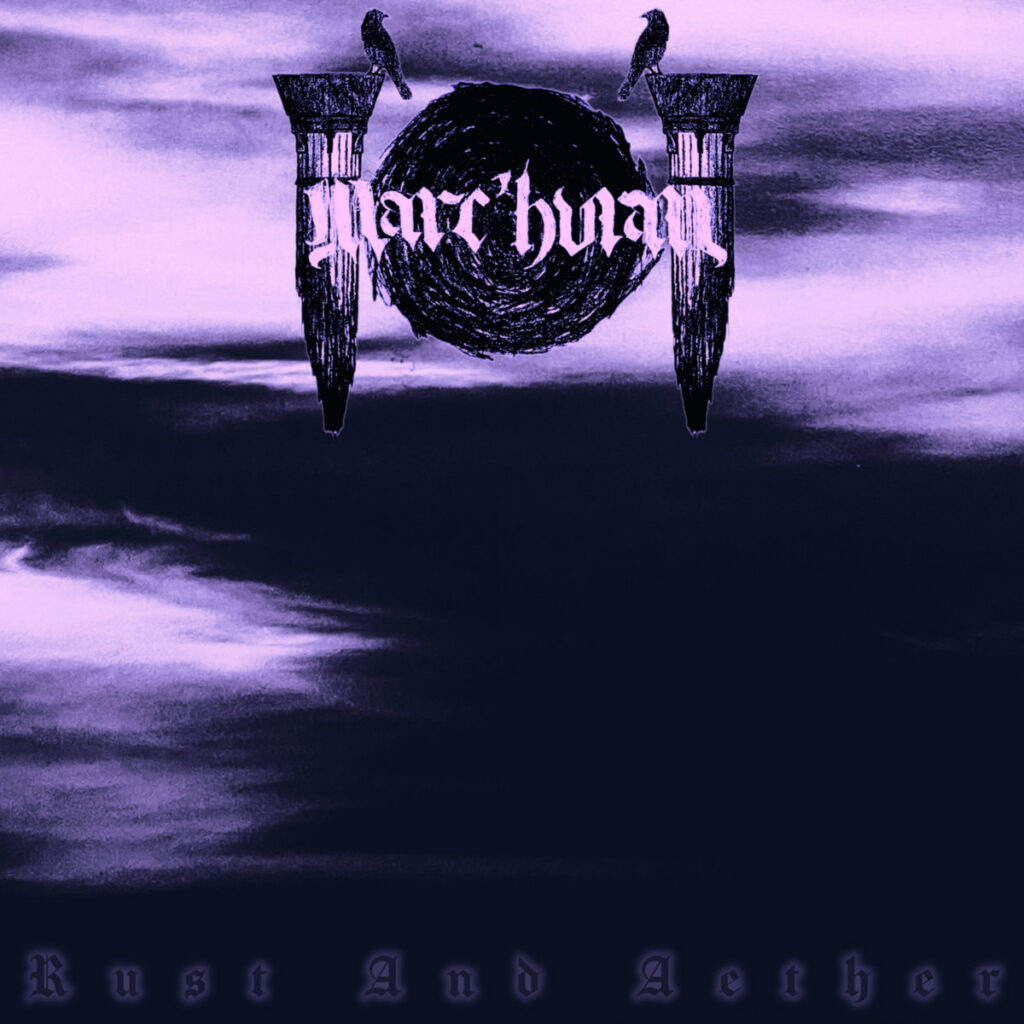
What are you working on at the moment? Are there new music plans after the Rust and Aether album?
As of writing this I’m working on a new full length for Marc’hvran that will most likely be released soon after this interview is out. It will be titled Cult Dark Meditation.
Are you mixing and mastering the album yourself, and was it recorded live?
Yeah all the mixing is done by myself. It’s a bit tedious but nothing beats the home style production. Lots of stuff is over-saturated nowadays, or too much thought is put into EQ and leveling and stuff. I like to play it by ear.
Do you use session musicians, or do you create the instrument sounds yourself?
Nope, everything is recorded and performed by myself. Even if it’s sloppy. At least it’s me.
Is the next album going to be a similar sound to Rust and Aether, with the same chord progressions? And do you play down-tuned or in standard tuning?
It’ll be similar compositionally but there are many differences already in the production. There will be much more synth, and although I really like the quieter guitar production on Rust and Aether, the dist guitars are more forefront on this upcoming record. But for good reason. After this I’ll probably go back to something like Rust and Aether’s production, but the new album has to make that change for it to work. Most importantly though, when I listen to it I know it is still Marc’hvran.
I play down-tuned. I believe it’s what you’d call C standard, where it’s like the natural E but every string is down-tuned according to a C chord. No particular reason for this choice, I just landed on it when composing the very first Marc’hvran riff and just decided to remain in that tuning.
Composition & Songwriting
Which practice routine changed your playing/singing most effectively?
Just playing and writing music, I never practiced scales or coordination or anything. I just write riffs and challenge myself to play some of the harder things. Over time I just got better, and I’m still improving. Same thing for vocals, I used to kill my voice trying to pull off harshes but now I’m pretty decent with them, and I can sing clean pretty well too. The vocals I do specifically for Marc’hvran are much easier though, although sometimes I’m basically gagging myself.
How do you approach tone selection (amps, mics, pedals, or vocal placement)?
At first I was using just this 100 dollar Fender amp.. the only controls were to adjust treble, mids, bass. Now I’m using a Boss Katana, it’s got delay and reverb that sounds a lot more natural than putting on effects in post. I don’t own pedals as of right now.
For vocals I’ll add reverb and echo, those are old school techniques, but other than that I prefer to do raw vocal takes without lots of effects. For Marc’hvran, however, there is a subtle vocal layer under the main vocals that are pitched down. This is just because for that style of vocals in particular there needs to be a bit of bass-y depth for them to have more audibility.
Which music theory concept do you return to most often when composing?
I’m self taught and don’t know any formal music theory, but I have learned a lot about what chords favor different progressions and what there needs to be to keep a strong pace going. One of the biggest things I find with anything atmospheric is that less is more… when you’re listening to something simplistic your mind has more room to wander around and fill in a lot of the gaps.
How do you arrange parts to balance rhythm, harmony, and melody?
When I have a riff that I want to harmonize I just visualize/hum it in my head and then put that to guitar. The balance is natural. I can tell if something has too much detail or not enough. Sometimes I’ll just play around a section and see if anything works as a harmony or added phrase, and if it doesn’t I leave it. You don’t need things like that to make a good song but it helps it become a little more memorable.
Where does a typical song start for you: lyric, chord progression, hook, or rhythm?
From beginning to end. I mean, I can definitely write songs where I build the chorus and then write all the other sections afterward. But I prefer to work with a riff that I think sounds like an opening riff, and then just build on from there, see what happens. It’s never failed me. In past projects I’ve had leftover riffs that get turned into other songs, but as far as Marc’hvran goes I burn every riff and just go with the flow. Because I feel it needs to be that way.
How do you decide when a song is finished?
When I listen to it and I feel it has a satisfying pacing with a beginning, middle, and end, just like a story. And it needs to have something different each time from any other song I’ve done, I don’t want to repeat myself over and over under the same formula.
The problem I have with a lot of modern Metal is that sometimes a song will feel like a compilation of riffs that don’t really go together or flow in a satisfying way. I try to approach songwriting not like a bunch of riffs crammed together but as an actual song. Funeral Doom is great for this, there’s room to breathe and the riffs are quality over quantity. It makes the payoff much greater when those climactic sections arise.
What revision process do you use between demo and final production?
I’ll listen to it until I feel like it’s what I want. Go on a walk.. see how it makes me feel. If a section bothers me I’ll change it, wait a bit, then go on another walk and listen again. If I still get chills after the hundredth time I’ve listened then I know it’s going in the right direction.
What does your style consist of? What are some important clothing articles to you, or items you think every Metalhead would or should own?
I’m really just a casual… jeans, flannel or leather jacket, band shirts. Sometimes a bandana. Unorthodox for what I play, I’m not big on corpsepaint or theatrics, but I do respect the culture surrounding that. It’s just better when it’s anyone else but me.
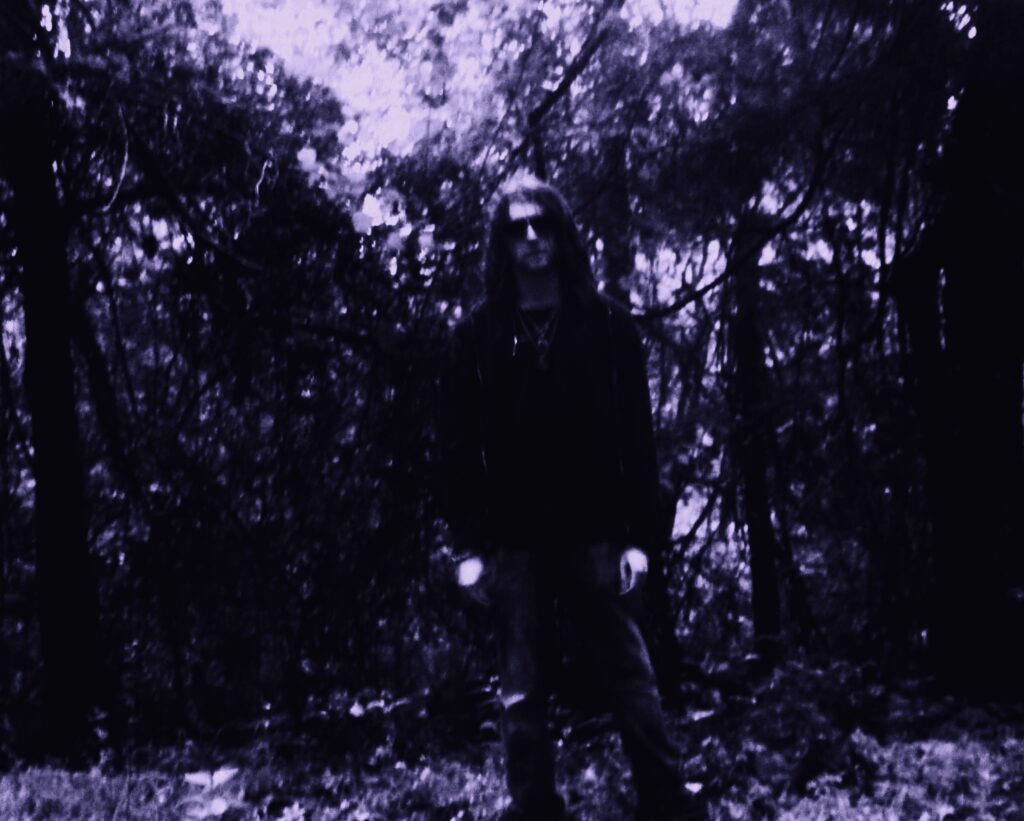
I wear sunglasses a lot on account of having terribly sensitive eyes and an eye with a tendency to turn in.
What instruments can you play?
Guitar is the only thing I can play decently. And then I play bass by association. I use the keyboard but I’m no piano prodigy.
Which instrument is your favorite to play?
Guitar, but my favorite instrument that I don’t play is bagpipes…
Which instrument is your least favorite to play?
Bagpipes…
What would you say is your greatest strength as an artist?
I can’t write bad music.
What would you say is your greatest weakness as an artist?
Production, but that weakness can make music special.
Who is your favorite musician?
Too many. Ozzy, Lemmy, Halford, Wolf Hoffman, Trey Azagthoth, Fenriz, Quorthon, Varg, Darken, Nemtheanga, Lucy Poems, Stijn Van Cauter, Nameless Void & Bestial Devotion, Vrajitor. Non-metal artists Peter Andersson, Jim Kirkwood, David Eugene Edwards, Geddy Lee, Frank Bornemann. And of course Lady Gaga. All of these people revolutionized something in the area of music they perform.
What is your songwriting process like, and which song in your set was the hardest to write?
It depends on the project but usually I’ll just get motivation and sit down and write something from start to finish. Sometimes it’s very fast and sometimes I have to walk away and come back to it multiple times. I don’t feel like any songs were particularly hard to write but they all come with their own challenges of trying to find a good pacing.
How would you describe your music style?
Dark and mystical.
If you weren’t a musician, what would you be doing right now?
Reading, I don’t read nearly as much as I should anymore because I have these other hobbies, but I would like to get back into it.