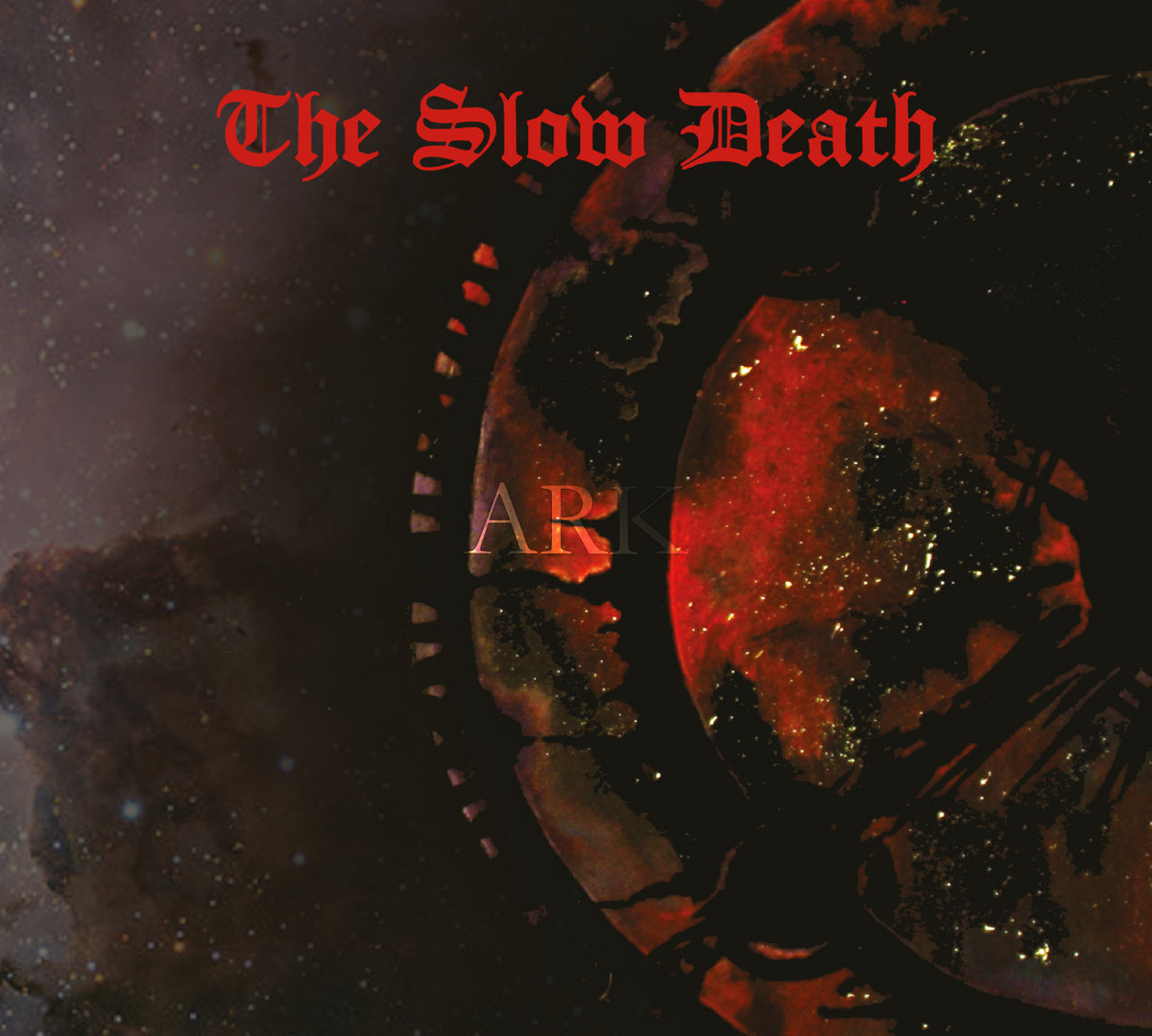
While S from Mesmur describes cosmic decay with almost mathematical precision, The Slow Death chooses the cosmos as the metaphorical stage for a social study that develops parallel to that of the poem Aniara and its cinematic adaptation. It is the story of a humanity unable to face its own Heideggerian thrownness. Heidegger’s philosophy becomes tangible in the musical structure and the lyrics of the album. It is the tale of a spaceship that must leave Earth behind forever after exploitation and war.
The Chosen Ones
The opening track The Chosen Ones describes the departure of the ship, named the Ark, from the perspective of those left behind on the destroyed and poisoned planet. In Harry Martinson’s 1956 epic Aniara, people embark on a journey in luxury, only for an accident to leave them drifting toward their doom in infinity. Analogously, the people of the Ark snatch the last goods from a world heading for destruction, taking even this away from those left behind. The final confession “We stole the earth from our children” bears witness to the awareness of their own guilt and their ambivalent feelings toward the Ark. It becomes humanity’s last beacon of hope and the ultimate expression of a flight from the apocalypse and from responsibility for a ruined world. How much stability and humanity remains for a fragment of humanity without a world and a global community, however, remains uncertain. The departure is accompanied by an electric guitar carried by pathos and confidence, while Mandy Andresen (MurkRat) sings with sublime elegance of the crimes committed against the remnants of humanity.
Severance
With Severance, the Ark leaves the space from which it can view Earth. The survivors, turning away from the last glimpse of their dying home planet, begin their journey with a deep sense of guilt and despair. Heidegger’s idea of care (Sorge) – the human confrontation with one’s own finitude – becomes briefly audible, yet tilts into misanthropic nihilism. With guttural laments and rumbles, bordering on rage, Gregg Williamson regrets human history as a crime against the planet, alternating with confessions delivered by Andresen. The music drives forward while the lyrics head toward the individual chorus lines that name the relationship to Earth in different stages of the first years of the journey: love, regret, longing. Meanwhile, the realization ferments that humanity does not learn from history and has secretly evolved into cosmic parasites, merely searching for a new host.
Ark between Aniara and Heidegger
The archetypal Ark of biblical and mystical narratives becomes a aimless, parasitic splinter in the cosmos, a “bubble […] in the glass of God’s spirit” (Aniara).
The spaceship of the last survivors remains as a fragment of a lost world in the indifferent infinity of space. The journey through the void follows a similar existential trajectory to Martinson’s Aniara, a similar tale of a spaceship that must leave its homeworld behind forever. In Martinson’s poem, the spaceship becomes a symbol for the alienation of humanity: the passengers, who will never reach their destination, cling to memories and create myths to cover up the meaninglessness of their existence. On the Ark, however, unlike on the Aniara, life unfolds. A new generation grows up beyond Earth, within the dystopian relations of the ship, beyond self-determination, forced to maintain humanity.
In their thrownness into the world beyond Earth, Heidegger’s concept of thrownness (Geworfenheit) becomes more tangible than ever. Human existence is comprehensively and fundamentally at the mercy of conditions that elude human control: death, finitude, and being in the face of nothingness are all-encompassing. Only the thin membrane of the ship’s hull protects humanity from extinction by the vacuum. The mechanisms of biopower (Biomacht) described by Foucault, to preserve, optimize, and regulate human life, become the first commandment of the society on the heterotopian Ark. Thus, the thrownness on the Ark gains a cosmic dimension. As a technical vehicle, the Ark is the manifestation of the condition of humanity, a closed world emerged from the destruction of Earth, without the possibility of escaping its past. The survivors on board are confronted with the insight that their rescue simultaneously represents a hopelessness: they have left Earth behind to subject themselves to species preservation in the lostness of space. It is a tragic realization transported with elegiac guitar playing and suffering vocals, conveying a feeling of hopelessness. Only delicate piano notes convey a sense of permanence and beauty in being.
Ark
With the instrumental Ark, the transition follows. The track intones the second part of the album with a gliding ambient style that weaves echoing organ and string sounds into a delicate tapestry of sound. The imagery of sliding over the surface of the spaceship is created to prepare for the changes within. In an inevitable juvenile rebellion, one of the succeeding generations disavows the original idea of the ship. They accuse the first generation of being world-murderers and no longer strive for salvation on a distant planet. In the society of the Ark, in an act of self-empowerment, the ship becomes the world in itself (Thackers world-for-us), and the new humanity accepts a fate of impending demise as a given fact.
Declamation
Declamation strikes conciliatory tones with plucked guitar strings and lets Andresen’s vocals echo into memory between long passages of stripped-back music until the riffing sets in. Williamson’s growling also remains free of violence and rage. Almost resignedly, thrownness is elevated to the purpose of existence. In the second part of the piece, a confrontation occurs between those who pledge themselves to the old ways and those who choose a new path. The track picks up speed, the growling becomes assertive, and Andresen backs Williamson’s proclaimed announcement “But we will be free of their past / Because this is the day when we choose” (Declamation) with a sublime choral chant. Subsequently, she repeats the stanza of confrontation with pathos and awareness. The decision made to accept the ship as the world and to renounce the past becomes a doctrine with religious implications, the new myth of humanity.
Adrift
With Adrift, Ark ends in the endlessness of the journey, showing the Ark falling prey to decay. Tenderly accompanied by piano notes, Andresen declares the approaching end of the Ark and with it that of humanity. After that, the piece shifts to a harsh sound carried by the drones of the heavily distorted guitar, placing the tragedy of Heidegger’s being-toward-death (Sein zum Tode) at the end of the narrative. Existence was oriented toward absolute finitude from the very beginning. The track changes its dynamics several times, yet always remains tragic. The Ark, which once set out as a symbol of hope, becomes a symbol for the condition of humanity itself: a fragment drifting in the infinite expanse of the cosmos, without purpose and without meaning. Here, a parallel to Aniara becomes clear once again: the spaceship drifts aimlessly through space, and humanity ends in the endless cosmos. The Ark remains as a testament to humanity, a splinter in the cosmos whose very origin falls into oblivion along with humanity itself: a bubble in the glass of God’s spirit.
Conclusion
With this album, driven by Stuart Prickett’s fascinatingly elegiac guitar work, The Slow Death succeeds in creating a deeply moving, monumental work within Funeral Doom that shines far beyond the boundaries of the genre. Instead of losing itself in cheap apocalyptic clichés, the band transforms the cosmos into an existentialist laboratory of the soul. Criticisms of environmental destruction and human megalomania emerge almost casually within an elegiac-melancholic artwork that never gets entangled in the typical stereotypes of world-weariness, misanthropy, and depression. The musical symbiosis of Gregg Williamson’s raging growls and Mandy Andresen’s sublime elegance perfectly mirrors the emotional tug-of-war between guilt, resignation, and relentless Heideggerian thrownness. In a narrative parallel to Aniara, Ark is not the soundtrack to a rescue mission, but rather the solemn, elegiac funeral of a humanity fleeing from its own finitude. The realization that mankind cannot escape its responsibility for the Earth echoes with a bitter resonance. An intellectually and emotionally shattering work that, both musically and narratively, must be counted among the very best concept albums in Atmospheric Funeral Doom.