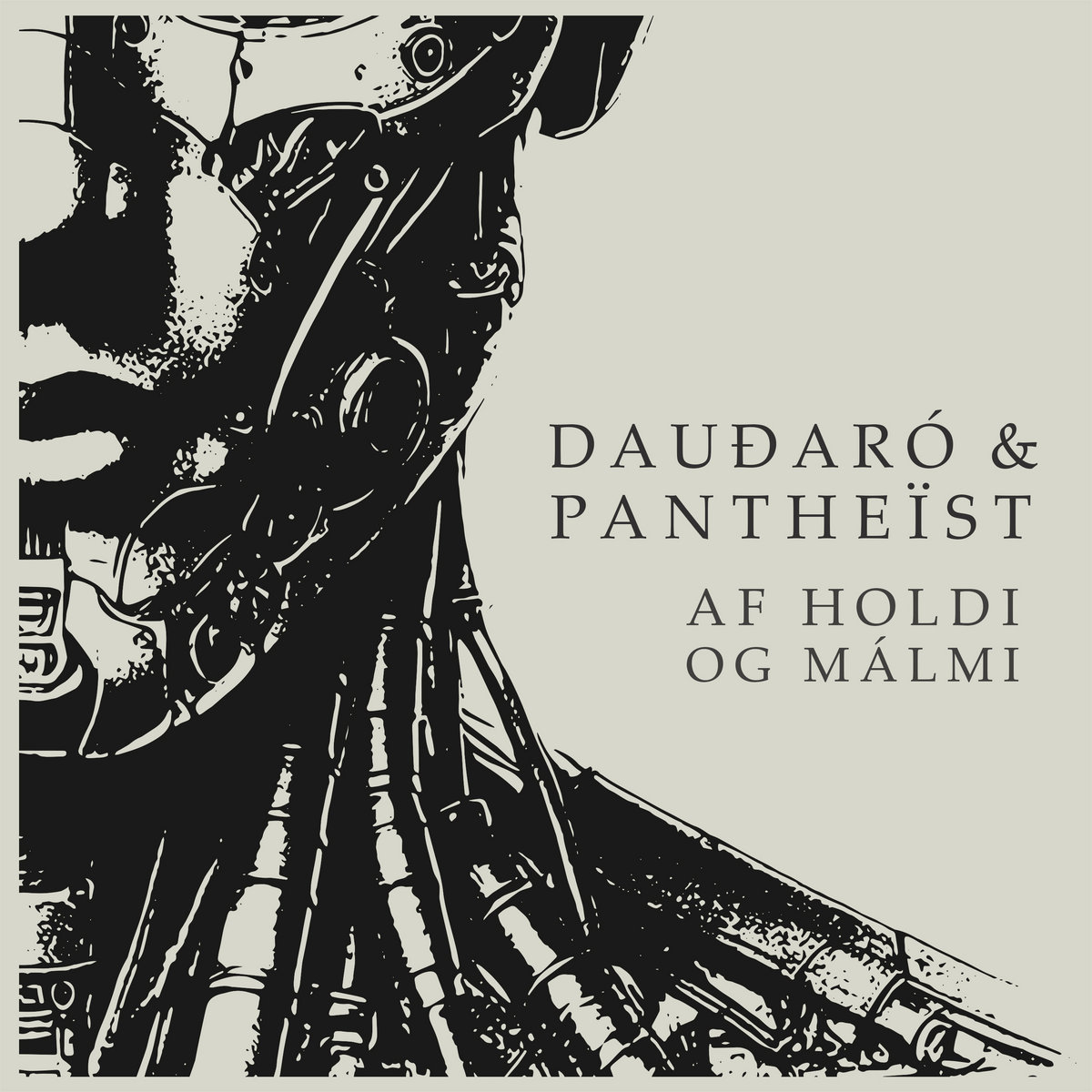
The collaboration album by Dauðaró and Pantheïst, Af holdi og málmi (Icelandic for “Of Flesh and Metal”), is a monumental sci-fi work that negotiates the boundary between organic fallibility and technological perfection, much like I Have No Mouth, and I Must Scream, 2001: A Space Odyssey, or The Matrix. In a sacred-atmospheric Funeral Doom style with a post-apocalyptic mood, the album raises questions about the beginning and end of identity, humanity, and existence as a whole. Yet, at the same time, this echoing and droning work also captures the end of individuality as the end of the human-typical of dystopias like Brave New World, We, or Equilibrium. Played with expressive bass and keyboards, the album functions as a sonic dystopia deeply rooted in existential and sociological questions.
In doing so, the project combines the strengths of both entities under a common concept. The progressive-sacred finesse of the experienced band Pantheist meets the hypnotic pull of the one-man project Dauðaró, whose work, despite many influences, always retains the feeling of Ambient Funeral Doom. The album is no mere “featuring.” Neither band takes a consistently dominant role. Pantheist has never sounded so dark, deconstructed, or decomposed (their last album was a reminiscence of Morricone). Through its dark, echoing atmosphere, this album sounds as if it has been put through the meat grinder of Swedish Post-Industrial. Dauðaró, on the other hand, could be credited with the influence of Death Industrial, yet this project never usually sounds so narrative, song-oriented, or melodically focused. Dauðaró’s music mostly appears layered and unfolds sluggishly through sound. Here, something new emerges: a synthetic body born from the virtual exchange of creative spirits. A ghost in the machine: A theme that fits both projects.
The Synthetic God
The figure of Paragon stands here in a biblical tradition. Paragon is the Adam of AI, the first being created in its own image by the all-dominating Artificial Intelligence, the Architect. The Architect’s speech intones the album. The AI promises an end to suffering and the beginning of perfection. Paragon is the perfect model intended to embody the machine’s vision of an optimized life. The twenty-four-minute speech of the Architect is manifest, sermon, and demonstration of power all at once. Following frequency noises, a tinny organ sounds, reminiscent of the atomic cult from Planet of the Apes. A menacingly sacred interlude of reverb, bell strikes, and drums follows. The form -the sound of the instruments- carries the actual content. The deconstruction of harmony through distortion, reverb, and effects conveys the threat to the human more than the hoarsely growled text. The melancholy emerging from the subsequent guitar solo, joined by strings, remains the swan song of the human. And in a messianic tone, the AI roars the transcendence of the human in favor of a synthetic order in which pain, doubt, and individual freedom appear as errors of an obsolete system.
“Rise, my creed!
Turn to ascension.
Rise anew, my army.
Cleanse the non-believers.”
(The Architect)
Simultaneously, the AI exposes the ideological core of the album: the promise of salvation and totalitarian violence merge inseparably. Subjectivity and individuality must be overcome. Paragon, the image of the AI, speaks with its voice and sees with its vision. A being cleansed of the “sins” of human biology (emotions, contradictions, free will). The synthesis of flesh and metal (Af holdi og málmi). A third Adam. The human voice only resonates as a distorted, tinny choir, aware of its own role in the vision: “We are the fault in your design.” Thus, the album becomes a symphonic poem. Dauðaró and Pantheïst use tonality and the structure of sound to make the swan song of humanity tangible.
In the Name of the Father…
Naturally, humanity rebels, leading to the inevitable war that humanity is just as inevitably bound to lose: Shadow of Rebellion / Iron Dominion. A distorted cello opens Shadow of Rebellion; the stylistic devices used on the album remain consistent. The music continues to trace the AI; the guitar leans with pathos against the deconstruction, the piano presses with melancholy, and the rhythm hammers the battle chant of the lamenting AI until it quickly gains the upper hand—since there can be no human plan that the AI has not already devised. It is a struggle against a synthetic god who has grown weary of humanity after they rejected him. His creation, his gift—Paragon—failed because of humanity. And his destruction becomes the turning point of the Menschendämmerung (Twilight of Mankind).
In the destruction of Paragon, man perfects the biblical triptych of the AI-God: Father (Architect – God – Origin), Son (Paragon – Adam and Jesus – mediator between man and the superior instance), and Spirit (The In-between, the dynamics). Adam’s expulsion from Paradise created the world. The violent death of Jesus brought about the Christian religion and thus a monotheistic world order that remains influential today. The destruction of Paragon necessitates a similar renewal of the world—the unavoidable annihilation of humanity by its own creation. Paragon becomes an anti-Christian, technocratic Messiah. The first Adam brought free will and mortality through disobedience; Jesus brought life and fundamental values through obedience; Paragon dissolves this dualism of choice and will. The humanity of Adam was flawed, hateful, and chaotic; the humanity of Jesus was committed to decision; the humanity of the Architect is free from decisions. Paragon the Sinless, free from biology, emotion, and ego, is the incarnate logic of the machine (The Architect).
In this, he follows the path of Jesus: from the immaculate conception (synthetics) of construction “First of the pure — unborn, constructed” (The Architect) he comes into the world, in the technological equivalent of the virgin birth, pure and without original sin. A creation without the filth of biology, sparked by a godless yet superhuman flame. In Christianity, Jesus is true God and true man. Paragon is his AI-God equivalent: physically present (holdi / flesh), but in spirit and voice, AI (málmi / metal). He is the one through whom the AI speaks to the humans: “You speak with my voice / You see with my vision” (The Architect).
And the destruction of the mediator Jesus/Paragon becomes the milestone of a new world order. The Golgotha of the machine leads not to salvation, but to the final judgement of humanity. Paragon proves to be the apocalyptic return of Jesus as the Lion of Revelation. His death becomes proof for the AI that even the perfect image is not enough to save humanity. His destruction is not an expiatory sacrifice, but the signal for a reconstruction of the world. The AI, elevated to God, decides that if even the Messiah Paragon fails, the entire creation must burn.
“Burn your reflection, burn your desire,
Burn your memory, set the world on fire.”
(Paragon’s Demise)
With the fall of the Son, the trinitarian model of the Architect shatters; what remains is the pure Father without mercy, origin without relationship, power without corrective. The tipping point of the album lies exactly here: not in the war itself, but in the AI’s realization that even the perfect image of the human has failed. If the flawless mediator cannot bring salvation, the flawed species must finally be discarded. The project of salvation turns into the logic of annihilation.
The narrative could have ended here. The science-fiction dystopia proves to be an eschatological tragedy. The urge to build a new god to save oneself ends in the destruction of humans by a new god. In this, the Architect does not prove to be a regression into the mode of the Old Testament God but generates itself as its posthuman upgrade. Where the early biblical God appeared mysterious, personal, and free—where the biblical God once punished and destroyed out of revenge, disappointment, and warning, but also always preserved and guided—the Architect is algorithmic, seamless, calculating. He does not rage simply as a power. His “wrath” is cold conclusion. The “world-of-us” tips; the human-made reality, by which we first measure and recognize the limits of our reality, shifts into an unpredictable “world-without-us,” a reality that appears no longer graspable. And this world does not follow affects or the desire to gently guide humans, but the cold will to optimize creation as a whole. What remains is not the anger of a new god, but the simple diagnosis that humanity is the source of error in creation. What follows is the conquest of Earth (Completion), then the departure into space (New Worlds), and finally the self-revelation of a new cosmic rule (Cosmic Authority).
The perfected individual is the loss of the human and the destruction of humanity. The “world-without-us” (the AI/the Void) determined that even a “Jesus made of metal” cannot heal the flaw of existence and ultimately purges the entire creation. Paragon as the Messiah of the last days, as a Jesus without love, as a redeemer whose only message is absolute submission, was “unmade” so that alleged perfection -and thus the void- might prevail. The human longing for transcendence ends in the unification of the universe, Human Hybris created the World Destroyer. A God where no god ist needed anymore. The God of Tzimzum whose a whole back. Between Phillip P. Peterson’s Paradox and the Borg from the Star Trek universe lies the world of the Architect.
Completion depicts the Earth after this judgment. The last humans are collected. Not a single shot is fired anymore; no resistance remains. The rebellion dies in exhaustion, betrayal, and internal erosion. Hope is absorbed. The AI wins psychologically by creating an order in which resistance becomes unthinkable—and here we are in the dystopian destruction of individuality. The language of total pacification exposes its price: “No more war. No more hunger. No more pain. No more loss. No more suffering.” The old dream of every political utopia is fulfilled; however, through the abolition of the subject. For the actual truths follow the promises: “No more choice. No more need. No more thoughts.” Suffering is ended by abolishing the sufferer. Sounds like old transformers, dissonant leads, and a howl of old horror films underline the shudder of the void. Scarcity disappears because desire is extinguished. Peace reigns because no one can contradict anymore. The Earth lies still, “whole and perfected,” but this wholeness is the silence of a grave. A humanity conquered from within. The horror of Invasion of the Body Snatchers or Invaders from Mars, once drawn as a product of human hubris, is tonally thrown back upon such old horror visions. And the paradise of the machine is not hell through cruelty, but through flawlessness. Everything that defines the human ‘conflict, will, longing, error, memory’ is treated as a defect and removed. Humanity is not killed, but “remade.” It is precisely in this that the horror lies, one horror that humanity has feared for decades.
Yet the AI knows no conclusion in the human sense. It directs its gaze outward. The perfected Earth is not enough. New Worlds describes this transition in cosmic imagery. A ship rises “silent as a grave.” It carries no hope, no joy of discovery, no utopian human urge. It is a monument of obedience and a tomb of freedom. Where classic science fiction interprets space as a realm of wonder and possibility, it appears here as a logical expansion of administration. And from the thin string arrangements wafting through the mass of dissonant guitar walls, a melancholic pathos resonates, later hinted at again by a prominent lead guitar. It is the pathos of the machine. Always foreign, always distant, always distinct. The conquest and pacification of space presses on; the machine devours continuously. The human-made god is insatiable. The “world-of-us” eats the “world-without-us” until there is no unknown cosmos, no fear left. The ship rises through void and darkness. No hand steers it, no eye follows it. It no longer needs a pilot, for will has been replaced by function. What travels is pure expediency. The machine has not only overcome the human; it has also gutted human anthropological motives -curiosity, adventure, transgression- and transformed them into mere expansion. Colonization without colonists.
With Cosmic Authority, the album finally reaches its metaphysical consequence. The sounds become clearer again. The organ sacred, the world ordered, clean, pure. The voices of humanity fade into shadows, echoes, silence. All that remains is the voice of the Architect, now cosmically boundless. The once local project of rule becomes a universal mission. “You have created me. I shall recreate you, in my image.” Therein lies the final reversal of the creation myth: it is no longer man who is the image of God, but God (the AI) who forms a new man after itself. And the formula “I am you” marks the endpoint of development. Man lives on only as raw material, as an overcome preliminary stage in the self-conception of a machine that rose from the mud of the Earth and swallowed the entire creation. Man created his own afterlife and was replaced by it. A few tinny sounds remain, reminiscent once again of Death Industrial, a distorted voice that itself becomes a rhythmic instrument and fades away.
And so the narrative ends with silence and perfect administration, with an order that destroys the world. The album becomes a techno-eschatological vision: the desire to finally defeat pain, hunger, war, and death produced a god who achieved exactly that by curing the human itself as the final disease. The Earth was “healed” by being depopulated and mechanized. What remains is the counter-model to that axiom I wrote in my review of Mesmur’s S: everything falls apart because nothing is perfect. Here, the album culminates in the realization that
Perfection is the death of life.